The F-16 narrowly beat out Sweden’s JAS 39 Gripen in the final selection, according to President José Balcázar.
The Fuerza Aérea Argentina (Argentine Air Force) announced earlier this month that its pilots would receive training on the US-made F-16 Fighting Falcon fighter jet from Top Aces Corp. The Mesa, Arizona-based aerospace firm is the only commercial owner and operator of the fighter jet.
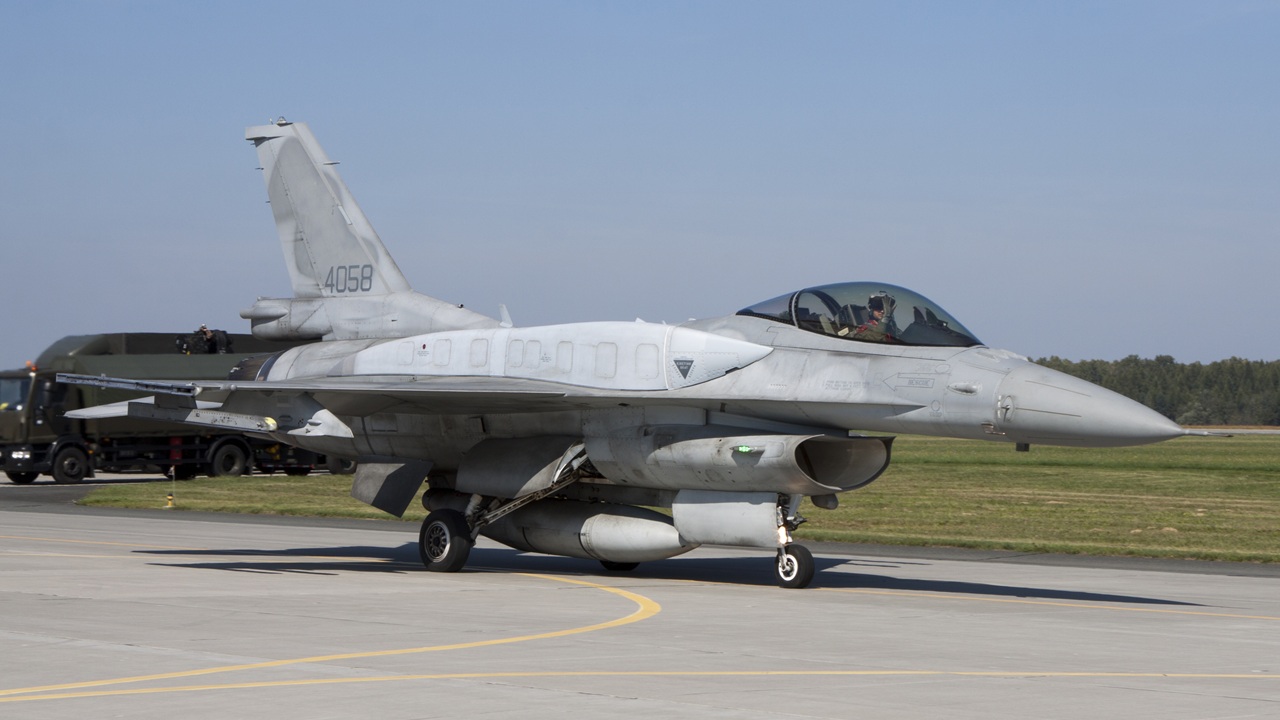
Perhaps Top Aces may find another South American nation that could use its services, as Peru confirmed last week that it would also purchase the F-16 Block 70/72 models as its new combat aircraft.
Peruvian President José Balcázar announced the purchase to his nation during a broadcast last week, explaining that the Fighting Falcon was chosen over the Swedish Saab JAS 39 Gripen E/F and France’s Dassault Rafale.
The Gripen had seemed the favored aircraft, given its lower ongoing operating costs and its ability to operate from remote and even austere airbases, whereas the F-16 requires more dedicated infrastructure. However, it appears that the slightly higher performance standards of the F-16 led to its selection instead.
According to the terms of the agreement, Lima will receive a total of 12 Fighting Falcons, including 10 single-seat F-16C and two twin-seat F-16D models. The aircraft will reportedly be outfitted with the F110-GE-129 engines, AN/APG-83 AEAS radars, AN/AAQ-28 Litening precision targeting pods, and AN/ALQ-254 “Viper Shield” electronic warfare (EW) systems.
The F-16s will allow the Fuerza Aérea del Perú (Peruvian Air Force or FAP) to replace its aging fleet of Soviet-designed Mikoyan MiG-29 (NATO reporting name “Fulcrum”) fighter jets, acquired from Belarus in the late 1990s. Three additional MiG-29SE fighters were later purchased from Russia. The FAP also operates around a dozen Dassault Mirage 2000 fighters that date to the 1980s.
The contract, valued at approximately $3.42 billion, will also include weapons and support. Under its terms, Peru is set to receive an undisclosed number of AIM-120C-8 long-range air-to-air missiles and 12 AIM-9X Block II Sidewinder short-range air-to-air missiles for its F-16s, as well as M61A1 cannons and LAU-129 guided rocket launchers.
The Peruvian Air Force Will Have the Best F-16s in Latin America
The contract for the aircraft is expected to be finalized in April, and Peru could eventually receive as many as 28 Block 70 aircraft. The timeline for delivery of the Fighting Falcons hasn’t been confirmed, but could begin before the end of the decade.
Once completed, the FAP will operate the most advanced F-16 variant throughout all of Latin America—surpassing Argentina, which bought older models of the same aircraft from Denmark.
“As the Fuerza Aérea del Perú (FAP) prepares to transform its fighter fleet, we are confident the F-16 Block 70 will deliver the advanced capabilities and performance needed to address Peru’s pressing defense requirements now and decades to come,” F-16 manufacturer Lockheed Martin wrote on its official website for Peru’s forthcoming F-16 fleet.
The F-16 Block 70/72’s Specifications
There are approximately 3,000 operational F-16s in service today in more than 25 countries—a testament to what is easily the world’s most successful, combat-proven multirole fighter jet ever produced. The Block 70/72 variants are the most advanced and capable versions of the aircraft built to date.
- Year Introduced: 2023
- Number Built: ~23
- Length: 49.3 ft (15 m)
- Wingspan: 31 ft (9.45 m)
- Weight (MTOW): Approximately 48,000lbs (21,772kg)
- Engines: One Pratt & Whitney F100-PW-229 afterburning turbofan
- Top Speed: ~1,500 mph (2,414 km/h) / Mach 2.0
- Range: ~1,740 nmi (2,000 miles, 3,220 km)
- Service Ceiling: ~50,000 ft (15,240 m)
- Loadout: Internal six-barrel M61A1 Vulcan 20mm cannon; nine hardpoints, including six under wings, two on the wingtips, and one under the fuselage; two additional locations under the fuselage for pods.
- Crew: 1–2, depending on variant
The F-16 Block 70 Fighting Falcons are equipped with advanced avionics, extended structural service life, and enhanced safety features, including the Automatic Ground Collision Avoidance System (Auto GCAS), with a structural service life of 12,000 hours.
In addition, the fighters are outfitted with the APG‑83 AESA radar, which shares 95% software commonality and 70% hardware commonality with the F‑35 radar.
About the Author: Peter Suciu
Peter Suciu has contributed to dozens of newspapers, magazines and websites over a 30-year career in journalism. He regularly writes about military hardware, firearms history, cybersecurity, politics, and international affairs. Peter is also a contributing writer for Forbes and Clearance Jobs. He is based in Michigan. You can follow him on Twitter: @PeterSuciu. You can email the author: [email protected].