“So slow,” remarked an audience member as he exited the hall after Act I of Matthew Ozawa’s fanciful but rather guileless new production of Richard Wagner’s final opera. A soulful meditation on the nature of guilt and redemption drawing from Wolfram von Eschenbach’s medieval romance of the Holy Grail, Parsifal is known for its occasional longueurs. San Francisco Opera’s music director Eun Sun Kim, who is now in her third straight season of presenting a Wagner production at the West Coast’s leading opera house, succumbed to them from the outset and never quite recovered, resulting in an orchestrally slack and underpowered performance.
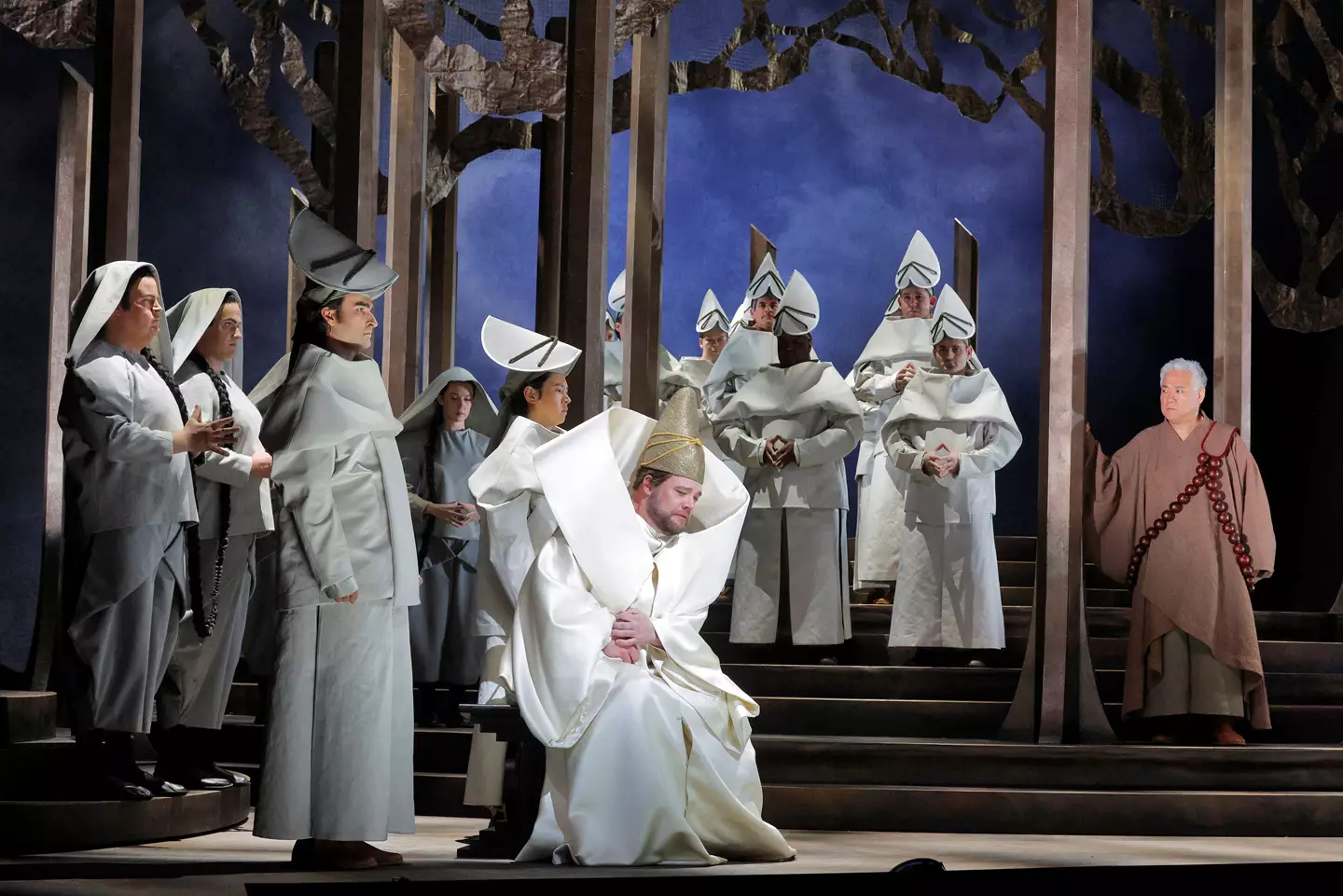
Ozawa’s production offered little relief. Rejecting “any fixed religious or historical imagery,” he and his production team instead “embrace a multicultural theatrical language” that, he claims, draws from “both Eastern and Western traditions, as well as diverse religious rituals and movement forms.”
It would be hard to guess what those traditions, rituals, and forms are without reading the director’s program note, but this is not an inherently unfounded approach to an opera that tells a Christian legend and refracts elements of Buddhism through the lens of Schopenhauer’s philosophical understanding of that religion. The visual effect here, however, left this Parsifal curiously unmoored. Robert Innes Hopkins’s sets somewhat suggest the realm of the Grail—a crude forest and an unfinished temple—but they were too stylized either to recreate the opera’s original mythical setting or to replace it with another coherent framing.
The costume designer Jessica Jahn wanted to endow each act with “its own spiritual energy and environment,” drawing on “three sources of emotional energy.” There is no evidence that Wagner conceived of his opera in this way, and the appearance of the characters consequently varied widely and rarely made sense. Parsifal’s sackcloth in Act I evokes the fool made wise through pity, but then strangely yields to a fire-engine-red suit recalling Spiderman before finally becoming black armor. Kundry, the seductress sent to lure him to his doom, starts out as an old crone resembling a bag lady one might find roaming the streets of San Francisco but then retires into cool, colored gowns. The evil sorcerer Klingsor, a rejected Grail knight who aspires to seize the sacred object, is a fiend worthy of Tolkien yet sports broad, black suspenders that hold up a crude dress.
Ozawa found it necessary to introduce a mute dancer to play the part of Parsifal’s mother, who does not appear in the opera but, as we learn, died of grief after he abandoned her to pursue worldly adventure. The choreographer Rena Butler intended the dancer’s moves to convey the poetic grace of Japan’s Noh and Butoh theatrical traditions combined with “ritual gestures found in Christianity.” The only effect of the disjointed and ungainly dance was distraction.
Ozawa hopes his work “speaks directly to the crisis of disconnection so many of us feel.” What I felt most disconnected from was Parsifal. Perhaps the only visually redeeming feature of the performance came with Yuki Nakase Link’s lighting design, which she derived, instructively, from “carefully studying” Wagner’s original stage directions, including his detailed notes on illumination and light sources. She writes that this was a deliberate attempt “to honor Wagner’s artistic legacy.” If more creative directors could humble themselves to do just that, they might be surprised at the results.
The San Francisco Opera assembled an estimable cast. Brandon Jovanovich is not exactly a Heldentenor but boasts a bright, ringing tone that can succeed in Wagner. Alas, the performance under review was not a particularly good day. After a passable first act, he lost steam in his confrontation with Kundry—one almost wondered if she would succeed in seducing the pure fool this time around. Before Act III, a stage announcement explained that Jovanovich was suffering from an ailment but would complete the performance. He tried to power through, sounding diminished in the scene of Parsifal’s coronation as the new Grail King, but recovered well enough for a satisfactory delivery of the finale monologue “Nur eine Waffe taugt,” the opera’s concluding moment of restoration and reconciliation.
The German mezzo-soprano Tanja Ariane Baumgartner made a spectacular company debut as Kundry. A lithe but lethal determination guided her Act II seduction scene, with the gestures instructed by the production team moderated by a superb theatrical sensibility that evoked the best moments in silent film. Despite his absurd costume, the bass-baritone Falk Struckmann’s Klingsor blasted hate and resentment for the character’s sixteen delectable minutes of stage time. The fine American baritone Brian Mulligan sang steadily as Amfortas, the wounded Grail King whom Parsifal is fated to replace. The Korean bass Kwangchul Youn has made the old Grail knight Gurnemanz a signature role and graced this performance with stentorian eloquence.
Maestra Kim will continue her Wagnerian adventure in future seasons, with plans for a 2028 revival of Francesca Zambello’s “American” Ring cycle, a production shared with Washington National Opera. One hopes she will find her way to a tighter and more coherent reading of Wagner’s scores.