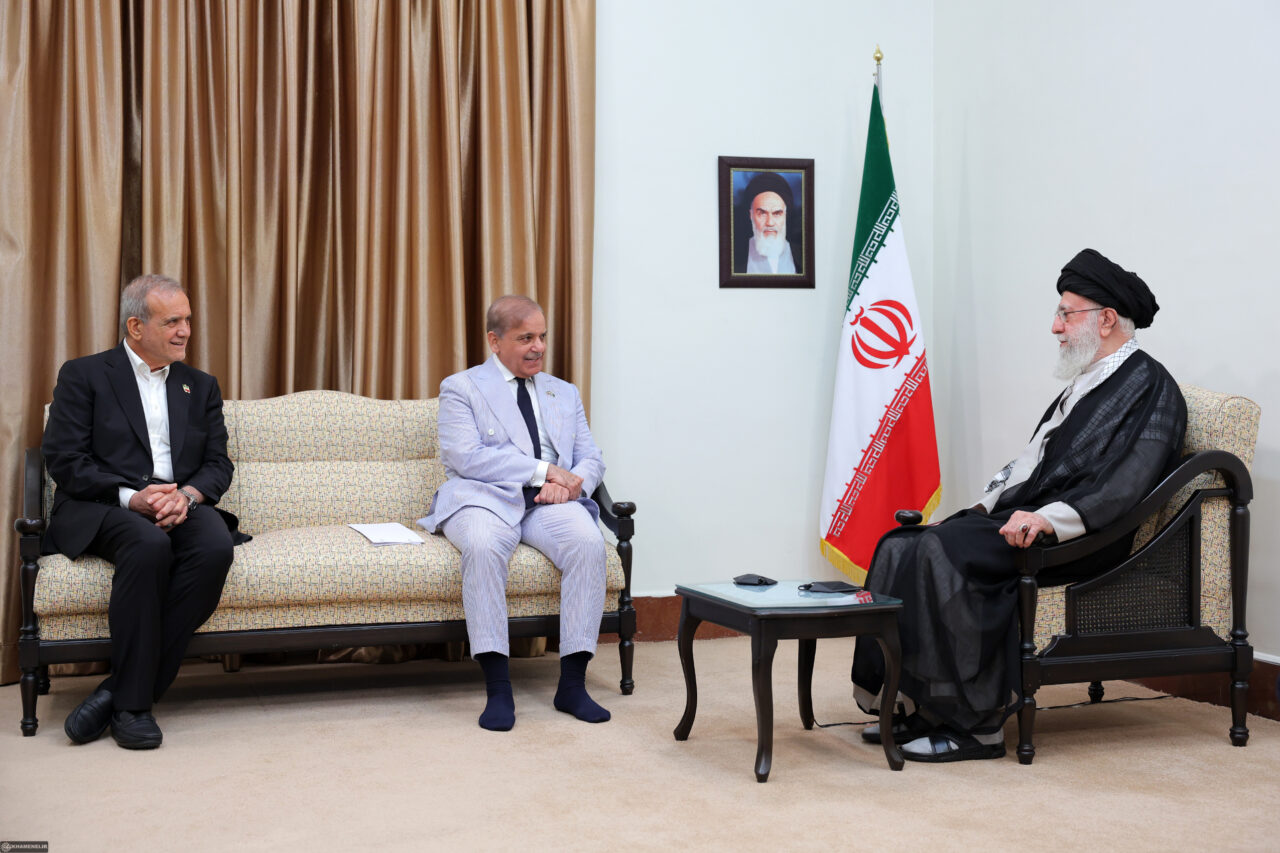
For now, Pakistan has opted to remain aloof from the Iran War. However, its geographical proximity to the conflict and alliance obligations will make that difficult.
As the confrontation between Israel and Iran widens, Washington’s regional partners face growing pressure to take sides. Islamabad, however, is pursuing a different strategy: remaining politically engaged with both Washington and Tehran while avoiding military entanglement in a conflict unfolding just beyond its borders.
Pakistan has criticized Israeli strikes and expressed support for Iran’s sovereignty. At the same time, Pakistan’s leadership is trying to prevent the conflict from spilling across its western frontier or disrupting the maritime energy routes on which the country depends. For Pakistan, the war is not a distant geopolitical contest but a nearby crisis with immediate economic and security implications.
Pakistan’s Geography Is a Strategic Constraint
Pakistan’s geography, rather than its ideology, shapes its position in the Iran crisis. The two Islamic republics share a roughly 900-kilometer (660-mile) border. Much of that boundary runs through rough, sparsely governed terrain where the reach of the state is feeble. Escalation, therefore, carries direct security implications.
Instability along the frontier could take several forms. Refugee flows, militant activity, intelligence operations, or accidental cross-border incidents could all complicate security conditions in border regions that already face governance and development challenges. Even limited instability could place additional pressure on local authorities and security forces.
Geography also places Pakistan close to one of the world’s most important maritime chokepoints. Much of Pakistan’s imported energy passes through the Strait of Hormuz, a narrow waterway through which roughly one-fifth of global petroleum consumption passes each day. Any prolonged insecurity in these waters would quickly affect Pakistan’s fuel prices, inflation levels, and balance-of-payments pressures.
For Islamabad, these realities mean that escalation in the Gulf is not simply a matter of diplomatic positioning. It is a crisis with immediate economic consequences.
The Limits of Pakistan’s Western Alignment
Pakistan’s relationships with the United States and Saudi Arabia add another layer of complexity to its strategic calculations. Islamabad has historically sought to maintain working ties with Washington even during periods of tension in the Middle East. Saudi Arabia, meanwhile, has long been an important economic partner, providing financial support and investment during moments of economic difficulty.
These relationships create expectations that Pakistan will align with Western and Gulf security concerns. Yet alignment has limits. Entering a military confrontation with Iran would carry high costs for Pakistan’s internal stability and regional posture.
Direct involvement in the conflict could provoke retaliation along the Iran–Pakistan border. It could also inflame sectarian tensions inside Pakistan, where regional rivalries sometimes resonate within domestic politics.
Pakistan’s leadership, therefore, faces a delicate diplomatic balancing act. On the one hand, maintaining positive relations with Saudi Arabia remains important for economic and security cooperation. On the other hand, Islamabad must avoid steps that would severely damage relations with Tehran.
Pakistan has often attempted to maintain ties with competing regional actors, pursuing what analysts describe as a strategy of balancing relations between Saudi Arabia and Iran.
Another factor shaping Pakistan’s cautious posture is the broader strategic competition among external powers in the region. Islamabad maintains close economic and military ties with China while continuing security cooperation with the United States. At the same time, Gulf stability remains central to the interests of multiple global actors whose energy supplies depend on uninterrupted maritime flows. A wider regional war would therefore place Pakistan in a particularly sensitive position, caught between competing strategic relationships and facing immediate economic exposure to disruptions in Gulf energy routes.
Pakistan’s Economic Vulnerabilities
Economic concerns play a central role in Pakistan’s cautious posture. The country already faces significant fiscal pressures, and volatility in global energy markets can quickly translate into domestic economic strain. Pakistan imports about 85 percent of its crude oil, much of it from Gulf producers, making the country particularly vulnerable to disruptions to energy routes through the Strait of Hormuz.
If hostilities in the Gulf were to disrupt maritime traffic, Pakistan would likely experience immediate consequences. Energy imports could become more expensive, intensifying inflation and placing additional pressure on foreign exchange reserves.
Because most of Pakistan’s trade moves by sea, maritime insecurity would also affect broader commercial activity. Rising insurance costs for shipping, delays in maritime transport, and supply chain uncertainty could deepen economic stress.
Recent tensions in the Middle East have already contributed to rising fuel prices and inflation concerns in Pakistan.
What Might Change Pakistan’s Calculus
Several developments could narrow Pakistan’s room for maneuver.
First, there is the possibility of instability along the Iran-Pakistan border. Increased militant activity, refugee movements, or cross-border incidents could compel Pakistani authorities to take stronger security measures.
Second, there is a scenario where Iran escalates against Saudi Arabia. If Saudi territory or energy infrastructure were subjected to sustained attacks and Riyadh formally requested assistance, Pakistan would face considerable pressure to respond.
Third, maritime escalation could also alter Islamabad’s calculations. If attacks on commercial shipping threatened Pakistan’s energy imports or trade flows directly, the country might feel compelled to participate in broader efforts to protect shipping routes in the Gulf.
Pakistan’s Strategy of Controlled Distance to the Iran War
For now, Pakistan appears determined to pursue a strategy of controlled distance from the conflict. Islamabad is signaling concern about regional instability while carefully avoiding commitments that would draw the country into direct confrontation with Iran.
Whether this balancing act can be sustained will depend largely on how the conflict evolves. If hostilities remain limited and geographically contained, Pakistan may be able to maintain its current posture. But broader regional escalation could significantly narrow Islamabad’s options.
Pakistan’s response illustrates a broader reality of the expanding Israel-Iran confrontation. Many regional states are not choosing sides so much as trying to manage exposure to a conflict that threatens their own economic and security stability. For Islamabad, the priority is to remain diplomatically engaged while keeping military distance from a war whose consequences could quickly reach its borders.
About the Author: Fatemeh Aman
Fatemeh Aman has written on Iranian, Afghan, and broader Middle East affairs for over 25 years and advised US and non-governmental officials. A former non-resident fellow at the Middle East Institute and senior fellow at the Atlantic Council, a writer, producer, and anchor at Voice of America, and a correspondent at Radio Free Europe/Radio Liberty, her work has appeared in Jane’s Islamic Affairs Analyst, Jane’s Intelligence Review, and the Stimson Center’s Middle East Perspectives. Follow her on X: @FatemehAman.