More than 20 nations spanning from Asia to Europe to the Gulf have expressed a “readiness to contribute” to the effort of opening up the Strait of Hormuz amid threats to ships by the Islamist regime in Iran.
In a joint statement released on Saturday morning, the nations of Australia, Bahrain, Canada, Czechia, Denmark, Estonia, Finland, France, Germany, Italy, Japan, Latvia, Lithuania, the Netherlands, New Zealand, Norway, Republic of Korea, Romania, Slovenia, Sweden, United Arab Emirates, and the United Kingdom condemned in the “strongest terms” the recent attacks by Iran against unarmed, civilian shipping vessels, its attacks on oil and gas infrastructure throughout the Gulf, and its move to shut down traffic in the Strait of Hormuz.
“We express our deep concern about the escalating conflict. We call on Iran to cease immediately its threats, laying of mines, drone and missile attacks and other attempts to block the Strait to commercial shipping, and to comply with UN Security Council Resolution 2817,” the group of nations said.
“Freedom of navigation is a fundamental principle of international law, including under the United Nations Convention on the Law of the Sea. The effects of Iran’s actions will be felt by people in all parts of the world, especially the most vulnerable.”
“We emphasise that such interference with international shipping and the disruption of global energy supply chains constitute a threat to international peace and security. In this regard, we call for an immediate comprehensive moratorium on attacks on civilian infrastructure, including oil and gas installations,” they continued.
“We express our readiness to contribute to appropriate efforts to ensure safe passage through the Strait. We welcome the commitment of nations who are engaging in preparatory planning.”
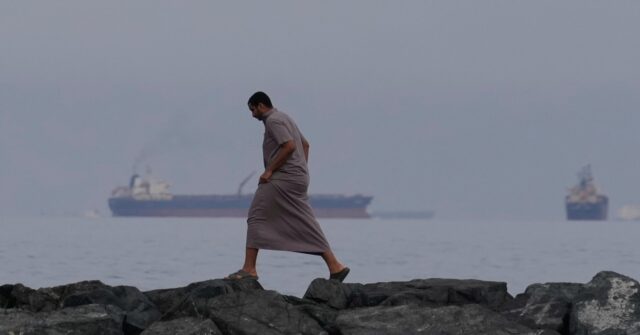
While the United States and Israel have destroyed much of the Iranian navy, including dozens of mine-laying vessels, most commercial ships continue to avoid the critical waterway out of concern for potential Iranian attacks from the coastline or potentially from mines previously laid by Tehran or its proxies.
Admiral Brad Cooper, commander of the U.S. Central Command, said on Saturday that Iran’s ability to threaten ships in the Strait has been “degraded” and that U.S. forces continue “to eliminate Iran’s ability to project meaningful power outside its borders.”
Adm. Cooper said that the U.S. recently dropped multiple 5,000-pound bombs on underground coastline facilities used to house various missiles and launchers “that presented a dangerous risk to international shipping.”
“We not only took out the facility but also destroyed intelligence support sites and missile radar relays that were used to monitor ship movements,” he said. “Iran’s ability to threaten freedom of navigation in and around the Strait of Hormuz is degraded as a result and we will not stop pursuing these targets.”
On Friday, President Trump said that “it would be nice” for allied nations that rely on oil flowing through the Strait of Hormuz to help keep the passage open, noting that the U.S. is mostly energy-independent and therefore less affected by its closure.
President Trump said that it would be a relatively “simple military maneuver” but said that a large “volume” of ships would be required for the effort.
Reopening the Strait for energy shipments will be critical for the global energy markets, with around one-fifth of the world’s oil and gas passing through the waterway.