The spiritual life grows the way a house does. Not all at once, and not because we force it to. It grows because the foundation is sound. Ignatius knew that, which is why he begins the Spiritual Exercises with the Principle and Foundation. Before you worry about anything else in your life or in your prayer, he says, remember what you were made for: to praise, reverence, and serve God, and to let everything else in your life serve that one purpose.
Everything falls under that.
Every desire. Every fear. Every plan you hold in your hands a little too tightly.
When that truth really begins to settle in a person, it does not usually arrive with a trumpet blast. It sneaks in quietly. You notice that certain patterns in your life lean toward God while others pull you away without your realizing it. You begin to see where you cling. You see what you reach for when you feel tired or unseen. It is an uncomfortable but honest grace.
Advent exposes all of this, not harshly but plainly. God comes as a Child, and nothing reveals the truth about our priorities faster than vulnerability. A child cannot be used. A child can only be loved. And love always rearranges things.
The Attachments We Prefer Not To See
Ignatius talks about attachments, but he is not warning us about obviously sinful things. Many attachments grow out of good desires. A steady income is good. A warm home is good. Wanting your children to succeed is good. Wanting to be respected is human.
But good things become burdens when we let them take the place of God. They bend the heart. They start making decisions for us. They swallow our peace when they wobble.
Most of the time we only discover an attachment when God lets something shift. A setback at work. A comment that stings. A plan that dies on the table. A moment when you have nothing left to lean on except God, and suddenly you realize how much you were leaning on something else instead.
Advent has a way of holding up a mirror to that. Not to shame us, but to show us the truth so God can rearrange it.
Would Mary Not Have Chosen Something Easier?
We sometimes imagine Mary floating above the difficulties of life. But the Gospels do not give us a woman untouched by inconvenience. They give us someone whose freedom was so complete that inconvenience did not own her.
Think about the birth of Jesus. There is no way she preferred a cold, crowded place far from home. She was young, exhausted, and far from her own mother. She gave birth with almost nothing: no midwife, no comfort, no familiar faces, no prepared space.
It is not unfaithful to imagine that she wished things were different. Preference is not sin. But Mary did not cling to her preferences. She received what God gave her, and her yes remained steady.
That is freedom.
That is what ordered love looks like.
Ignatian spirituality does not teach us to kill our desires. It teaches us to put them in the right place so they stop ruling us. Mary shows us that a heart ordered toward God loses none of its humanity. It simply becomes capable of saying yes without fear.
Learning to Let God Rearrange Us
Most of us will never face a moment as dramatic as giving birth in a stable. But every day brings smaller invitations that tug on our attachments.
- A plan that collapses before it even starts.
- The interrupted quiet moment you were counting on.
- A bill that stretches you thin.
- An uncomfortable truth about yourself that surfaces in prayer.
- A child whose need arrives at the worst possible time.
- A bout of exhaustion that ruins your sense of competence.
These are not random irritations. They are places where God gently presses a finger on something in us and asks, “Can I reorder this for you?”
Holiness is not built on heroic moments. It is built on this slow, steady willingness to let God rearrange what we cling to. The work is quiet, often invisible, but it frees the heart piece by piece.
The God Who Comes Into Our Disordered Rooms
Ignatius ends the Principle and Foundation with something that sounds impossible at first. He says we should desire neither health nor sickness, wealth nor poverty, honor nor dishonor, long life nor short life, but only what draws us closer to God.
Most of us are not there yet. God knows that. Advent is not a test of spiritual skill. It is an invitation into freedom. The more God becomes the center, the more everything else can find its right proportion.
The God who comes in a manger does not wait for our lives to be tidy. He enters the mess. He enters the unfinished room. He steps right into the places where our loves have gotten tangled, and He does not flinch.
Mary shows us that holiness is not about perfect conditions. It is about trust. A heart ordered toward God is not a heart that never struggles. It is a heart that believes God can be found precisely where comfort cannot.
So let Advent do its work. Let God show you the places you cling. Let Him reorder them. Let your freedom grow a little at a time. And let your heart become, like Mary’s, a place where Christ can enter exactly as He is.
This Week’s Meditation Challenge
1. Name one attachment you feel tugging at your peace this week.
Do not analyze it. Simply name it in the presence of God. Tell Him honestly what you fear losing or what you fear might change.
2. Ask for the grace of interior freedom.
Use Ignatius’s simple request: “Lord, grant me the grace to desire only what leads me closer to You.” Let this be a slow, sincere prayer rather than a quick formula.
3. Practice one concrete act of detachment today.
Choose something small: delaying a comfort, stepping away from a screen, setting aside a preference for someone else’s good. Let the act become a quiet offering.
4. Spend two minutes sitting before God with empty hands.
Literally open your hands on your lap. This physical posture trains the interior posture. Say: “Everything is gift. Everything is Yours.”
5. Engage Scripture through imaginative prayer.
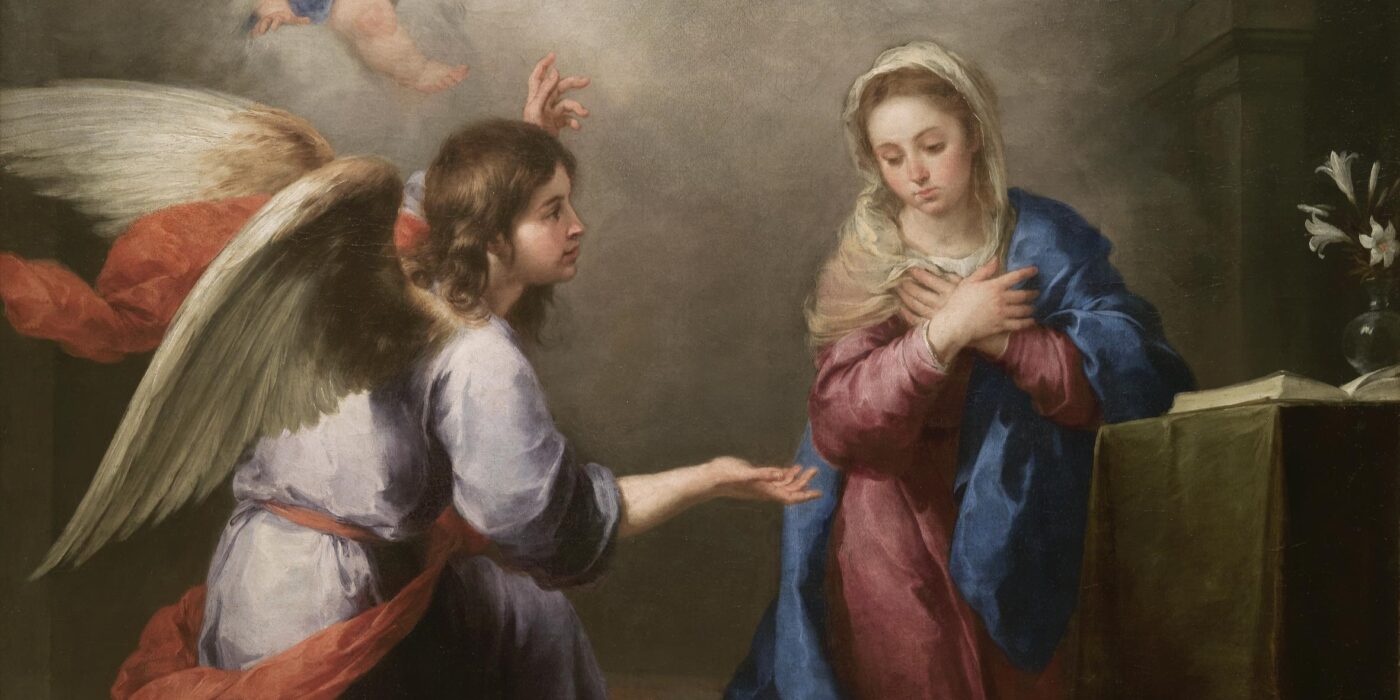
Spend a few minutes with Luke 1:26–38. Enter the scene of the Annunciation. Notice Mary’s freedom. Notice her surrender. Ask God to reveal where your own heart is clinging too tightly.
Image from Wikimedia Commons