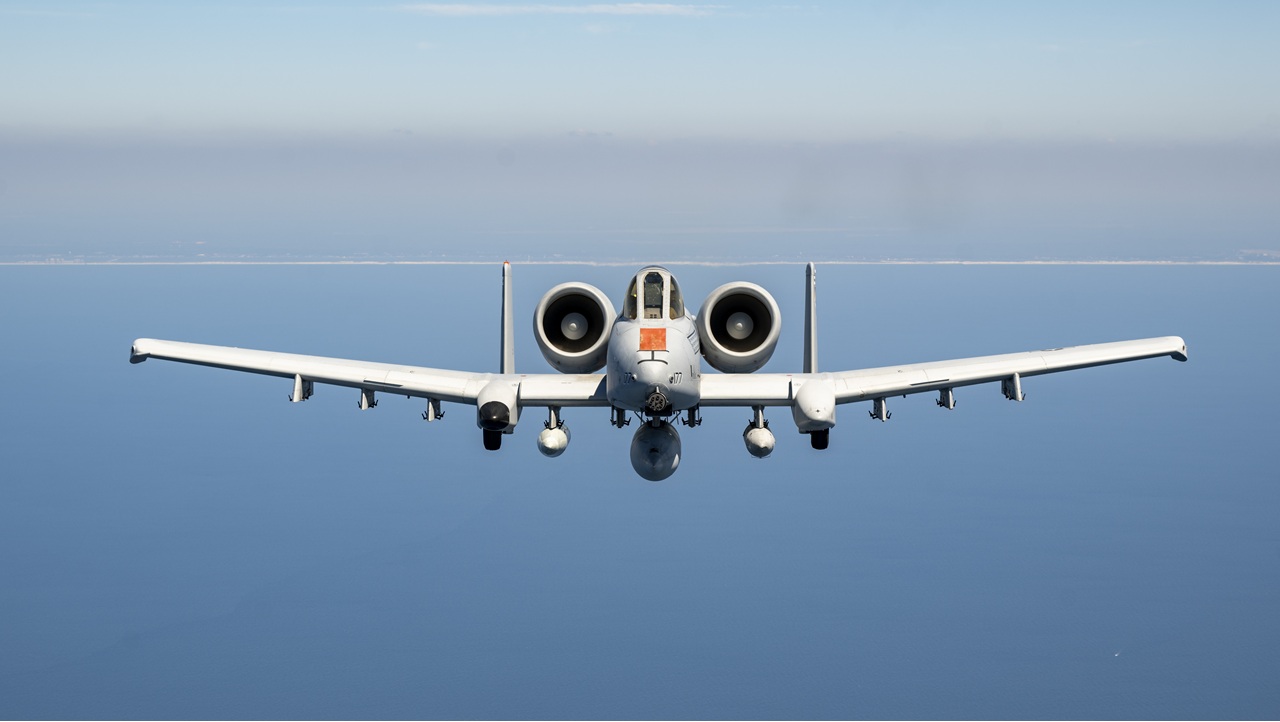
The Warthog is unsuited to combat against near-peer adversaries with modern air defense systems—but is superb at tearing apart Iranian “fast boats” in the Persian Gulf.
The United States Air Force’s A-10 Thunderbolt II has long been on the Pentagon’s chopping block. As the US military has refocused its efforts from counterinsurgency operations to great-power competition against near-peer adversaries like Russia and China, the A-10 stands out as a slow-moving, antiquated attack jet unsuited to modern aerial combat.
However, the A-10, affectionately known as the “Warthog” by those who have flown it, has proven more than capable in operations in the Middle East over the past two decades.
The A-10C variants have already been supporting Operation Epic Fury since the United States and Israel began to target Iran more than a month ago, and recently began targeting Iranian fast-attack boats in the Strait of Hormuz.
The latter mission followed live-fire gunnery drills with the US Navy’s Independence-class littoral combat ship (LCS) USS Santa Barbara (LCS-32) in the 5th Fleet area of responsibility in February. The demonstrations highlighted how an A-10 could provide close air support (CAS) against maritime targets.
Additional A-10s Are Bound for the Middle East
A dozen A-10s reportedly arrived at Royal Air Force (RAF) Lakenheath on Monday evening, flying from Pease Air National Guard Base, New Hampshire. The A-10s are assigned to the 107th Fighter Squadron, Michigan Air National Guard, at Selfridge ANGB, north of Detroit.
The aircraft crossed the Atlantic, supported by eight KC-135 Stratotankers, with four of the aerial fuelers operating from RAF Mildenhall and four others from Bangor Air National Guard Base, Maine.
An additional six A-10s from the 190th FS, Gowen Field ANGB, Idaho, are now at Pease and could be deployed soon.“Having more A-10s in theater would provide additional capability, were the US military to occupy or blockade Iran’s strategically vital Kharg Island,” TWZ added.
What to Know About the A-10 Warthog
- Year Introduced: 1979
- Number Built: 713 (~270 remaining in service)
- Length: 53 ft, 4 in (16.16 m)
- Wingspan: 57 ft, 6 in (17.42 m)
- Weight (MTOW): 51,000 lb (22,950 kg)
- Engines: Two General Electric TF34-GE-100 turbofans
- Top Speed: 420 mph (676 km/h) / Mach 0.56
- Range: 800 miles (1,287 km)
- Service Ceiling: 45,000 ft (13,636 m)
- Loadout: One 30mm GAU-8/A seven-barrel Gatling gun; up to 16,000 pounds (7,200 kilograms) of mixed ordnance on eight under-wing and three under-fuselage pylon stations
- Aircrew: 1
Production of the A-10 Thunderbolt II began in 1972, and the aircraft officially entered service with the United States Air Force in 1977. The A-10’s short takeoff and landing (STOL) capability permitted it to operate from airstrips close to front lines. Service at forward base areas with limited facilities is possible due to the A-10’s simple design.
The A-10 was first deployed during “Operation Urgent Fury,” the 1983 American invasion of Grenada, where it provided air cover for the United States Marine Corps but did not fire its weapons. It wasn’t until the Gulf War in 1991 that the aircraft first took part in combat operations. A-10s successfully shot down two Iraqi helicopters with the GAU-8 and took part in numerous sorties against Iraqi Republican Guard ground targets.
Given that the Islamic Republic’s air defenses have obliterated—at least according to the White House—the A-10 is well within its element. Iran continues to maintain a massive fleet of small, nimble “fast attack boats,” faster than US Navy ships and hidden in small bases along Iran’s rocky coastline. An attack aircraft like the A-10 Warthog is ideal for clearing these boats from the Gulf; it is far faster than the boats, but not so fast it cannot easily target them without overshooting. If the Pentagon’s plans to retire the A-10 remain on track, Operation Epic Fury could serve as the finale for the famed warbird.
About the Author: Peter Suciu
Peter Suciu has contributed to dozens of newspapers, magazines and websites over a 30-year career in journalism. He regularly writes about military hardware, firearms history, cybersecurity, politics, and international affairs. Peter is also a contributing writer for Forbes and Clearance Jobs. He is based in Michigan. You can follow him on Twitter: @PeterSuciu. You can email the author: [email protected].