Every year, the US Air Force airdrops Christmas gifts to remote islands in Micronesia—with increasing assistance from allied partner nations.
Santa Claus won’t be coming to town for a couple more weeks, but the United States Air Force has already begun its seasonal Operation Christmas Drop on Monday at Andersen Air Force Base (AFB), Guam. The program remains the Pentagon’s longest-running humanitarian operation, with 2025 marking the 74th iteration of the operation, which began in 1951 when an Air Force B-29 Superfortress dropped supplies to civilians on the Micronesian atoll of Kapingamarangi. At the time, the island had no running water or electricity.
Over the following seven decades, the program expanded. Now conducted from Andersen AFB and Yokota Air Base, it is supported by partners from Japan, South Korea, Australia, and Canada. Operation Christmas Drop delivers supplies to nearly five dozen remote islands in the Federated States of Micronesia and the Republic of Palau. In 2024, 220 bundles were dropped, delivering more than 77,000 pounds (39 tons) of goods.
“These bundles supply 56,000 people across 59 islands each year, but I don’t think we can truly grasp that impact until we see the families wave and jump up and down in excitement as we fly by,” said US Air Force Col. Richard McElhaney, 374th Airlift Wing commander. “While this is an amazing humanitarian mission, it’s also an invaluable training event for participating aircrews. This training, and the work we do here, matters and translates to our readiness.”
Guam Is the Christmas Island
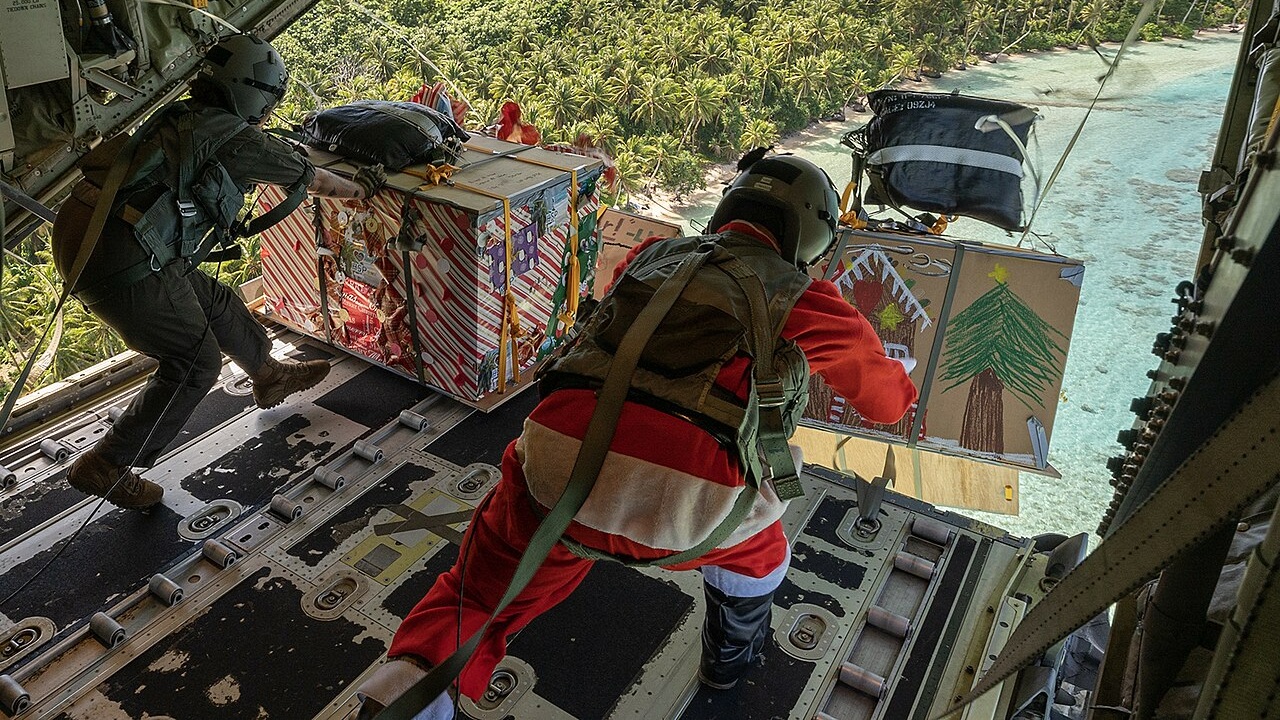
Santa’s base of operation remains in the North Pole, but Andersen AFB continues to serve as the primary “base camp” to airlift donated goods to the islanders throughout Micronesia. Rather than a reindeer-powered sleigh, Operation Christmas Drop relies on Lockheed Martin C-130J Super Hercules transport aircraft. The airlift operation remains relatively low-tech, with aircrews linked to the village via ham radio as they fly overhead and drop supplies.
Last weekend, McElhaney helped load the first bundle of cargo onto a Super Hercules, assigned to the 36th Airlift Squadron, 374th Expeditionary Wing.
The Low Cost Low Altitude (LCLA) airdrop remains highly cost-efficient and easy to apply across the global airlift community, leveraging readily available resources and repurposed personnel parachutes to build supply pallets at a fraction of the cost of other airdrop bundles. In addition, the pallets are dropped at low altitudes to improve drop accuracy.
“Operation Christmas Drop delivers more than just supplies,” said Aren Palik, vice president of the Federated States of Micronesia. “It delivers hope, connection, and the reassurance that even across a vast ocean, we remain part of one family. It is an accomplishment that speaks to the steadfast commitment of the United States and its Pacific partners to care for our people and our communities.”
Uncle Sam-ta Has Lots of Little Helpers
Unfortunately, there aren’t any elves available to help. Instead, a week before the drop, volunteer Airmen, Soldiers, Sailors, Marines, civilians, contractors, and families assist in picking up and sorting the donations. After the goods are sorted, volunteer riggers from Yokota and Andersen build dozens of boxes to hold the materials—most containing school supplies, clothing, rice, fishing equipment, and, of course, no shortage of toys.
The Christmas drops have become quite the international effort. In 2015, the Japan Air Self-Defense Force (JASDF) and the Royal Australian Air Force (RAAF) participated in the operation, each now providing a C-130 Hercules to join the three C-130s provided by the United States Air Force. The Philippine Air Force joined in 2017, and in 2023, the Royal Canadian Air Force participated for the first time.
“The people of the Federated States of Micronesia extend our deepest gratitude,” Palik explained. “Beyond the food, tools, fishing gear, school supplies, and gifts, you deliver something far more valuable: the spirit of compassion that defines this Christmas season.”
About the Author: Peter Suciu
Peter Suciu has contributed over 3,200 published pieces to more than four dozen magazines and websites over a 30-year career in journalism. He regularly writes about military hardware, firearms history, cybersecurity, politics, and international affairs. Peter is also a contributing writer for Forbes and Clearance Jobs. He is based in Michigan. You can follow him on Twitter: @PeterSuciu. You can email the author: [email protected].
Image: Wikimedia Commons.