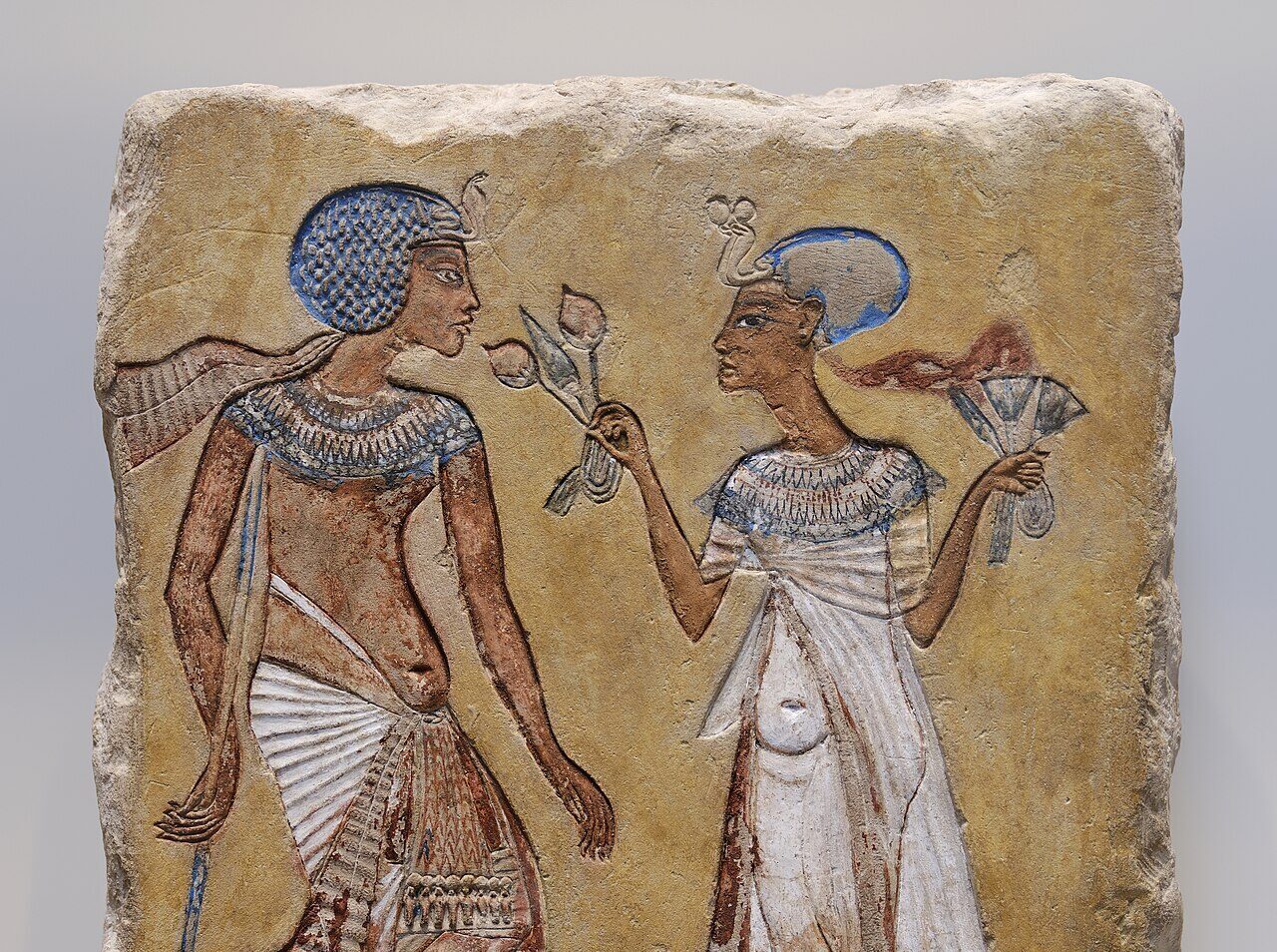
In 1887, at the aptly named “Horizon of the Sun Disk,” a new dawn broke on our understanding of the Near East in the Late Bronze Age. What began as a local woman’s search for clay fertilizer near the ancient Egyptian capital of the pharaoh Akhenaten (modern Tell el-Amarna) transformed into a fervent race to collect and publish the archive of clay tablets found in the ruins of Amarna. The ancient struggles between petty kings that the documents revealed and the modern contests between ambitious scholars vying to decipher the tablets are detailed in Eric H. Cline’s entertaining new book, Love, War, and Diplomacy: The Discovery of the Amarna Letters and the Bronze Age World They Revealed.
The majority of the tablets are letters written in Akkadian cuneiform, roughly fifty of which record the correspondence between the great powers of the Late Bronze Age, including the rulers of Babylonia, Assyria, and Anatolia, who found themselves in the orbit of pharaohs Amenhotep III (r. ca. 1391–53 B.C.), Akhenaten (r. ca. 1353–34 B.C.), and Tutankhamun (r. ca. 1333–23 B.C.). The twenty-five or so years covered by the letters offer a snapshot of relative regional stability, secured by diplomatic marriages and Egyptian gold. “As to the gold I wrote you about,” pressed the Babylonian king Kadashman-Enlil I, “send me whatever is on hand. . . . If you send the gold I wrote you about, I will give you my daughter.” The pharaoh Amenhotep scolds him: “It is a fine thing that you give your daughters in order to acquire a nugget of gold from your neighbors!”
Some three hundred letters, however, tell a rather different story, of Levantine vassals and autonomous rulers attempting to stay afloat amid the great geopolitical struggle for regional supremacy between the Egyptian and Hittite empires. Their letters vary from desperate pleas for Egyptian aid from the oppressed to protestations of innocence from the oppressors. Cline makes sense of this cacophony of complaints, requests, rebellions, betrayals, and exiles, offering a selection of chronologized letters that constitute vivid windows into the Realpolitik of the Late Bronze Age Near East.
Cline’s primary and most entertaining contribution is not the study of the Amarna Letters themselves but rather a thorough account of their discovery and of the race for their subsequent publication between the French, British, and Germans, especially in the years 1887–96. The particulars of what got lost (far too much, as is the unfortunate pattern with many premodern excavations), of what went where and when, and of the early negotiations between enterprising scholars and antiquities dealers may confuse the general reader but all form part of Cline’s objective: to establish the provenance and month-by-month publication history of the tablets as a record for posterity.
These minutiae aside, the most engrossing chapters detail the early attempts of scholars to decipher the letters, only thirty years after the final decipherment of cuneiform in 1857. We meet eccentric personalities such as the omnivorous orientalist E. A. Wallis Budge of the British Museum, who dusts off his undergraduate cuneiform to authenticate the letters by candlelight. His bitter rival, the Oxford don A. H. Sayce, with his regrettable penchant to publish first and ask questions later, manages persistently to mangle his own translations and interpretations in an almost comical fashion. Sayce finds echoes of biblical figures such as Moses (Masu) and David (Dûdu) in the letters and alternates between dates ranging from the fifteenth to the seventh century B.C.
Other scholars are afflicted by even more potent “biblical flights of fancy,” translating and interpreting the letters with the kind of amateur’s confidence only Victorian dilettantes could muster. Amusing as these errors are, Cline soberly reminds us that they were inevitable, given the state of Near Eastern archaeological research in the 1880s: Troy had only just been excavated, and the discoveries of Knossos, Hattusa, and Tutankhamun’s tomb still lay some way into the future. Ultimately, and perhaps unsurprisingly, it was the industrious “Young Berliners” who identified the correct period and cast of characters almost right off the bat.
Cline neatly interweaves these episodes of scholarly trials with the tribulations of the rulers who appear in the letters. He avoids the thrilleresque tone typical of many popular books aiming to revive the ancient world. If the dramatis personae of the Amarna archive are not already “old friends” to the reader by the closing chapters of this slim book, as Cline promises, then his final, somewhat more technical section ensures it—albeit through a series of dizzying diagrams. He maps out a world in which each individual who appears in the letters—whether king, vassal, or intermediary—is separated by just over three degrees, attesting to the density of contact over vast, seemingly unbridgeable geographical and cultural distances.
Cline’s book is thus a welcome, public-facing addition to the recent resurgence in scholarship on the Amarna correspondence, including a full edition of the letters (2025) and a forthcoming monograph on the scribal creativity of many of their Canaanite composers (2026). Readers familiar with the Amarna Letters will no doubt be absorbed in the details of their acquisition and publication, which Cline relates in lucid prose. Readers less at home in the Bronze Age will enjoy a stimulating sketch of its lives and afterlives.