The Haifa Opera opened its much-delayed season at the Haifa Auditorium with two performances of Tchaikovsky’s Eugene Onegin. The tragic story is adapted from Alexander Pushkin’s novel in verse of the same name. The story opens in the Russian countryside, where the naive and youthful Tatyana falls in love with and is rejected by the eponymous Eugene Onegin, a wealthy, cosmopolitan libertine from St. Petersburg. Onegin later rouses jealousy in his friend the poet Lensky by flirting and dancing with Lensky’s fiancée and ends up killing him in a duel. Years later, Onegin returns to St. Petersburg to find Tatyana a sophisticated woman and wife to the wealthy and much older Prince Gremin. He pleads with Tatyana to take him back, only this time it’s his turn to be rejected.
The score’s melancholic undertones, and the libretto’s focus on the characters’ inner turmoil eschew much of the outsized grandeur and awe expected in opera in the second half of the nineteenth century. The youthful naivety of Tatyana, the irrational jealousy of Lensky, and the superfluous nature of Onegin, who is the Russian embodiment of the Romantic nihilistic hero, embody what some critics call an encyclopedia of the Russian character. Tchaikovsky described the three acts of the opera as “lyrical scenes,” and it has become a Russian classic.
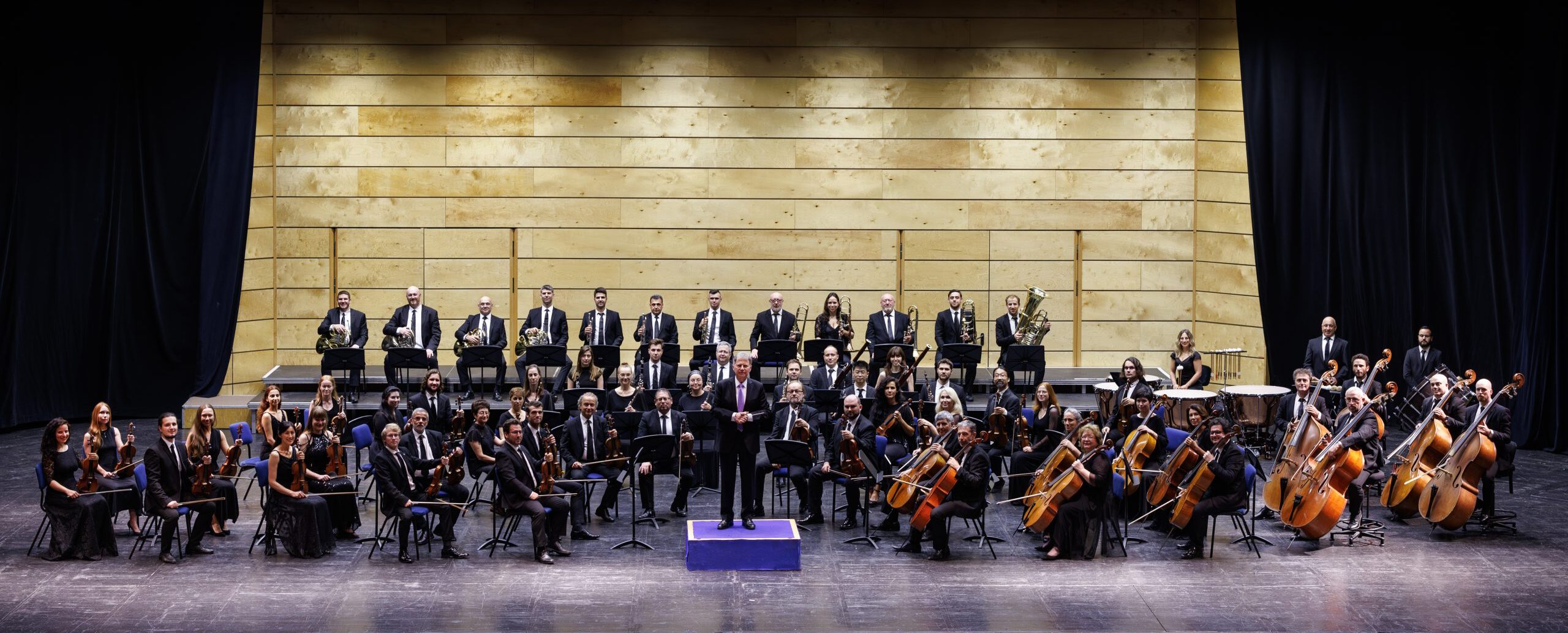
Onegin first appeared at the Haifa Auditorium to inaugurate the venue’s new orchestra pit in 2018. Since then, Israel’s northern metropolis has emerged as more than just another stopover in the Jerusalem–Tel Aviv circuit trod by international touring companies, becoming a destination in itself. Onegin, performed by the Haifa Symphony Orchestra under the baton of Yoel Levi, the Haifa-based Bat Shir Choir, and principals from Israel, Russia, and Romania was initially scheduled to open the 2025 season with three performances in July. It was delayed until December because of the unpredictable security situation following Israel’s missile war with Iran in June.
Julia Pevzner, who last directed Onegin for the Virginia Opera in 2008, followed in the footsteps of other Onegin interpreters (notably Dmitri Tcherniakov at the Bolshoi in 2006 and Stefan Herheim in Amsterdam in 2011) by staging the Haifa production in a twentieth-century setting. Tatyana and Onegin meet in what looks like an American suburban neighborhood rather than the garden of a Russian country estate, as called for in the libretto. Tatyana and her sister, Lensky’s fiancée, Olga, are decked in plaid skirts and saddle shoes, while Onegin and Lensky strut around in unzipped leather jackets. In the second act, Tatyana holds her name-day celebration at a disco hall where she is serenaded by Monsieur Triquet dressed as an Elvis Presley impersonator. The waltzes have been replaced with swing dance.
Lensky and Onegin’s duel, perhaps one of the most splendid scenes in opera, is set properly against a forested and snow-patched riverbank. Still, some liberty is taken with Lensky’s death. Onegin hands his pistol back to the officer, refusing to duel, as Lensky takes his own life. The stunning digital backdrops to these new settings, by the Israeli video designer Yair Katznelson, captures the passing of time or mood alterations with landscapes shown in slow motion. As Lensky awaits his duel and laments the passing of his youth, storm clouds roll overhead, the muddy riverbank hardens, and the river freezes over.
Pevzner’s attempts at reinvention, however, muddle the production’s coherence when paired with the traditional libretto (the opera was sung in Russian with Hebrew and English subtitles). Turquoise and spandex-clad disco dancers at Tatyana’s party, calling for Lensky and Onegin to duel, and Lensky anguishing in his leather jacket to be run through with an arrow are anachronistic to say the least. The classical, opulent interiors of Prince Gremin’s palace and his formally dressed guests in the final act seem incongruous, like an entirely different opera altogether.
The strong performances of the principals made up for what the stage direction lacked. The Russian-born Israeli soprano Alla Vasilevitsky first sang Tatyana in 2022 for the Israeli Opera in Tel Aviv. Her performance this year in Haifa was breathtaking, and she seems to be filling the shoes of other notable Tatyana divas, such as Galina Vishnevskaya and Anna Netrebko. Her aria in the “Letter Scene” was an emotional tour de force, filled with the youthful energy of a lovesick child. Later, Tatyana’s rejection of Onegin in the final act was conducted with a mature air of confidence and poised regret.
The Romanian tenor George Vîrban first filled the role of Lensky for the Romanian National Opera in 2017, followed by the Bucharest National Opera in 2022. His performance in Haifa was spectacular. His voice was refined and commanding. His versatility captured Lensky’s haunting transition from a romantic poet to a jealous lover to a fatalistic man of sorrow and regret at the end of the opera. The Bolshoi-trained baritone Maxim Lisiin, by contrast, seemed bored throughout the night. His voice was quiet and distant, his emotions restrained. Some would say that this is exactly how Onegin should be. Not until he was on his knees in Prince Gremin’s palace in the final act, begging for Tatyana’s love, did the misery of his superfluous and spoiled life become evident.
Rona Shrira, a contralto who trained at the Israeli Opera’s Meitar Opera Studio, gave a good performance as Olga. The Israeli tenor Etan Drori, singing Monsieur Triquet while comically impersonating Elvis visually, captivated the audience with his seductive and dazzling voice. The Moscow-born, Frankfurt-trained Mischa Schelomianski’s Prince Gremin warmed the audience with his seasoned low tones and paternal charm in the final act, even if he looked like he could be Tatyana’s grandfather.
The production concluded a year in which Russian masterworks defined much of the repertoire of the Haifa Auditorium, including Tchaikovsky’s Symphony No. 1, Prokofiev’s Lieutenant Kijé, and a spellbinding performance of Prokofiev’s Piano Concerto No. 3 by the soloist Roman Rabinovich. Verdi’s Il Trovatore, scheduled for next summer, will hopefully be performed without delay.