German artists and intellectuals in the 1920s interpreted their new reality, shaped by the traumatic military defeat in the First World War and the political and economic turmoil of the early Weimar Republic, with sobering, critical matter-of-factness. Gustav Friedrich Hartlaub, the director of the Kunsthalle in Mannheim, termed this cultural phenomenon Neue Sachlichkeit, or New Objectivity. “Art now expresses the human pursuit of a stable, objective ground, of things as they are,” Hartlaub wrote for his “New Objectivity” exhibition in 1925. The artists featured in Hartlaub’s show, such as Otto Dix, George Grosz, and Rudolf Schlichter, refused to conceal the horrific consequences of the war in German society and strove to interpret the harshness of reality through a satirical, critical, and often brutal lens.
To commemorate the centennial of Hartlaub’s exhibition, institutions such as the Kunsthalle in Mannheim and the Neue Galerie in New York organized major exhibitions in 2025 to challenge preconceptions about the scope and limitations of the artists and artworks associated with the New Objective style. As James Panero commented in his review, the selection at the Neue Galerie show “extended beyond the satirical eye of such painters as George Grosz and Otto Dix, the focus of Hartlaub’s original show, to the clean lines of the Bauhaus . . . and to the crisp focus of modern photography and design.”
The Tel Aviv Museum of Art is also honoring the centennial with the exhibition “The Day is Gone: 100 Years of the New Objectivity,” which displays the vast collection of the German collector Jan E. Fischer. The show dismantles any notion of a homogeneous pictorial style and accurately frames Neue Sachlichkeit as a societal perception manifested through the various strands of the avant-garde.
The five galleries are organized thematically to accompany an audio narrative (provided on a headset) of a day in the life of a fictional Berlin artist in 1925 as he wakes early in the morning, works in his studio, strolls through the inner city, attends the avant-garde theater, and ends his day at an underground bar.
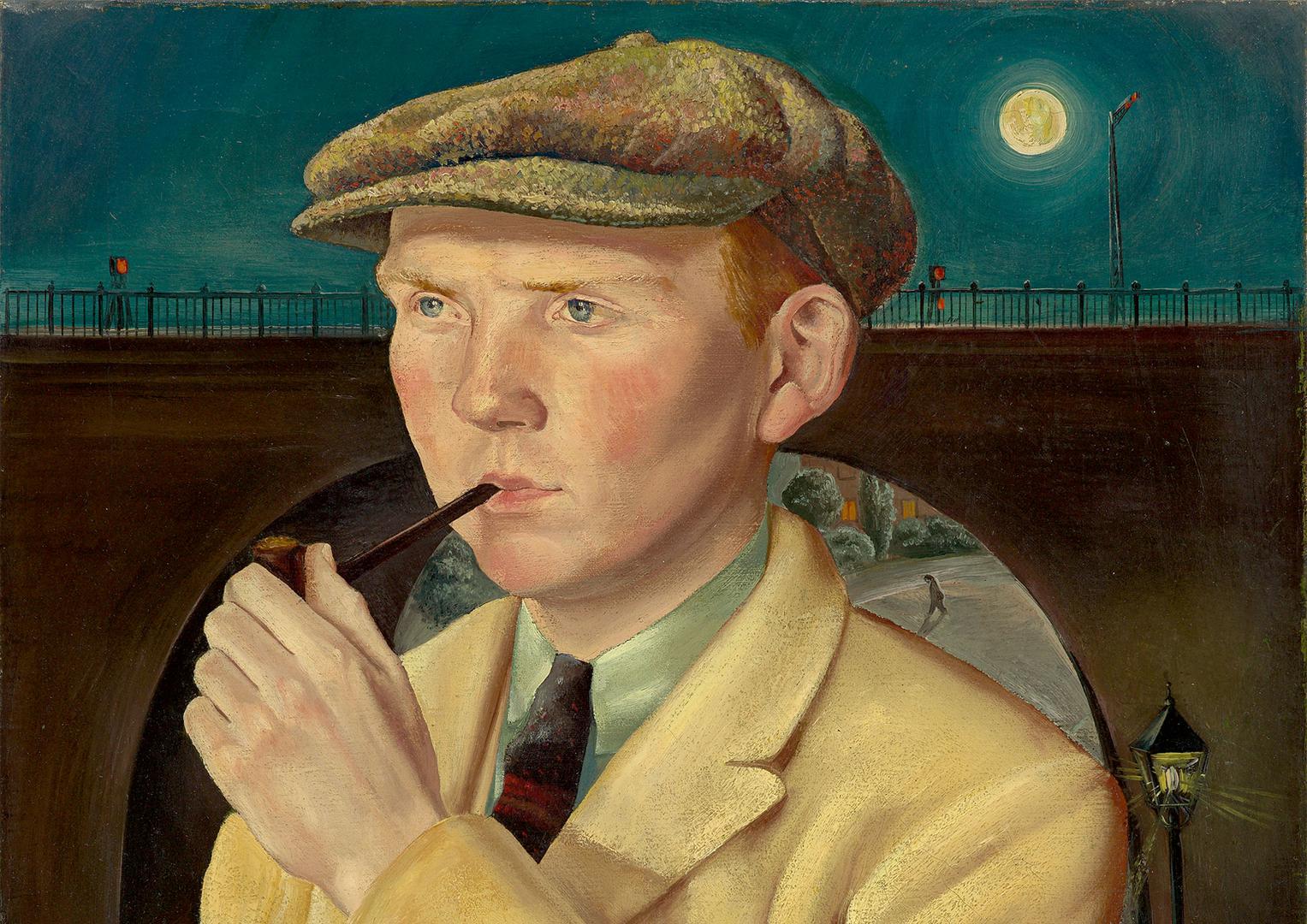
The first gallery opens with a selection of prints from Otto Dix’s series The War (1924) and Volker Böhringer’s The Nurse (1936). Dix’s graphic images of gas-masked soldiers and trench carnage, paired with Böhringer’s decrepit nurse, represent the horrific memories that haunted this generation. The trauma is perhaps best captured in Wilhelm Lachnit’s Portrait of My Brother (1924), where a young man, neatly dressed, ventures out into a dark and empty city with eyes in a lost gaze extending beyond the picture frame.
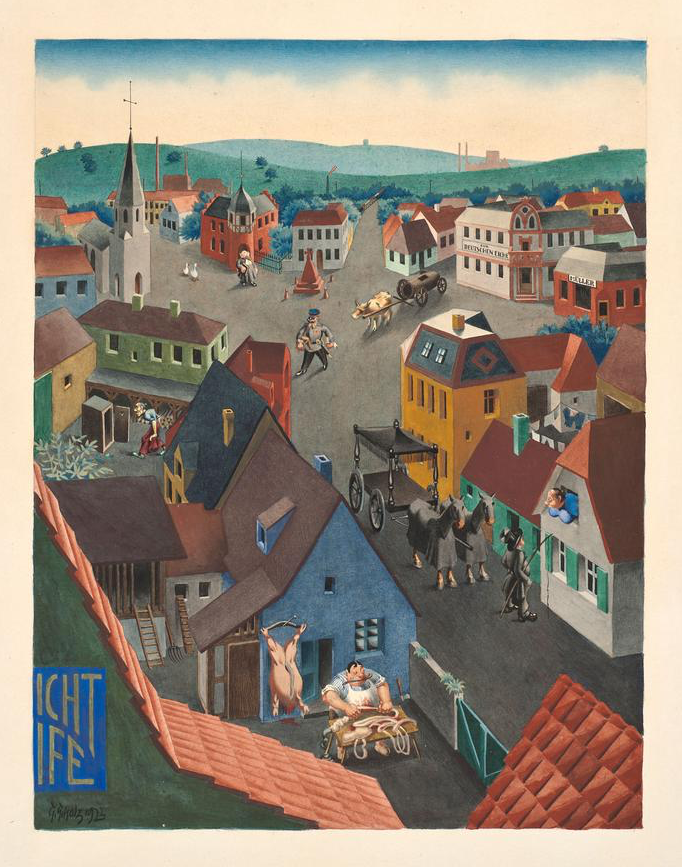
The second gallery widens the artistic scope of the New Objective style. Hannah Höch’s Symbolic Landscape I (1924) is a lively abstract ensemble of colorful, geometric motifs. Six years later, however, the scenery in Höch’s Symbolic Landscape III (1930) is that of a lucid surrealist nightmare, perhaps reflecting the artist’s attitude toward the precarious spiritual atmosphere in the final days of the Weimar Republic. Another social critique is Georg Scholz’s German Town by Day (1922), where the pleasantries of bourgeois provincial life are satirized as a humorous caricature of naivety and blindness to the struggles and privations ravaging German cities after the war.
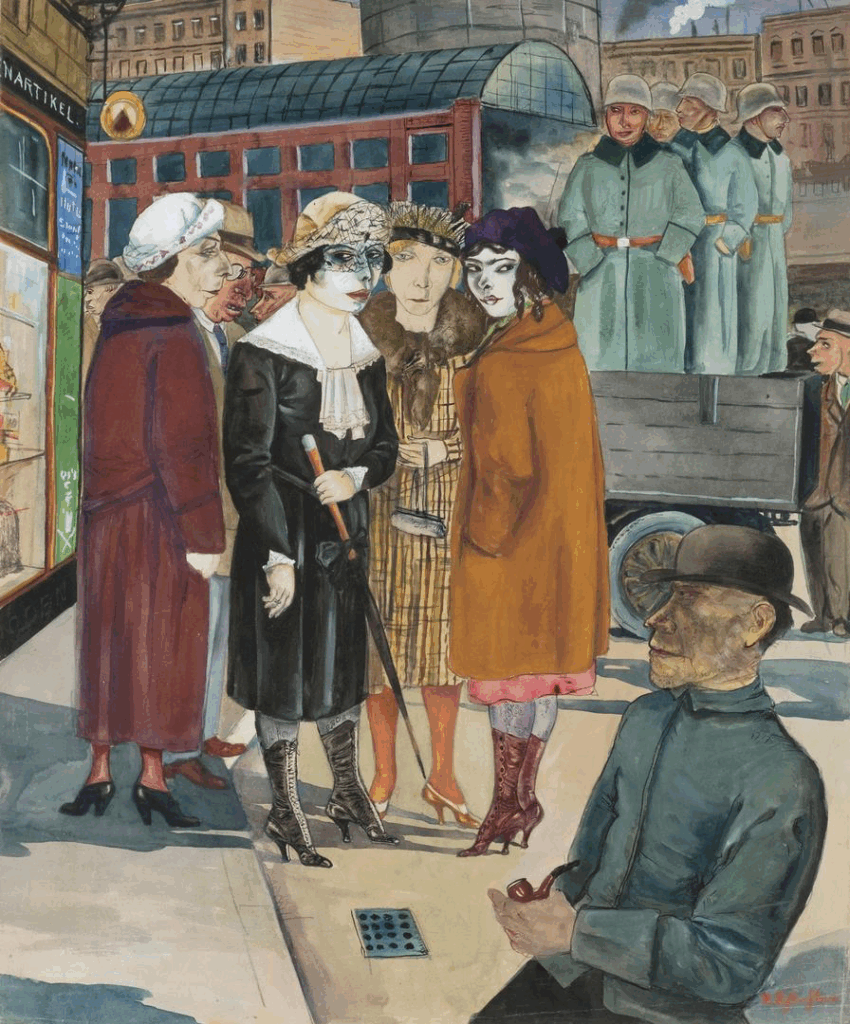
The third gallery features various interpretations of urban living. Rudolf Schlichter captured the dark underbelly of Berlin in Passers-by and Soldiers (1925–26) by crowding his pseudo-realist city streets with sneering soldiers, pale prostitutes, and a battle-scared veteran with a gangrenous-looking face. Commenting on Schlichter and his circle, the art critic Carl Einstein stated that “A German who wishes to portray reality no longer thinks of blooming gardens, but rather of the transmission of venereal diseases.” By contrast, the crisp, bright, meticulously detailed, and ultrarealistic portrayals of urban development and industry in Carl Grossberg’s AVUS Berlin (1928) and Steel Skeleton (1935) elevate the urban environment above its moral decay and aim to redeem progressive industry from its association with mechanical warfare.
In the woodcut series Houses of Our Time (1927), Gerd Arntz attempted to translate urban living conditions into a pictorial language of simple Isotype pictograms—a method he developed alongside his Communist Party comrade Otto Neurath. The twelve graphic woodcuts depicting various urban housing types were an attempt to cultivate class consciousness and facilitate the establishment of an egalitarian society.
Opening the fourth gallery—taking on the theme of an avant-garde theater—is Siegfried Shalom Sebba’s Portrait of Actor Kurt Gerron (1928), depicting a caricature of the corpulent actor in a tuxedo. Aside from a few sardonic and risqué watercolors by Dodo (Dörte Clara Wolff), the gallery is filled with abstract stage designs from Xanti Schawinsky and Sascha Wiederhold. In Schawinsky’s Stage Design for a ‘Tiller Girls’ Show (1925), mechanical motifs, floating abstract objects, and oscillating patterns replace human figures as a critique of an entertainment industry increasingly overcome by mechanical production.
At the end of the last gallery hangs Otto Dix’s Thunderstorm at Lake Constance (1939), depicting storm clouds rolling over the lake as if in a hazy dreamscape. It’s appropriate that Dix—the artist who exhibited seven paintings at Hartlaub’s 1925 exhibition and claimed to have “invented” the genre of Neue Sachlichkeit —opens and closes the Tel Aviv show. The ominous clouds over the lake are perhaps an expression of Dix’s “inner exile,” noted the Tel Aviv curator Noam Gal. They also foreshadow the rise of the Nazi regime and the banning of New Objectivity as degenerate art.
“What do we have in common with these artworks?” Gal asks the Israeli audience in the exhibition literature. The differences between 1925 Germany and 2025 Israel are “numerous and significant,” but the urgency for artists to present a critical mirror of society is “very familiar to us, and even essential to our existence,” Gal states. The exhibition’s title, “The Day is Gone,” resonates with the common political phrase “the day after,” used to denote the end of Israel’s war in Gaza. By reflecting on past interpretations of a traumatized post-war society, this exhibition also questions how artistic manifestations will interpret and critique Israeli society after the guns fall silent in Gaza.