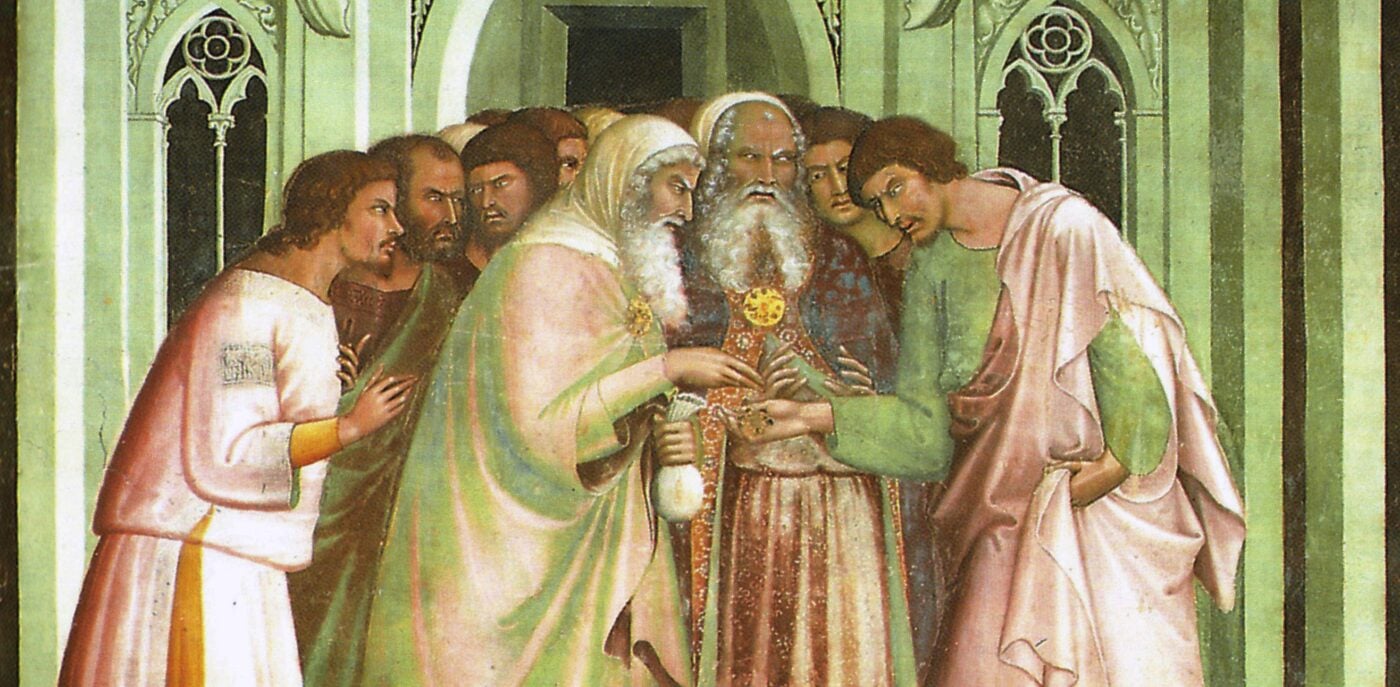
They paid him thirty pieces of silver, and from that time on he looked for an opportunity to hand him over. (Mt. 26:15-16)
There is no shortage of books written or movies produced in which the villain is portrayed in a sympathetic light. We see his “backstory,” one which explains his evil actions as having been committed as the result of a childhood wound, or the suffering he endured at the death of his true love. Whatever the explanation, the script is written in such a way that we end up pitying the bad guy; we even find ourselves rooting for him! It is no different with Judas.
There is a strange compassion we feel at his act of betrayal, right along with our horror—for who among us cannot understand pride or resentment taking over our reason in a terrible moment of misjudgment? Some have even theorized Judas’ actions from the perspective of one who was just trying to “help” Jesus’ mission along, in however misguided a way.
But this is not how Jesus explains Judas’ actions. The only words of “explanation” that Jesus has to offer about Judas’ transgression are:
Woe to that man by whom the Son of Man is betrayed. It would be better for that man if he had never been born. (Mt. 26:24)
These are shockingly abrasive words. Only God, the author of life, can determine who is better off “never [having] been born.” And today, He has. That one is Judas.
Then Judas, his betrayer, said in reply, “Surely it is not I, Rabbi?” (Mt. 26:25)
In John’s depiction of this scene, we hear that the disciples are “at a loss” as to who among them Jesus could be referring to as the betrayer (Jn. 13:22). At this point in their ministry, the disciples have no idea that Judas “was a thief and held the money bag and used to steal the contributions” (Jn. 12:6). They trust him just as surely as they trust each other. Judas was their friend.
Perhaps Simon the Zealot had shared personal stories of his childhood with Judas, over a cup of wine at the end of a long day. Perhaps Matthew had confided in Judas the pangs of guilt that still haunted him occasionally over the shame of his past—an admission of guilt he had not shared with anyone else. Perhaps Judas had teased Mary Magdalene for being “daddy’s little girl” among the bunch; it is possible that Judas was the one with the sense of humor.
Whatever the case may have been, one thing we can conclude is that if the disciples had no problem with Judas handling the money bags, it is because they trusted him. We can only imagine what a terrible blow it must have been to the disciples that it should be Judas, of all people, who would have been the one to deceive them. The “loss” which the disciples experienced at Jesus’ mysterious and troubling words tells us that when Judas made the decision to betray the Master, he made the decision to betray them all.
In Matthew’s Gospel, we hear that the disciples “began to say to him one after another, ‘Surely it is not I, Lord?’” (Mt. 26:22). Jesus neither confirms nor denies any of their individual questions. It is only after they have each finished asking that Jesus then replies:
He who has dipped his hand into the dish with me is the one who will betray me. (Mt. 26:23)
Despite having just heard Jesus’ prophetic warning about the hand dipping, Judas then “takes the morsel” that Jesus dips and hands to him!
In Matthew’s account, just before this takes place, we hear that Judas has asked Jesus a curious question. After Jesus’ “woe to that man” statement, Judas asks Jesus, “Surely it is not I, Rabbi?” Why is this so curious? After all, each of the disciples have asked Jesus the same question, one by one. Except in Judas’ case, he either did not ask Jesus at the same time as the rest of the disciples—that is, before Jesus’ chilling admonishment—or he has asked the same question twice.
In other words, at this point, Judas is either attempting to deceive the other disciples (and perhaps even Jesus Himself) by “acting” just as shocked as they are, or…he truly does not know that he will be the one to betray the Lord. But how could this be possible? Perhaps because Judas has convinced himself that what he is planning to do is not an act of betrayal at all, but rather, an act that is justifiable.
After he took the morsel, Satan entered him. (Jn. 13:27)
What’s interesting is that it is only after Jesus prophesies about the morsel and Judas takes it (thus fulfilling the prophecy) that “Satan enter[s] him.” In other words, the devil did not “make him do it.” Judas was not “predestined” to betray the Savior; rather, he chose to. That his actions had been prophesied in the Scriptures is simply a function of the omniscient God knowing from all eternity the unconscionable choice that Judas would make.
By grabbing the morsel from Our Lord’s hands right after he has told him what such an action would mean, Judas brazenly reveals that he is done with pretexts. Jesus knew he would be the betrayer, and now Judas knows too. We imagine Judas looking straight into the eyes of Our Lord, grabbing that morsel from his hand, and shoving it into his mouth with an antagonistic and belligerent stare as he chews it loudly, mouth open. Any pretense of deference or respect for the Master is now gone. And it is at this moment that he has made room in his soul for a new lord and master.
So Judas is perhaps not the sympathetic figure some have made him out to be. Judas’ determination to follow his own will in favor of the Lord’s has led him to just one place: the darkness of evil.
Thus we learn from Judas that there is no middle ground when it comes to the choices we make. It is true, God gives us the free will to make our own choices in life, but let’s make no mistake: if we do not choose what is good, we will, by definition, choose what is not. Any turn away from God will necessarily mean a turn away from that which is good.
Of course, unlike Judas, not all our bad choices are made with bad intent. Sometimes we act out of emotion, or too impulsively, or without thinking—as did our dear Simon Peter. But whether our sinful actions are done out of malice or weakness, we must remember that there is no transgression we could ever commit that is greater than God’s mercy. Peter and Judas both had the same opportunity to be restored in God’s grace, but only one of them embraced the opportunity. All it would require for either of them—and for any of us—would be a humble, contrite heart.
Author’s Note: Adapted from 26 Steps with the Apostles—coming summer 2026! (26 Steps series)
Image from Wikimedia Commons