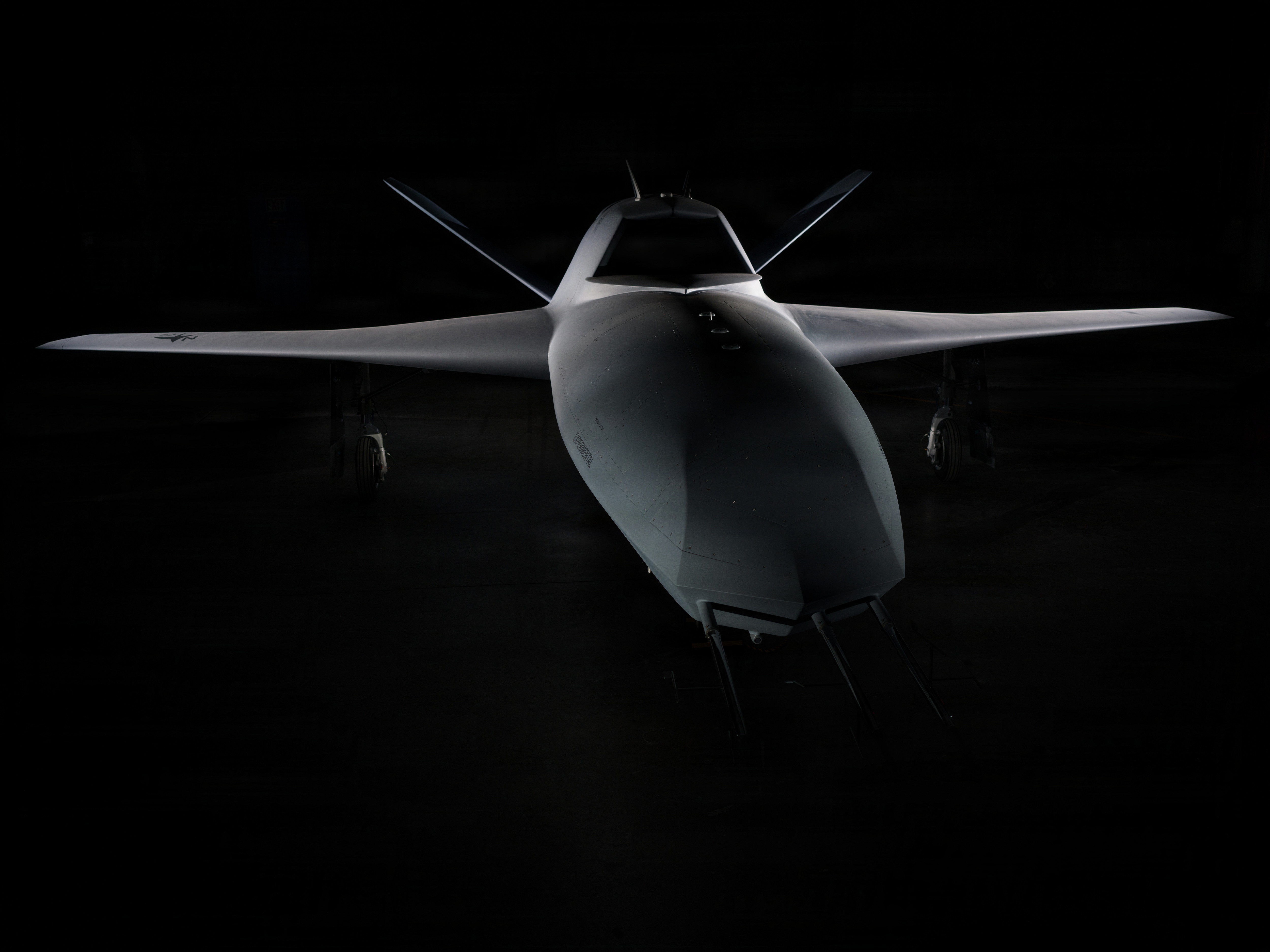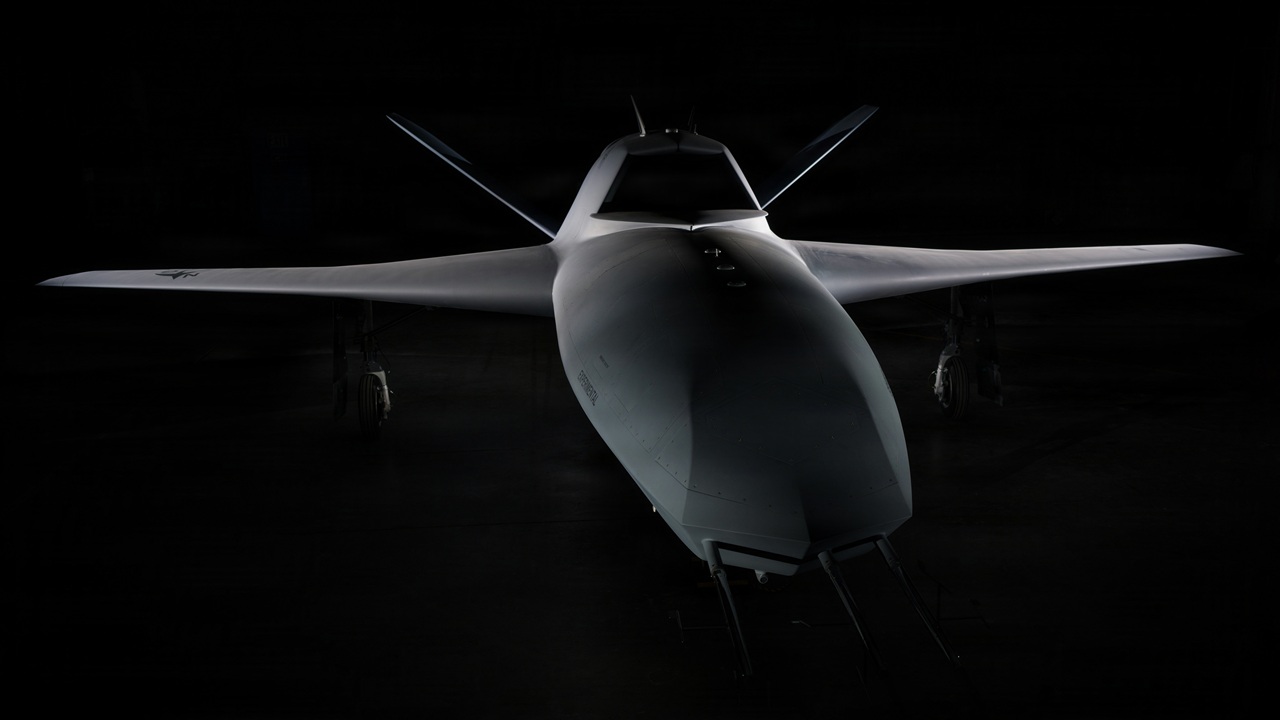
The YFQ-48A drone is now the third drone vying for the US Air Force’s “Collaborative Combat Aircraft” program, following General Atomics’ YFQ-42A and Anduril’s YFQ-44A.
In April 2024, the unmanned aerial systems (UAS) developed by Anduril and General Atomics Aeronautical Systems (GA-ASI) were selected by the United States Air Force to advance in the Collaborative Combat Aircraft (CCA) program, which seeks to develop loyal wingmen to serve alongside manned fighters. In March, Anduril’s “Fury” received the designation YFQ-44A, and GA-ASI’s “Gambit” was designated YFQ-42A. Just over a year ago, the two drones passed a critical design review, while flight testing began earlier this year.
The two companies competing for the CCA program have likely spent months sizing one another up—but the rivalry between them has been disrupted by the arrival of a new challenger. On Monday, the Air Force announced that Northrop Grumman’s “Project Talon,” a semi-autonomous prototype aircraft, would be designated the YFQ-48A—becoming the third drone in the second phase of the CCA effort.
“This designation marks a key step forward in the Collaborative Combat Aircraft program, underscoring the Air Force’s commitment to rapidly delivering next-generation capabilities that meet the urgent and evolving needs of the warfighter,” the Air Force explained.
It added that the Mission Design Series (MDS) designation “highlights the ongoing partnership” between the service and the aerospace firm and further “acknowledges the continued progress of the YFQ-48A as a strong contender in the CCA program.”
The Air Force has called for a fleet of thousands of low-cost drones that could serve as force multipliers for the vastly more expensive manned aircraft. Northrop Grumman continued development of Project Talon even after it failed to win a spot in the original CCA competition, which suggests the Air Force now sees a variety of drones could fill different roles, each offering specific capabilities.
“We are encouraged by Northrop Grumman’s continued investment in developing advanced semi-autonomous capabilities,” said Brig. Gen. Jason Voorheis, program executive officer for Fighters and Advanced Aircraft. “Their approach aligns with our strategy to foster competition, drive industry innovation, and deliver cutting-edge technology at speed and scale.”
The Air Force Is Encouraging Competition in Drone Design
Northrop Grumman, which is producing the B-21 Raider long-range strategic bomber for the US Air Force and remains a contender in the US Navy’s F/A-XX sixth-generation carrier-based fighter program, failed to advance beyond Increment 1 of the CCA competition. Boeing and Lockheed Martin were two of the five companies that presented offerings, and neither advanced.
However, Northrop Grumman believed in the promise of the Talon, and continued developing it without formal support from the Pentagon.
As the program has evolved, the Air Force may have room for more than one or even two options. The Air Force explains that the “CCA program’s acquisition strategy emphasizes continuous competition, providing multiple on-ramps for industry participation.”
By taking an “open, competitive approach,” the Air Force can better leverage what it stated were the “most innovative solutions from across the defense industrial base to meet the evolving demands of modern warfare.” The service has said it will “continually compete for future phases of the program.” The Talon seemed to fit nicely into one of those programs.
“Northrop Grumman’s commitment to innovation, low-cost manufacturing, and calculated risk-taking aligns perfectly with the CCA acquisition strategy and the Secretary of War’s Acquisition Transformation Strategy,” added Col. Timothy Helfrich, director of the Agile Development Office. “Project Talon is a testament to their ability to push boundaries and experiment with new technologies, ultimately advancing solutions that could enhance the future of airpower.”
Northrop Grumman is also the first of the seven companies to have its platform emerge from the Increment 2, with the others including Anduril, General Atomics, Boeing, Lockheed Martin, Kratos, and Shield AI.
About the Author: Peter Suciu
Peter Suciu has contributed over 3,200 published pieces to more than four dozen magazines and websites over a 30-year career in journalism. He regularly writes about military hardware, firearms history, cybersecurity, politics, and international affairs. Peter is also a contributing writer for Forbes and Clearance Jobs. He is based in Michigan. You can follow him on Twitter: @PeterSuciu. You can email the author: [email protected].
Image courtesy of Northrop Grumman / US Air Force.