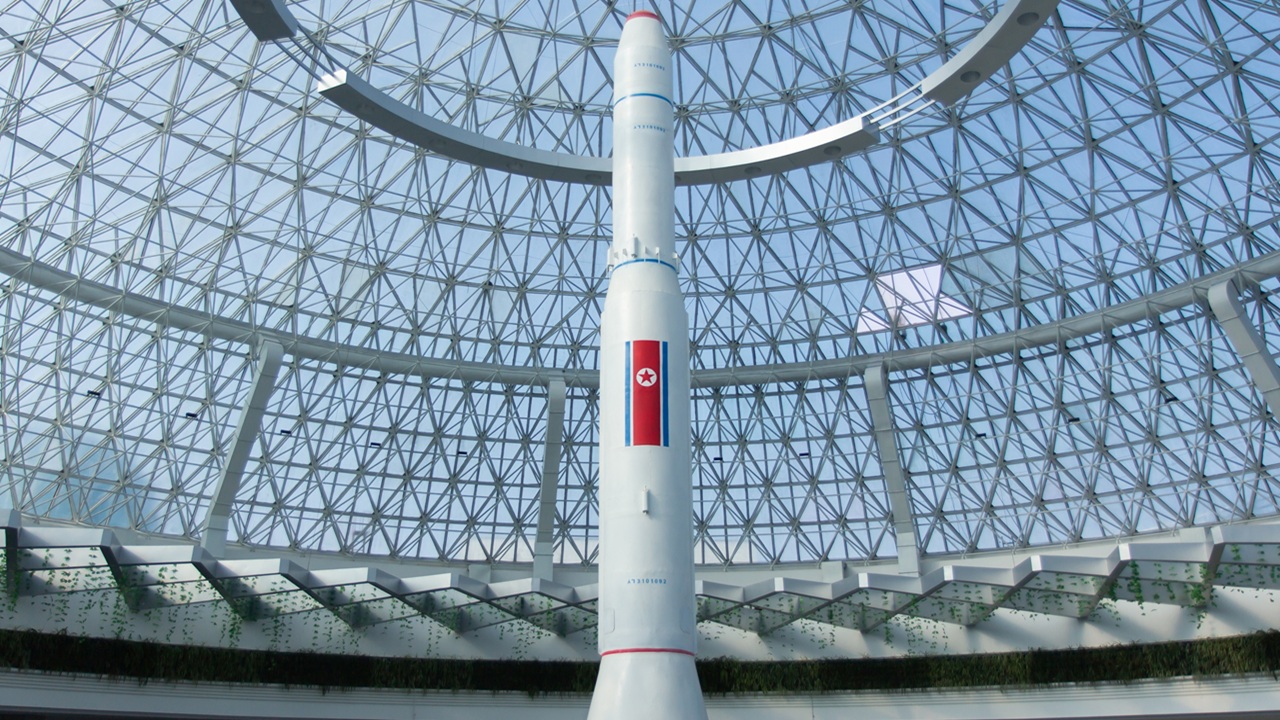
For years, the Western pundit class has insisted that North Korea’s missiles are far away and Pyongyang is not serious about their use—even as evidence mounts to the contrary.
For years, many Western analysts have laughed off North Korea’s intercontinental ballistic missile (ICBM) program. They rely on old assumptions, such as the notion that the DPRK’s missile program is “primitive” and that its missiles are unreliable.
In fact, the North Korean military today is developing one of the most rapidly advancing, survivable, and operationally flexible nuclear ICBM forces on Earth. These systems are being built to defeat US early-warning, missile defense, and political will.
North Korea Has Successfully Miniaturized Its Nuclear Warheads
The North Korean Hwasong-18 was first flight-tested in 2023. This system is the crown jewel of Pyongyang’s nuclear weapons arsenal. Its solid fuel-operated missile means it can launch within minutes rather than hours. This weapon is mobile and comes in a three-stage configuration that appears optimized for long-range precision. Its large diameter suggests the ability to carry multiple reentry vehicles, penetration aids, or heavier-yield warheads.
Until very recently, Western analysts argued that North Korea lacked miniaturization technology for their nuclear weapons. The Hwasan-13 modular nuclear warhead family disproves that. This weapon is small enough to fit inside a Hwasong-17-or-18 reentry vehicle. It appears standardized for multiple delivery systems.
As the recent hit Netflix film A House of Dynamite showcased, the United States military is largely unprepared to respond to the North Korean ICBM threat; it has defensive systems, but those systems are far from adequate. That isn’t just for entertainment in a movie. This is a sad reality that Americans must face every day—even if they don’t want to. Indeed, the paucity of American air defenses is one of the many reasons why one of President Donald Trump’s first actions at the start of his second term was to order the creation of the “Golden Dome” missile defense shield for America.
How Can America Protect Itself from North Korean ICBMs?
Right now, there are between 44 and 64 interceptor missiles deployed for homeland defense—and they are getting older. Ground-based Midcourse Defense (GMD) was designed to defeat primitive one-to-two missile salvos, not a modern-day fusillade of missiles. And today, North Korea possesses decoys, radar-evading bus maneuvers, multi-stage burnout profiles, and even possible MIRV development.
Of course, regional missile defenses, like the THAAD, Aegis, and Pac-3, can help Japan and South Korea, but they cannot protect the American homeland from a dedicated ICBM strike. And the Hwasong-18 would be the one that breaks the back of America’s defense.
More to the point, the United States cannot reliably neutralize the North Korean nuclear force Russia launches, which means North Korea has de facto nuclear deterrence over the American homeland. Of course, at any moment, the United States could turn Pyongyang into a sheet of glass. But North Korea doesn’t need to win a nuclear war against the United States. It only needs the American president to hesitate in responding to its other actions.
Western analysts have persistently underestimated North Korea’s military threat because it threatens their narrative. The West wants you to believe that North Korea can’t hit the United States, American missile defenses will save the day, and Kim Jong-un is irrational and therefore predictable. Every major test of North Korean ICBMs since 2017—including lofted trajectories in simulating full-range ICBM flight—has proved all these assumptions wrong.
North Korea has the ability to strike American cities today, and most of official Washington pretends like it doesn’t—because accepting the truth means accepting that the US homeland defense strategy is inadequate. American extended deterrence is shakier than advertised. Meanwhile, the Indo-Pacific, the balance of military power is shifting faster than anyone cares to admit.
But don’t tell Washington that.
About the Author: Brandon J. Weichert
Brandon J. Weichert is a senior national security editor at The National Interest. Recently, Weichert became the host of The National Security Hour on America Outloud News and iHeartRadio, where he discusses national security policy every Wednesday at 8pm Eastern. Weichert hosts a companion book talk series on Rumble entitled “National Security Talk.” He is also a contributor at Popular Mechanics and has consulted regularly with various government institutions and private organizations on geopolitical issues. Weichert’s writings have appeared in multiple publications, including The Washington Times, National Review, The American Spectator, MSN, and the Asia Times. His books include Winning Space: How America Remains a Superpower, Biohacked: China’s Race to Control Life, and The Shadow War: Iran’s Quest for Supremacy. His newest book, A Disaster of Our Own Making: How the West Lost Ukraine is available for purchase wherever books are sold. He can be followed via Twitter @WeTheBrandon.
Image: Shutterstock / BGStock72.
PYONGYANG, NORTH KOREA – NOVEMBER 11, 2016: Pyongyang Sci-Tech Complex in North Korea. This symbol of North Korea’s pursuit of scientific advancement was opened in 2015. Image: Shutterstock / BGStock72.