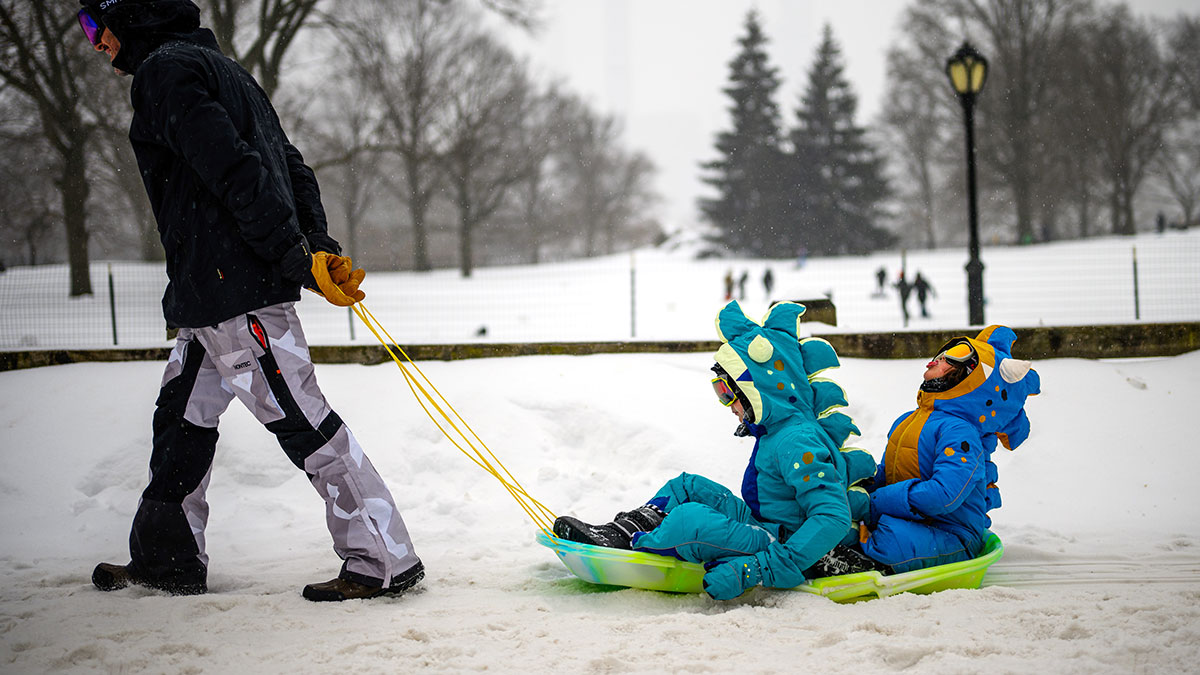
Can there be a more exhilarating experience for a child than a snow day? Kids erupt in jubilation at the news that they’ve been liberated from their normal routine, free to enjoy a day with friends in a world transformed into glistening white.
Yet, with most of the nation bracing for an historic winter storm, New York City Mayor Zohran Mamdani ruled out the possibility that school kids would get a snow pass. Despite recalling fond memories of snow days in his childhood, the mayor announced that classes will be in-person or remote, depending on the conditions.
Finally, a reason to check your email.
Sign up for our free newsletter today.
Mamdani may have been the face of the decision, but he wasn’t its author. The real culprit behind the disappearance of snow days is the scheduling inflexibility caused by new holidays and the city’s contract with the United Federation of Teachers (UFT).
The Department of Education (DOE) sets the school calendar in close consultation with the teachers’ union, which generally tries to minimize the work required of its members. During the 2023 contract negotiations, the DOE issued calendars for the following two school years, effectively locking in the current 2025–26 school calendar as part of the teachers’ labor contract.
Over the years, the DOE calendar has also inserted more holidays as a sign of cultural inclusivity. Mayor Bill de Blasio added Lunar (Chinese) New Year and the Muslim holy days of Eid al Fitr and Eid al Adha. Mayor Eric Adams added Diwali, the Hindu festival of lights.
The union has tacked on still more vacation days. In September 2019, a petition—led by the UFT’s social-justice caucus—accumulated 33,000 signatures demanding that Monday, December 23, be made part of the winter vacation. The de Blasio administration quickly caved. In 2024, Adams likewise yielded, again declaring December 23 a day off—alongside UFT President Michael Mulgrew.
Holidays are far easier to add than to remove, and the resulting inflexibility, combined with the union’s recalcitrance, has made compliance with state law more difficult. New York’s Education Law requires a minimum of 180 days of instruction to qualify for state school aid.
Before the pandemic, the calendar typically included more than 180 days of instruction to accommodate snow closures. In 2020, however, the advent of remote learning rendered snow days effectively obsolete. Mayor de Blasio declared them “a thing of the past.” In September 2022, Adams’s schools chancellor David Banks confirmed that city schools would no longer close due to bad weather and would instead switch to virtual learning.
In short, remote instruction and a calendar pared to the legal minimum of school days have crowded out weather closures. Reviving them would require other difficult choices, such as keeping schools open on a Monday or Friday during otherwise holiday-shortened weeks.
To reclaim snow days, the logical step would be to start the school year earlier, eliminate a holiday, or shorten a vacation, restoring some flexibility to the calendar. But by longstanding—nearly sacrosanct—custom, the school year begins only after Labor Day. Add the convenience of teaching from home on remote-learning days, and the UFT is unlikely to surrender the ground necessary to restore weather closures.
While in-class learning is critically important, every child should experience the occasional snow day, if only to create memories that will last for the rest of their lives. Happy surprises may be rare in adulthood, but they need not be in childhood. Besides, students are unlikely to learn much from a day of virtual instruction—especially when you factor in technological snafus and kids’ dismay at missing the chance to play outside.
That is why state education officials should require every district to preserve at least one traditional snow day each year. If additional storms occur, districts could shift subsequent closures to remote learning. In snowless years, districts could instead grant an extra day off in the spring, or, better yet, keep the schedule and give students an extra day of class.
The teachers’ union might object, but this would merely restore (partially) a practice it long tolerated. A school system that can’t spare a single snow day isn’t serving students; it’s denying them a small but enduring bit of enchantment.
Photo by Alexi Rosenfeld/Getty Images
City Journal is a publication of the Manhattan Institute for Policy Research (MI), a leading free-market think tank. Are you interested in supporting the magazine? As a 501(c)(3) nonprofit, donations in support of MI and City Journal are fully tax-deductible as provided by law (EIN #13-2912529).
Source link