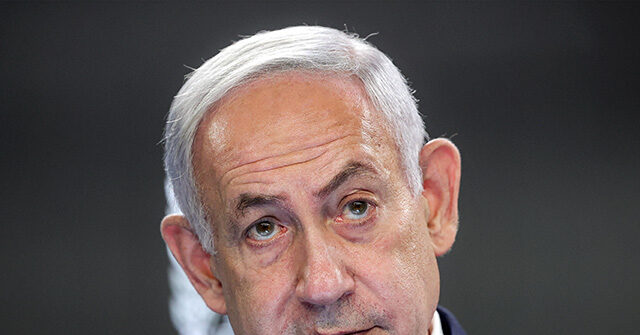
Israeli Prime Minister Benjamin Netanyahu said on Tuesday that it would be possible to negotiate a non-aggression pact with Syria, as desired by President Donald Trump, if the Syrian government is willing to establish a “demilitarized buffer zone.”
“What we expect Syria to do is, of course, to establish a demilitarized buffer zone from Damascus to the buffer area, including the approaches to Mount Hermon and the Hermon peak,” Netanyahu told reporters during a visit with wounded Israeli soldiers.
“We hold these territories to ensure the security of the citizens of Israel, and that is what obligates us. With goodwill and an understanding of these principles, it is possible to reach an agreement with the Syrians, but we will stand by our principles in any case,” he said.
The Israeli prime minister was responding to an unusual warning from Trump on his preferred social media platform, Truth Social.
Trump wrote on Monday that he believes great progress has been made by the new Syrian government following the overthrow of dictator Bashar Assad one year ago and he was concerned that Israel’s ongoing military actions against Hezbollah in Syria could jeopardize that success.
“The United States is very satisfied with the results displayed, through hard work and determination, in the Country of Syria. We are doing everything within our power to make sure the Government of Syria continues to do what was intended, which is substantial, in order to build a true and prosperous Country,” Trump wrote.
“One of the things that has helped them greatly was my termination of very strong and biting sanctions — I believe this was truly appreciated by Syria, its Leadership, and its People!” he said.
“It is very important that Israel maintain a strong and true dialogue with Syria, and that nothing takes place that will interfere with Syria’s evolution into a prosperous State,” he added.
Trump praised Syria’s interim president Ahmed al-Sharaa, a former leader in the al-Qaeda terrorist organization, for “working diligently to make sure good things happen, and that both Syria and Israel will have a long and prosperous relationship together.”
Sharaa met with President Trump at the White House on November 10, the first Syrian leader to enjoy such an honor since Syria became an independent nation in 1946. The Trump administration hoped for a rapprochement with Israel, and possibly even steps toward the new Syria joining President Trump’s Abraham Accords peace initiative, but Sharaa said there could be no progress in that direction until Israel withdrew its forces from Syria and stopped interfering in Syrian affairs.
Sharaa’s distance from the Abraham Accords was disappointing to the White House but, on the positive side, he did not completely rule out developing a better relationship with Israel and he at least tacitly acknowledged that Israel had legitimate security concerns pertaining to Hezbollah. The major sticking point was Sharaa’s contention that his government has “expelled” Hezbollah and other Iran-backed terrorist forces, a claim strongly disputed by Israeli and international military analysts.
Israeli forces raided a Syrian village called Beit Jinn last week, killing 13 people, according to Syrian state media.
Israel said the raid was intended to capture members of a Lebanese Islamist group called Jama’a Islamiya that launched rocket attacks against Israel during the Gaza war, and was involved in further “terrorist plots.”
Israeli military officials said the raid escalated into a pitched battle when “armed terrorists” returned fire, wounding six Israeli soldiers.
The Syrian Foreign Ministry claimed ten of the casualties in Beit Jinn were civilians, including women and children. Local officials claimed there were no terrorists hiding in the town, only a “peaceful, civilian population” with a “legitimate right to defend ourselves.”
Sharaa’s government denounced the raid as a “criminal attack,” while United Nations Deputy Special Envoy for Syria Najat Rochdi called it a “grave and unacceptable violation of Syria’s sovereignty and territorial integrity, further destabilizing an already fragile environment.”
The Jerusalem Post noted on Tuesday that “Israel’s current leadership is very suspicious of the government of Syria” due to incidents like the battle in Beit Jinn. Many Israeli officials believe Sharaa’s government is an unsteady alliance of “jihadists” that could unravel at any time.
According to the Jerusalem Post, the Israeli government believes constant “raids and strikes” are necessary to keep terrorist forces along its border “off balance,” creating a constant environment of “low-level conflict” that will prevent enemy forces from gathering enough strength to perpetrate another outrage like the October 7, 2023, attack on Israeli civilians by Hamas.
Trump, on the other hand, evidently wants Netanyahu to give Sharaa a chance to pacify the border. Netanyahu’s demand for an extensive demilitarized zone from Damascus to Mount Hermon, which is located on the border between Syria and Lebanon, would give Sharaa a means of demonstrating a solid commitment to peace with Israel.
Israel created its own buffer zone shortly after the fall of the Assad regime in December 2024, running along the lines of the 1974 ceasefire agreement between Israel and Syria, which includes the Golan Heights. Israeli forces are also currently in position on the summit of Mount Hernon.
Netanyahu led a high-level Israeli delegation to visit the buffer zone in mid-November, greatly angering the Syrian government, which insisted Israel’s presence was “illegal.”
“We affirm that the visit represents a new attempt to impose a de facto situation that contradicts relevant U.N. Security Council resolutions and falls within the occupation’s policies aimed at consolidating its aggression and continuing its violations of Syrian territory,” the Syrian Foreign Ministry said in November.