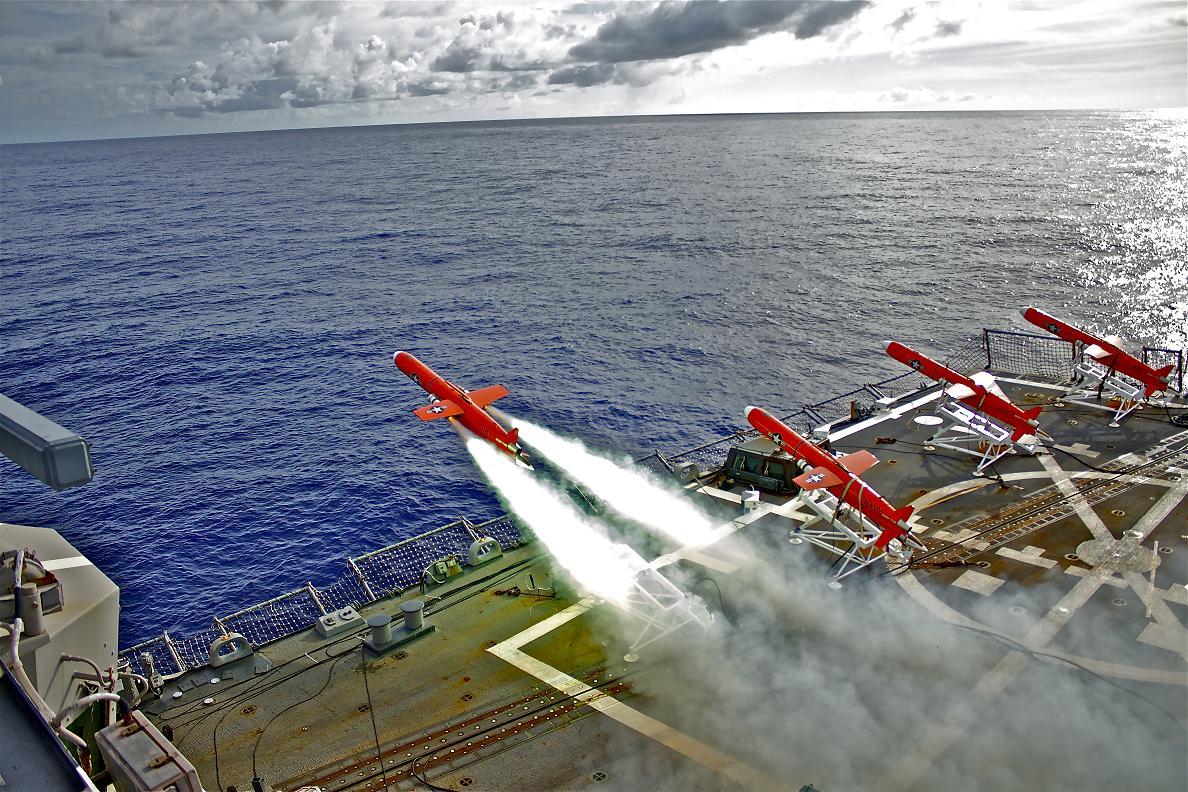
The Navy expects to purchase 128 suicide drones by 2032 for the first increment of the program.
The US Naval Special Warfare Command is looking to equip some of its small craft with suicide drones.
The aim is to pair some of the Navy’s most advanced special operations craft with the latest drone technology, thus increasing their lethality.
The Navy’s Plans to Use Suicide Drones
In November, the Navy issued a request for information to explore options to equip the Combatant Craft Medium (CCM) special operations boat with loitering munitions.
Under the title of “Maritime Launched Effects – Increment (MLE) 1,” the Navy is asking the defense industry for information about how to best outfit the CCM with organic suicide drones that can be launched and controlled from the commando boats.
One-way unmanned aerial systems, colloquially known as suicide drones, have become quite popular due to the war in Ukraine, where both combatants rely extensively on suicide drones for tactical and even strategic strikes.
“MLE-1 provides combatant craft with an organic precision-strike mission package to engage targets over-the-horizon when conventional methods cannot be employed. The MLE-1 mission package is designed to be a beyond line-of-sight missile system with man-on-the-loop flight controls, multi-mode seeker, loitering, and scalable effects warhead/payload options that minimizes collateral damage,” the request for information states.
The Navy expects to purchase 128 suicide drones by 2032 for the first increment of the program. The service indicated that there will be at least two additional programs for the procurement of additional one-way attack unmanned aerial systems once the right candidate has been found.
During prototype testing, the Naval Special Warfare Command has been using Anduril’s ALTIUS 700 suicide drones to explore the potential and viability of the project.
The Naval Sea Systems Command issued the notice on behalf of the Program Executive Office Undermanned and Small Combatants, Naval Special Warfare Program Office.
The Navy was explicit in stating that the request for information is not a request for proposals but rather “a market research tool being used to determine overall market developments, capabilities, and adequacy of the industrial base capable of providing the supplies/services described herein prior to determining requirements and the method of acquisition.”
Companies have until December 19 to respond to the request for information.
Benefits for CCM2 Mk 2 and VBSS Operations
The Navy plans to outfit the suicide drones with the new CCM Mk2, which is under development and will replace the current version of the special operations boat.
Operated by the Special Warfare Combatant Craft (SWCC) crewmen, these commando boats are designed to infiltrate and exfiltrate Navy SEAL platoons in littoral environments. They can also support Visit, Board, Search, and Seizure (VBSS) operations in the middle of the sea. During VBSS missions, Navy SEALs (or other appropriately trained special operations units) board an enemy or suspect vessel, often moving. It is one of the toughest special operations mission sets and requires exceptional strength and stamina.
Equipping special operations craft with suicide drones will increase the lethality of SWCC special boat teams and give more kinetic options against conventional and unconventional threat actors.
About the Author: Stavros Atlamazoglou
Stavros Atlamazoglou is a seasoned defense journalist specializing in special operations and a Hellenic Army veteran (national service with the 575th Marine Battalion and Army HQ). He holds a BA from the Johns Hopkins University and an MA from the Johns Hopkins’ School of Advanced International Studies (SAIS). His work has been featured in Business Insider, Sandboxx, and SOFREP.
Image: DVIDS.