
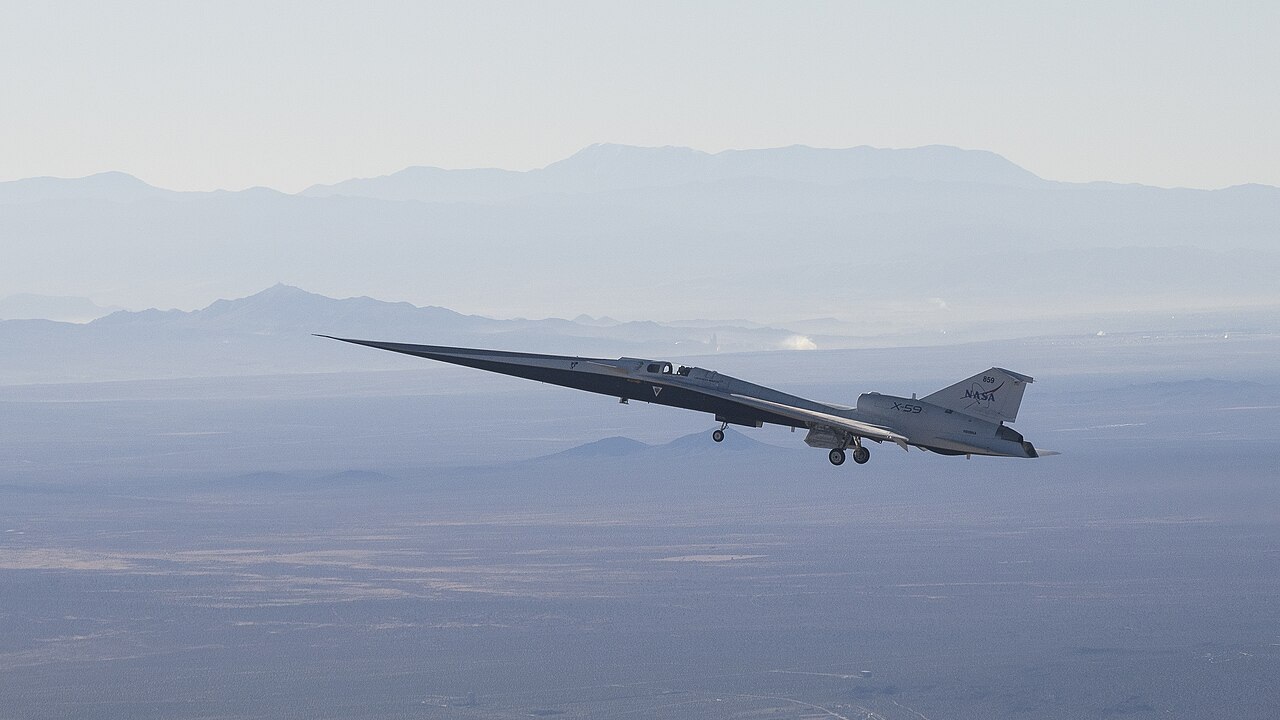
The X-59 is designed to transform the sonic boom associated with supersonic flight into a “sonic thump”—making it feasible to fly over populated areas.
NASA’s new X-59 experimental jet flew for the first time last month, despite the government shutdown, thanks to a mission-critical exemption. Part of the “Quiet SuperSonic Technology” (Quesst) program, the X-59 was designed to address the issue of the sonic boom—which the FAA banned over land in 1973, throttling the usefulness of supersonic aircraft for commercial aviation. By negating the sonic boom, the X-59 is intended to open up a new realm of possibilities for supersonic commercial travel.
What to Know About the NASA X-59
- Year Introduced: 2025 (first flight; experimental aircraft, no expected military use)
- Number Built: 1
- Length: ≈99 ft (30 m)
- Wingspan: ≈29.5 ft (9 m)
- Height: ≈14 ft (4.3 m)
- Weight (MTOW): ≈32,000 lb (14,500 kg)
- Engine: One General Electric F414-GE-100 turbofan
- Top Speed: ≈940 mph (1,512 km/h) / ≈Mach 1.4
- Range: Unknown
- Cruise Altitude: ≈55,000 ft
- Avionics: External Vision System (camera + cockpit display), flight-test telemetry suite, advanced boom-shaping control software
- Acoustic Signature: Target ≈75 PLdB “soft thump” (vs. ~110+ dB conventional sonic boom)
- Loadout: None (unarmed research aircraft)
- Aircrew: 1
The X-59’s first flight occurred on October 28, 2025 from the Palmdale Regional Airport in California. Newly released video footage shows the aircraft taxiing, with the long, needle-like nose visibly flexing; takeoff over the Mojave Desert; the view of the cockpit with flight data overlays; the perspective of the chase plane; and the landing. The flight was a success, according to Lockheed Martin, the aircraft’s designer.
Lockheed, which is famous for its work on groundbreaking aviation projects like the U-2, SR-71, and F-117, designed the X-59 specifically to shape shockwaves so that they merge into a soft thud instead of the traditional, glass-shattering sonic boom. Notable design features of the X-59 include its extremely long nose—measuring an astounding 38 feet long—which serves to redistribute pressure waves; a single GE F414 engine (usually used on the F/A-18 Super Hornet); and, perhaps most interestingly, no forward-facing window (the pilot uses redundant external cameras to navigate). The plane has a slim delta wing for efficient supersonic cruise.
Why Sonic Booms are Bad—and How to Get Rid of Them
Given the destructive nature of sonic booms—they strike the ground as a sudden explosive bang, scaring people and causing physical damage to certain structures—the FAA enacted a ban on civilian supersonic flight over US land in 1973. This ensured that the Concorde, the West’s only supersonic passenger airliner, could only be used for trans-oceanic flights, limiting its usefulness. Ultimately, the industry interest in supersonic transport collapsed; it was just too impractical with the ban in place.
However, faster air travel is an attractive proposition for many airlines—and the relative success of the Concorde, in spite of its high price tag, showed that many wealthy people would be willing to pay a premium for supersonic flights if they could be allowed over the continental United States. Aerospace firms such as Lockheed Martin have worked on aircraft like the X-59 that can stretch pressure waves, pushing them outward and downward in controlled patterns. This prevents constructive interference that produces a boom, resulting instead in a 60–75 decibel “sonic thump”—more similar to a car door closing than the explosion of a sonic boom.
How the X-59 Could Legalize Supersonic Air Travel
The X-59’s goal is to change public perception about supersonic travel, gather data, and give regulators the scientific evidence necessary to prove that low-boom flight is feasible (and quiet).
To test the new aircraft, the X-59 will be flown over ground microphones placed throughout the Mojave Desert to measure pressure signatures. Other recording aircraft will also measure shockwaves from above and the sides. Then, after initial local testing, the X-59 will be flown over select US communities to gather public response data. The results will be submitted to the FAA and ICAO to inform new supersonic noise standards.
The hope, one day, is that the X-59 could enable coast-to-coast US supersonic travel, cut global travel times by 50 percent, and provide rapid-response transportation for medical evacuation, disaster relief, and military logistics. If successful, the X-59 will mark the first significant breakthrough in supersonic travel since the Concorde’s retirement in 2003.
About the Author: Harrison Kass
Harrison Kass is a senior defense and national security writer at The National Interest. Kass is an attorney and former political candidate who joined the US Air Force as a pilot trainee before being medically discharged. He focuses on military strategy, aerospace, and global security affairs. He holds a JD from the University of Oregon and a master’s in Global Journalism and International Relations from NYU.
Image: Wikimedia Commons.

















.jpg)