The economic impact of the 1994 free trade deal with Mexico chopped a year off many Americans’ lives, according to a report in the New York Times.
The North American Free Trade Agreement (NAFTA) boosted Wall Street by sending millions of U.S. jobs to lower-wage workers in Mexico. The civic cost is described in a new study titled ‘Trading Goods for Lives: NAFTA’s Mortality Impacts and Implications.”
“In the first 15 years of NAFTA, about 3 percent of 45-year-old men lost a year of their remaining life expectancy as a result of the trade deal,” hte newspaper reported, adding:
The researchers saw increases in mortality across most major causes of death, including illness, drug overdoses and suicides. The overall trends particularly affected working-age men, and were more pronounced in the Southeast and parts of the Midwest, like Michigan.
Matthew Notowidigdo, one of the report’s authors, said in an interview that the work highlighted an “underappreciated cost of globalization.” In the cities and towns facing new competition from Mexican factories, “life expectancy falls, and it hits really hard on men,” he said.
“We’re talking about a lot of life years lost,” he added.
The study concluded:
In the 15 years post-NAFTA, an area with average NAFTA exposure experienced an increase in annual, age-adjusted mortality of 0.68 percent … an increase that more than erases prior estimates of the welfare gains from NAFTA’s nationwide economic benefits. Mortality increases appear across all broad age by sex groups, but are particularly pronounced among working-age men, a demographic that also experienced disproportionate NAFTA-induced declines in (primarily manufacturing) employment
President Donald Trump renegotiated the three-nation NAFTA deal in 2018 to help Americans. This year, he is expected to review the replacement treaty, dubbed the United States-Mexico-Canada Agreement (USMCA), with Mexico and Canada.
The NAFTA study helps to account for the many “Deaths of Despair” as discarded factory workers lost hope for work and their children. That term was coined by British-born economist Angus Deaton, who subsequently declared opposition to migration:
I also no longer defend the idea that the harm done to working Americans by globalization was a reasonable price to pay for global poverty reduction because workers in America are so much better off than the global poor
“We certainly have a duty to aid those in distress, but we have additional obligations to our fellow citizens that we do not have to others,” he added.
The New York Times‘ coverage of NAFTA’s Death of Despair comes as more left-of-center journalists recognize that white-collar outsourcing — accelerated by H-1B visas and AI technology — may cause similar levels of damage to American college graduates.
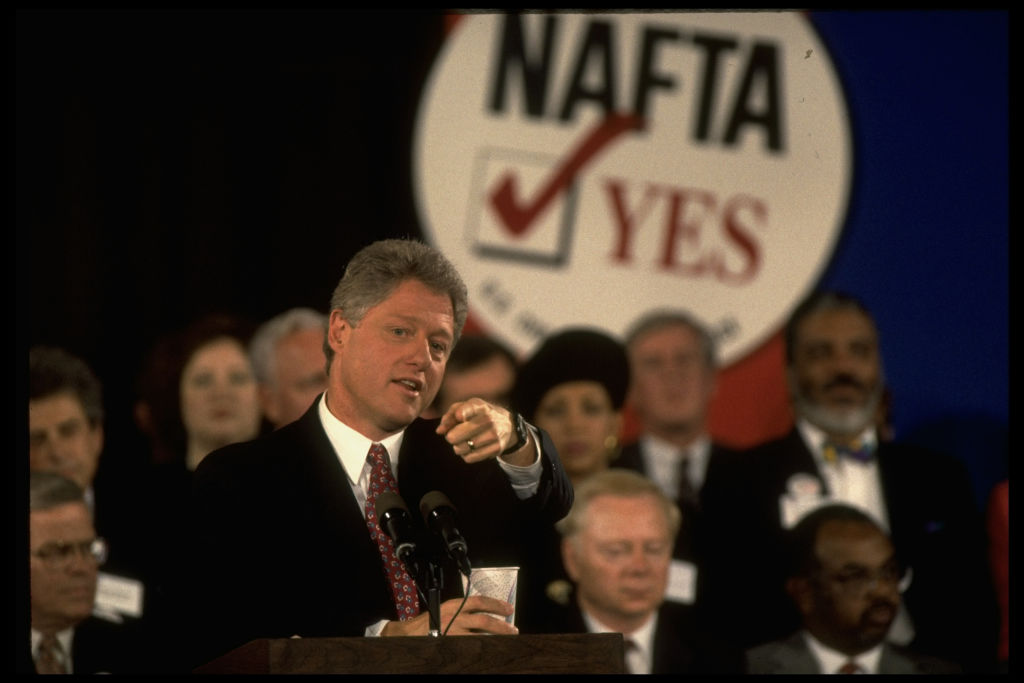
File/President Bill Clinton addressing a Chamber of Commerce group in 1993 re. benefits of North America Free Trade Agreement (NAFTA), below pro-NAFTA banner. (Photo by Diana Walker/Getty)
The combined threat of AI, outsourcing, and visa workers could wreck the American middle class, leave U.S. national security dependent on foreign managers, cripple the housing market, and sink the consumer economy. The pro-migration Atlantic reported on February 18:
White-collar workers would go through what blue-collar workers went through beginning in the 1970s. Advances in machine technology improved productivity and depressed employment in Detroit; Pittsburgh; Gary, Indiana; and Worcester, Massachusetts. Rust Belt communities fell apart and never recovered. Then China joined the World Trade Organization, and globalization spurred another round of job losses, causing even more permanent damage. Affected workers ended up poorer, less happy, and less healthy. They died sooner. Their kids were worse off too.
To get the economy going again during the AI transition, the country would need to figure out how to get white-collar workers back to work. And I really mean figure out—essentially from scratch.
President Donald Trump is zig-zagging through the complex issues: He is touting AI while shrinking migration to pressure CEOs to hire more Americans for high-productivity jobs. He is also shrinking the inflow of drugs and is trying to renegotiate free-trade deals to help revive U.S. industry.
In contrast, left-wing advocates are pushing for universal welfare and government dependence — dubbed “Universal Basic Income” — as a supposed compensation for absent jobs, work, children, purpose, and hope.
An op-ed for the New York Times reported on March 5:
Thomas Greifenberger graduated from the University of Delaware last spring. Although he double-majored in finance and marketing and minored in economics, it took him just three years to earn his bachelor’s degree. He had hoped that his solid grades and demonstrated drive would help him land a position in the financial services industry. But when Mr. Greifenberger began his job search, it quickly became apparent to him that he was sending résumés into a void …
He has returned home to Long Island, where he is now employed by his family’s tree service business. Mr. Greifenberger enjoys the work — he is often the guy up in the bucket, pruning branches — and the tangible results it yields. But he admits that it’s not the future he had envisioned for himself.
“I still go on LinkedIn from time to time, but I think that ship has sailed for me,” he told the New York Times.