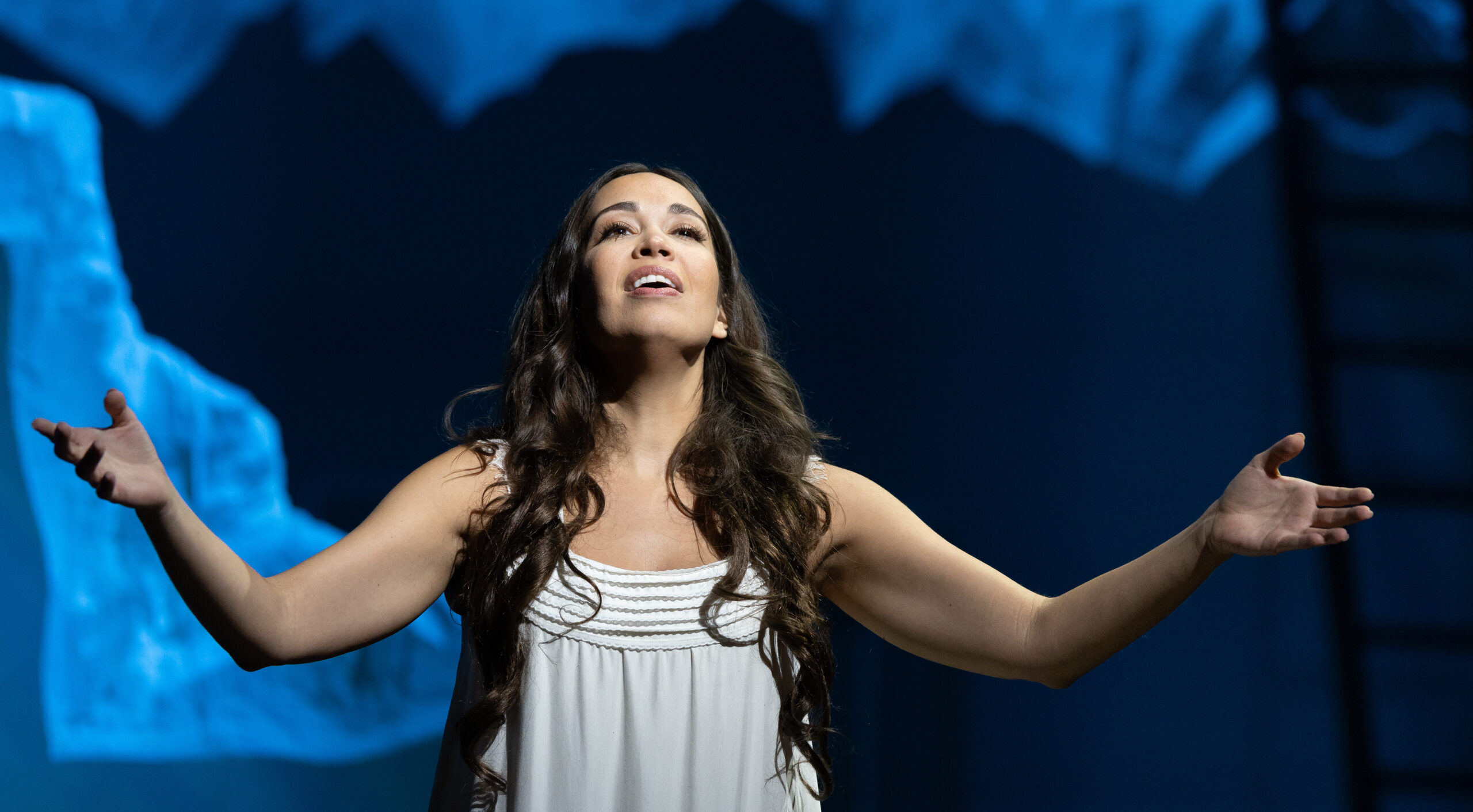
To say it immediately, Nadine Sierra proved herself a great singer at the Metropolitan Opera last night. The company began a run of La sonnambula, Bellini’s opera of 1831. I will return to Ms. Sierra in due course.
The opera was conducted by Riccardo Frizza—not to be confused with Carlo Rizzi, another conductor. I have confused the two in the past. In this business, you have to know your Rizzis from your Frizzas.
In the main, the score was graceful and nimble, without being dainty. Daintiness can kill a bel canto score such as La sonnambula. Also, the music was sturdy and incisive where necessary. Now and then, there was some misalignment between the stage and the pit—but this was a well-conducted Sonnambula.
First to sing is Lisa, one of the two sopranos in the opera. (The other is the title character, Amina, who is the sonnambula, or sleepwalker.) Lisa was sung by Sydney Mancasola, who is from California. She proved a very good bel canto soprano, a very good coloratura—with finesse, flexibility, and other essential tools.
On another occasion, Mancasola might have been the headline—the headline the next day. But there was a stunning headliner last night.
Doing his part—more than his part—was the evening’s tenor, Xabier Anduaga, who portrayed Elvino. Why is there a “b” in this singer’s first name? He is a Spaniard from the Basque country. His singing was fresh and easy. He could go high and soft like a champ. And he could hold notes for as long as he wanted.
“Good news,” I thought. “Man cannot live by Polenzani and Brownlee alone.” I had named two lyric tenors who appear regularly at the Met. There is always a need for more.
The bass in the show is the Count, and last night he was portrayed by Alexander Vinogradov, a Russian. Beautiful voice. Sometimes quavery on this occasion. He had an aristocratic bearing, true to the role.
In charge of the production—a new one—is Rolando Villazón. The starry Mexican tenor? Yes—he also works as a director now. In the new production, La sonnambula is recognizable as La sonnambula. What do I mean by that? Before this one, the Met had a production that bore little resemblance to the opera.
Villazón’s is not exactly “traditional.” (That would get him booted out of the guild.) It has “concepts,” not comprehensible by me. There is a series of doors, which people come in and out of, in a stylized way. Some spirit dancer accompanies Amina. Etc.
Still, you can tell you are looking at La sonnambula, I think.
At the end, Amina rejects Elvino, rather than marrying him. This rewrites the story. Is this kosher? Well, it is by now customary—even “traditional,” you could say. People always think that operas need updating. Personally, I think they should write new operas (their own operas).
Now to the main event: the performance by Nadine Sierra, that soprano from Florida. She put on a clinic of bel canto singing, and of singing tout court. I will list some of the ingredients.
Evenness of production (vocal production). Focus of sound. Beauty of sound. Accuracy of pitch. Agility. High notes way above the staff, sounding natural, not freakish. An ability to play with the notes, bending them, melting with them—pulling them around like taffy.
She was Bellinian, through and through. Which is a good thing to be in a Bellini opera.
As an actress, she blended charm and pathos. She was girlish, tragic, decisive, confused, innocent—thoroughly believable as her character.
I will make a confession: after an Act I aria, I found myself shouting “Brava!” rather involuntarily. It just came out of my mouth, like an unexpected cough. The audience gave Sierra an ovation that lasted maybe a minute—but which feels like an eternity in the opera house. There was something close to pandemonium. I have not witnessed that in this house, or any other, in a long time.
Late in the opera, Sierra faded and stumbled a bit. That is, she was imperfect. She seemed to be tiring (vocally). Still, she met a very high standard.
Obviously, Nadine Sierra is no discovery. Anyone who saw her Lucia, for example, knows what she can do. (In the 2021–22 season, Sierra sang the title role of Donizetti’s Lucia di Lammermoor at the Met.) But last night kind of clinched it for this critic: the G-word, “great,” should be applied.
The opera at large was exceptionally well sung—icing on the cake, for a cake that did not especially need it.