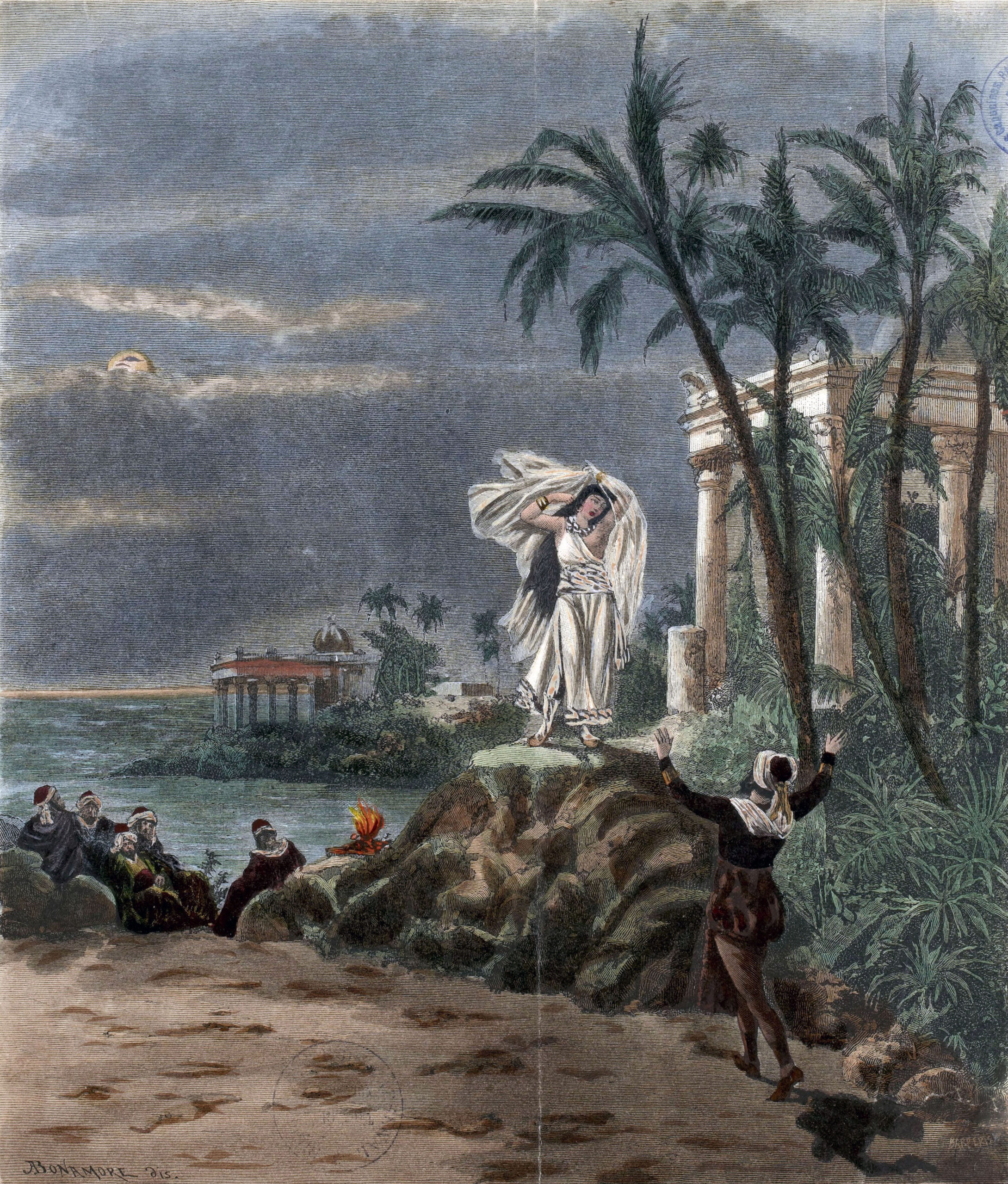
“There were neither fishermen in the libretto nor pearls in the music.” That was the scathing verdict of Le Figaro on Georges Bizet’s Pearl Fishers when the youthful opera juxtaposing love and duty premiered in Paris in 1863. This season, Palm Beach Opera presents the work for the first time in its history, staging the British fashion designer Zandra Rhodes’s vibrant San Diego Opera production of 2004.
Only twenty-four at the time of his opera’s premiere, Bizet was struggling to have his works performed by the Second Empire’s snobbish musical establishment. He won a windfall commission when Napoleon III’s fine-arts minister Count Alexandre Walewski gave a gift to the capital’s Théâtre Lyrique to support operas from laureates of the prestigious Prix de Rome who had not yet had any commercial productions. Few eligible composers fit those very specific criteria, and Bizet quickly withdrew the work he had submitted to the Opéra-Comique, which later served as The Pearl Fishers’s main performance stage, so as to pocket Walewski’s cash. With only a few months to complete the opera, Bizet cut corners by adapting music from other projects, including the prelude and two major vocal selections he had already written for a now-forgotten opera about Ivan the Terrible. He considered setting his opera in Mexico before deciding upon Ceylon.
The Pearl Fishers was a crowd-pleaser in its initial run, but critics then and now have castigated its weak story and nondescript libretto. The plot is a traditional tenor–soprano–baritone love triangle in which the pearl divers Zurga and Nadir, who never go to sea, must govern their passions for Leila, a priestess who never performs any act of worship. The two suitors decide to bury their romantic rivalry to preserve their friendship—apparently without consulting Leila—but when Zurga is chosen to be king, Nadir breaks their agreement and finds that the priestess returns his forbidden affections. The high priest Nourabad quickly exposes their affair and condemns them to death. Zurga makes the moral choice to free them by starting a massive conflagration. The finale, which Bizet labored to complete even as the opera entered rehearsals, is a Mad Libs of possible endings for future interpreters. His original performance score was lost, but in most traditional versions Zurga kills himself, after having lost his love and betrayed his duty. Sometimes Leila takes the suicidal role out of guilt for abandoning her own vows, just as the titular Norma in Vincenzo Bellini’s opera does. In Rhodes’s production, Leila and Nadir flee, leaving Zurga alone and alive to contemplate his moral quandary.
Long remembered only for its vocal highlights, The Pearl Fishers has become more popular in recent years, though any staging will inevitably draw comparisons to Bizet’s much more successful Carmen. The short length of The Pearl Fishers and easy casting make it relatively inexpensive to stage, and productions have proliferated in recent years. Rhodes’s production draws on her travels to Sri Lanka, where the opera is set. (Bizet never went there or even to Spain, the setting of Carmen.) The stage décor’s cool blues and purples reflect the seaside. Red, yellow, and orange colors suggest the characters’ passions and the finale’s blaze.
The Russian soprano Aigul Khismatullina, who will return in Palm Beach’s production of Rigoletto later this season, sang an affecting Leila, with limpid tones and flawless coloratura. The tenor Jack Swanson’s Nadir sang sweetly and sympathetically but chortled with a bit too much vibrato in the part’s cadences. Joo Won Kang, a Korean baritone who replaced the Russian singer Guriy Gurev as Zurga in this performance, was steadfast and resonant. The opera’s famous tenor–baritone duet showed why it endures as a concert set piece.
That all four principals (as well as Gurev) have also appeared in significant roles at New York’s Metropolitan Opera is a testament to Palm Beach Opera’s reputation and its leadership under the general and artistic director James Barbato. As the Met undergoes a period of financial crisis and prepares for its shortest full season in sixty years, it may want to look south for inspiration.