In late June 1961, Muriel Spark traveled to Jerusalem to attend the trial of Adolf Eichmann. She was there to report for the Observer, but no writing connected to her trip would appear until 1965, when the first four chapters of a new novel, The Mandelbaum Gate, were serialized in The New Yorker.
A light comedy juggling dark themes, The Mandelbaum Gate pleased no one and had an especially poor reception among Jewish American intellectuals. Even advocates for Spark’s fiction wondered at her ill-judged hubris. Spark’s tone was considered too ironic, distanced, dispassionate; she had, it was said, “made distastefully light of the situation in Jerusalem.”
Finally, a reason to check your email.
Sign up for our free newsletter today.
The Mandelbaum Gate maps the comings and goings of various flaky characters—tourists, diplomats, smugglers—thrown together in Jerusalem in the “year of the Eichmann trial.” Full of hesitant dialogue and feverish monologues, it privileges the messiness of lived experience. The Mandelbaum Gate is Spark’s most obviously autobiographical work, its pivotal character Barbara Vaughan as close as the novelist ever got to a self-portrait. Vaughan—forthright but elusive; half-Gentile and half-Jewish—baffles everyone she meets. Even in casual conversation, she is put on the spot. Why doesn’t she testify to her Jewishness? Why does she vacillate? Perfect strangers regard her as tantamount to a double agent, betraying two causes at once.
The Mandelbaum Gate had an unusually long gestation and is a notably chewier read than most Spark novels. (Some of her best works can be finished in half an afternoon.) Here we are set down in an apparent chaos of loose ends, tangents, and divagations. Put the book aside in frustration and return later, and you may feel as though it was you who lacked focus, not the novel. You begin to notice its precise repetitions of certain phrases and figures, like an anxiety-inducing musical fugue. The Mandelbaum Gate remains an anomaly in Spark’s oeuvre—strangely overlooked and ripe for reappraisal. In retrospect, it feels like a bridge between early and middle Spark, a turn toward what many consider her crowning heights.
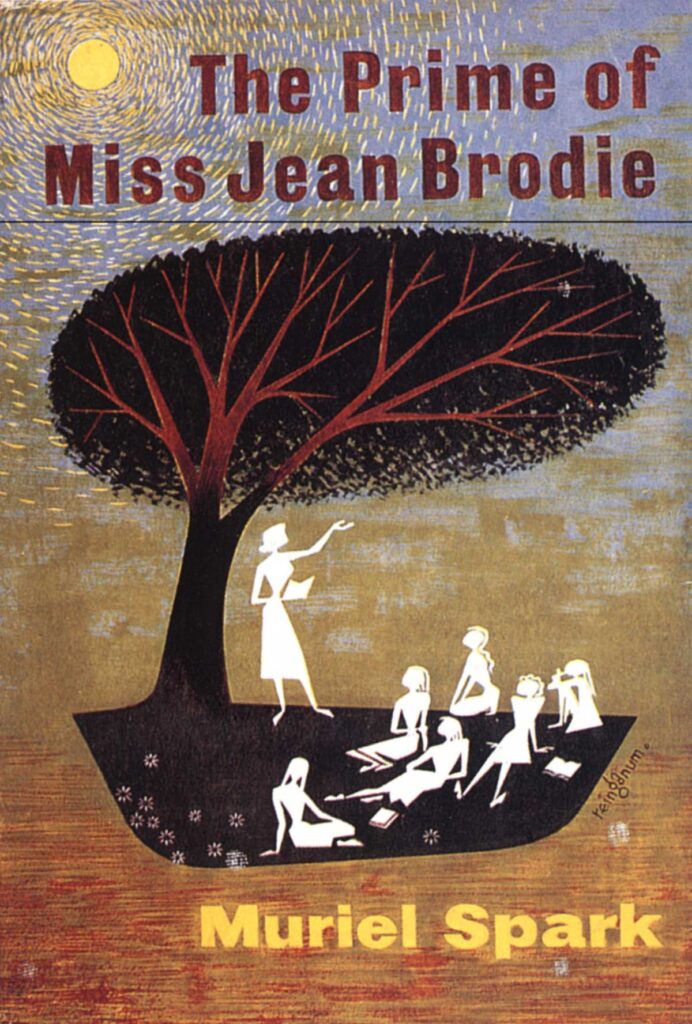
Between 1965 and 1984, Muriel Spark published a series of novels that, taken together, are an unmatched log of the private apprehensions and public duplicity of the Cold War era. She was not, on the face of it, a Big Themes writer, but shadows lurk between her terse, always readable, lines: faith, predestination, and sacrifice; diabolical whispers under the messy spritz of current events. A political awareness, never doctrinaire, also hums in the background: The Prime of Miss Jean Brodie (1961) engages with the lure of fascism; Watergate shadows The Abbess of Crewe (1974); terrorists invade The Only Problem (1984).
Graham Greene divided his own work into “entertainments” and more theological meditations. In Spark, those two continents do not collide but merge seamlessly. Her novels may present as “interior” and talky, yet their itinerary is global: Rome, Paris, Venice, New York, Geneva, Crewe, Jerusalem—the opposite of parochial or domestic. This is a different kind of project from the big skyscrapers of doctrinaire modernism: elliptical, small-scale, and flawlessly crafted. Spark is an intelligencer, a bringer of news, whose most memorable stylistic quality is her lack of ostentation—a style that never feels labored.
Muriel Sarah Camberg was born in Edinburgh in the winter of 1918, the product of two family lines that made her “half-Scottish and half-English, half-Jewish and half-Gentile.”
Edinburgh itself was a city of paradox: buttoned-down yet gabby, dour yet contrarian, where miserly prudence could be ambushed by sudden flurries of gaiety. Spark came to resemble her double-faced home—stern moralist and wry comedienne; hoarder of documents yet writer of spare, economical prose; conservative anarchist with a “capacity for joy” and a “streak of paranoia.” She was both precocious child-poet and novelist late to her vocation. That latter delay is the seedbed of Frances Wilson’s fizzing new biography, Electric Spark, which surveys—and plays with, and shuffles—the first 39 years of her subject’s life, asking “how Muriel Spark became Muriel Spark,” and why it took so long.
Wilson’s take is partial, in both senses. In many biographies, the rough-and-tumble of childhood is zipped through to get us ringside for the heavyweight adult stuff. As with her excellent biography of Thomas De Quincey, Wilson burrows inside the stacked logic of the Spark foundations to inhabit the fledgling writer’s psyche. Spark seems to have been an utterly self-possessed child—the phrase “self-possession” already suggesting a kind of inner haunting. She was born with a spark inside, and Wilson plays on the many nuances of this word, as well as claiming that the name “Muriel” means “sparkle,” making Muriel Spark already something like a double of herself before she even wrote a word.
The young Muriel Camberg seemed precociously receptive from the start. One of the first influences to settle like fog over her soul was the poetry of the Border Ballads: words as music and music as moral lesson. Like much folk culture, it was conservative in form but intensely uncanny, echoing eternally with love and betrayal, delicacy and carnage. At nine, Muriel rewrote Robert Browning’s Pied Piper of Hamelin; soon after, her first original poem appeared in the school magazine. The school “broke its own rule” and published five of her poems in a single year. She imbibed Wordsworth, Tennyson, Swinburne, and Yeats, and her work was included in a national anthology.
Where does such brilliance come from? One answer, the answer that you suspect Spark herself would prefer, is that it’s an absolute mystery. We touch here on questions of predestination and gifts granted by the gods. Still, it’s not enough to be blessed—such a gift must be nurtured and submitted to training, discipline, and will. One cornerstone of the Spark legend has it that all she needed to begin a new novel was the title: once she had it, the work was painlessly born. Wilson shows that Spark occasionally said the opposite—she knew a novel was ready to go only “when I realize how it is going to end”—as though interviewers were just a different subset of her readers, to be teased and mystified and jollied along in the wrong direction.
If the first mystery is Spark’s prodigal talent, the second is why she didn’t complete her first novel until early middle age, though she had by then published several volumes of poetry, literary biography, and critical editions of favorite writers. One answer is that the pulse of fiction had to wait until, as Wilson puts it, she had “hoarded enough material—metaphorically and literally—to begin the process of alchemical reduction.” Spark’s early adult years often read like dizzy fiction themselves: a succession of unlikely meetings and bizarre coincidences, each random-seeming moment charged with a secret logic that would ultimately serve her vocation.
Surprisingly—or perhaps not—this already-feted child prodigy never went to university. (Family finances were inadequate, but a young autodidact’s arrogance likely played its part.) Instead, she enrolled in a secretarial course in “commercial correspondence and précis writing,” where she absorbed the writerly virtues of compression and clarity.
In 1937, out of the blue, she became engaged to Sidney Oswald Spark, 13 years her senior, and followed him to Southern Rhodesia (now Zimbabwe), where they married. She had a son, Robin, before discovering that her husband was a violent manic-depressive. Returning alone to Britain, she secured an unlikely wartime post in intelligence, helping to spin black propaganda against the Nazis—a mind-boggling chapter that deserves a book, or a film, of its own. There was a twisted wit and unsentimental flair to the dissimulation practiced behind those top secret doors: scripting believably sordid legends about Nazi brass and extravagant personae for Allied agents proved, in retrospect, superb training for a novelist.
Wilson vividly conjures each successive Spark location: not just the jittery backroom chatter of secret-service magi or the unreal world of African settlers, but the torpid gray waiting room of postwar Britain—a time when small magazines sprouted like mushrooms and literary criticism was still considered a viable long-term career choice.
Many of Spark’s novels evoke this time and place: a bomb-site London of deprivation and making do. She was one woman in a world of men—half-Jewish, Catholic by choice, bright, divorced, and avowedly un-maternal. She seems to have sent the boys into a tizzy. But what a third-rate bunch they were: lurkers, impostors, hacks—staid, patronizing, smug. They inhabit a world apart from the fascinating women whom Spark encountered, who blaze with the improbable vividness of fiction: Princess Marie Bonaparte (psychoanalysis), Christine Brooke-Rose (avant-garde experiment), Marie Stopes (women’s rights, eugenics). The men had straitened horizons; the women, wild visions—or, at least, a visionary bent.
Still, voices in the head can go either way. One moment’s joyful epiphany can slide into looming paranoia, encouraged by poor diet, overwork, and chemical dalliance. Spark started seeing patterns everywhere, convinced that she was plugged in to a network of malign surveillance and meaningful serendipity. Certain drugs were legally available at this time, and, like other writers—including Graham Greene, Evelyn Waugh, Julian McLaren Ross—she regularly took amphetamines. And, like both Waugh and McLaren Ross, she toppled into a calamitous breakdown. Indeed, she thought that her debut The Comforters (1957) and Waugh’s The Ordeal of Gilbert Pinfold (1957) were two halves of the same phantasmic palimpsest.
Spark’s conversion to Catholicism followed in the wake of her collapse, as if that excess of voices could at last be harnessed. Becoming a Catholic, she said, enabled her to see “life as a whole.” Life brings annoyances and enmities, pleasures and vexations—but also a corona of mystery. Any moment in the everyday is also a glimpse of eternity. What flesh has broken may be revivified in spirit.

Spark came into her own at a time when you couldn’t not talk about religion, even if it were only to affirm the death of God or cobble together his existentialist replacement. She found contemporary exemplars in T. S. Eliot, Greene, and Waugh, each of whom provided praise and support, both material and spiritual. But her two touchstones were the journals of Cardinal Newman and the Book of Job. The Comforters takes its name from the three friends who debate with Job about his life’s catastrophic downturn—Spark was no fan of these poor-weather friends—and she returned to the same biblical ground in her later The Only Problem.
These may be religious works, but they are not works of consolation. They are waspish, clear-eyed, and astringent. Far from her faith being a sop, Spark’s characteristic tone is bleakly comic. Like Greene, Spark was an “odd sort of Catholic” (as per a character in The Comforters), for whom dogma and worship were not the paramount thing. Wilson: “She was in favour of abortion, contraception and divorce; she never went to confession.” After a period in the United States working for The New Yorker, she embraced Italy; where else should a Catholic go but to Rome? A wandering exile in the physical world, her religion was her permanent north. She was also given to much talk of ghosts, second sight, and ominous “atmospheres.” Elsa in The Hothouse by the East River (1973) describes herself as a “bit uncanny. I have supernatural communications.” Spark seems to have inherited aspects of this eclectic mysticism from her mother, Cissy, who, Wilson recounts, “worshipped many gods” and “put seven candles in the window on the Sabbath, went to synagogue on Yom Kippur . . . celebrated Passover, kept an image of Christ in her locket, a Buddha on a lotus leaf in the living room, served hot cross buns at Easter, mince pies at Christmas and pork all year round.”
Lynne Barber, who interviewed Spark, left this memorable characterization: “She is the magician who makes you concentrate on the egg in his right hand, while all the time maneuvering the dove in his left.” The egg discloses plots of blackmail and fraud; the dove is metaphysics. In an unpublished author’s note to The Prime of Miss Jean Brodie, Spark is up-front about this, in her own fashion: “It has always been my intention to practise the arts of pretence and counterfeit on the reader.” As well as magic, this sounds like another vocation: espionage, with its fronts and legends, its misdirection. The title of her novel Loitering with Intent (1981) could serve as a capsule definition of espionage (and of journalism). Given the range of places she traveled, it is not hard to imagine that, as with her friend Greene, Spark’s global movements might read as the itinerary of a genuine spy.
Many remarked on Spark’s chameleonic aspect. As a BBC Scotland profile put it: “She is fifty-three but looks thirty-three; at thirty-three she looked fifty-three. Between the ages of nineteen and eighty, Spark seems in every image to be played by a different actress.” Actress, or director? One thinks here of her fellow Catholic Alfred Hitchcock, with his weightlessly dark tales set across a flung-open atlas of locations—consider the Job-like trials of Cary Grant’s Roger Thornhill in the Cold War atmosphere of North by Northwest. Spark’s fictions are likewise “mysteries,” in the double sense: they abound with blackmail, murder, and fraud, but also metaphysical riddles. Sometimes the crime is the metaphysical riddle, which can be jarring, even unsettling.
At barely 100 pages, The Driver’s Seat (1970) is more like a treatment for a film than a conventional novel: Hitchcock hijacked by Alain Robbe-Grillet or Nathalie Sarraute. Lise flees her clockwork job and colorless apartment in cold northern Europe and flies to an unnamed, balmy location that is probably Spark’s beloved Rome. She is like a female counterpart to Elliott Gould’s Philip Marlowe in Robert Altman’s The Long Goodbye (1973): someone roused from deep sleep into a shiny new world of macrobiotics, student protest, airplane meals, and stripped-pine minimalism. But where Gould’s Marlowe ambles, rubs along, and tries to please, Lise unsettles. She leaves people feeling offended, got at, plunged into an abyss where the feathers of social consensus turn to black confetti. She is like the skull in Holbein’s The Ambassadors: a clammy reminder of death, throwing everything around her out of joint.
Lise has a mission: she wants someone to kill her. She is most particular about who will perform this task, and how. No motive for her quest is ever given, and the novel is more like the blankly “unnerving statement” given to the police by one winded bystander. The nearest we get to anything like a clue may be Lise’s hysterical refusal of the new “stain-free” fabric proffered by a snooty young assistant in a boutique. For Lise, and maybe for Spark, some stains are ineradicable.
In choosing her killer, Lise has a precise conception of how her final moments should unfold. She alternates between impatience, fatalism, and disappointment—three words that might also describe Spark’s own unhappy experience with her official biographer, Martin Stannard. Frances Wilson relates, with sympathy and without a trace of professional schadenfreude, just how difficult Spark made it for the supposed villain—or victim—in question. Stannard had been chosen by Spark on what looks suspiciously like a whim—was it his initials?—and granted full access to her voluminous archives. When she read his first draft, she was appalled. Appalled as though she’d never encountered a modern biography. Appalled like Lise in The Driver’s Seat: You’re not the assassin I ordered at all! Stannard failed to realize that what he had signed was less a book contract than Spark’s own version of the Official Secrets Act.
I fell upon Stannard’s biography hungrily in the first flush of my own Muriel worship and was baffled at how such dash and complexity had been rendered so flat. It is one of those biographies where the quotidian facts are lined up in a row, yet the subject feels strangely absent. What is lacking is, precisely, any kind of spark. Spark’s own “autobiography,” Curriculum Vitae (1992), is exactly what its title implies: an outline, a crib, a secretarial précis—telling next to nothing of her inner journey. Her two nonfiction collections—The Golden Fleece: Essays (2014) and All the Poems (2004)—are far more revealing, if only in a roundabout way.
Electric Spark is much more in the spirit of things. As much fun to read as it must have been to write, gimlet-eyed and playful, it tallies a serious mischief of correspondences, echoes, and refrains. Wilson begins with a preface called “The End” and closes with an afterword titled “The Beginning”—suggesting less a traditional, reassuring biography than a hypnotic loop. Because Wilson confines herself to Spark’s first 39 years, the blueprint remains open-ended: Spark is forever in the process of becoming who she turns out to be.
In one of Spark’s adamantine short stories, the narrator realizes that she is a ghost only after returning to her office and finding her own strangled body on the floor. Spark’s version of the supernatural is never woolly or wispy, but like the edges of an unframed mirror. “Causality is not chronology,” she once asserted. “There is another dimension which is a bit creepy, supernatural, not necessarily consequential.” Sentences that initially seem neutral linger in the mind like rat scratches behind the skirting board of an old attic. Apparently simple declarations, on second or third reading, disclose a dizzying spiral of reflections, such as this line from her final work, The Finishing School (2004): “Once you have written The End to a book it is yours, not only till death do you part but for all eternity.”
Frances Wilson has managed to disinter the many shades of Muriel Spark, without dispelling anything of her mystery; if anything, it has in the process become only odder, and more haunting, and more profound.
Top Photo: Spark in 1960 (Evening Standard/Hulton Archive/Getty Images)
Source link