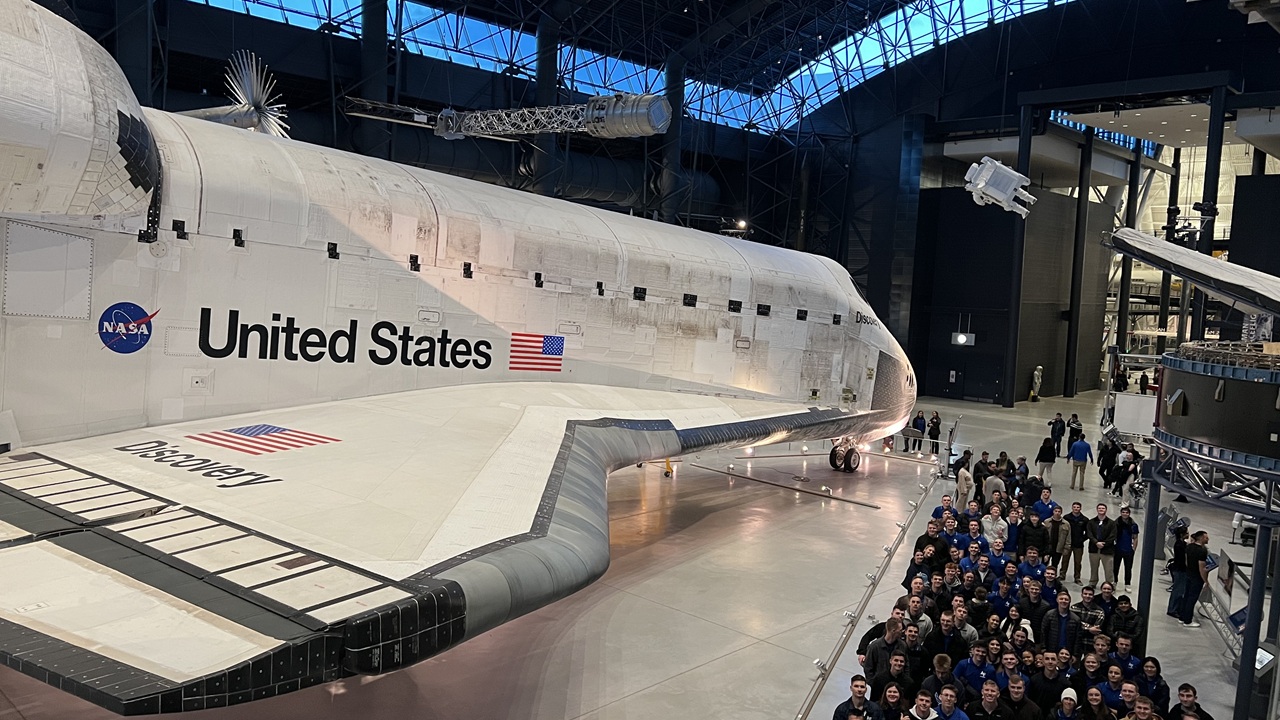
NASA has clarified that any attempt to move the Discovery space shuttle from Virginia to Texas could not involve its disassembly—more or less making the project impossible.
Texas lawmakers haven’t given up on seeing the Space Shuttle Discovery (OV-103) relocated from the Smithsonian National Air and Space Museum’s Steven F. Udvar Hazy Center in Chantilly, Virginia, where it has remained since 2012, to the Johnson Space Center in Houston, Texas.
Texas Republican Senator John Cornyn even praised the National Aeronautics and Space Administration (NASA) for announcing that it had accepted Requests for Proposals (RFPs) for moving the historic spacecraft to Houston.
However, Senator Cornyn may want to take another look at NASA’s specifications—notably the proviso that the shuttle can’t be dismantled in the process of transporting it.
“For assets of exceptional national significance, the Government may require intact transportation concepts that avoid disassembly, cutting, structural breakout, or permanent alteration of the item being transported,” the NASA RFP read.
NASA Just Made It Impossible to Move the Shuttle
In other words, NASA has committed to making any move utterly and completely impossible.
Last fall, NASA and the Smithsonian estimated that moving the Discovery across the country would cost at least $120 to $150 million, not including the cost of building a new exhibit in Houston. It also warned that the shuttle would need to be cut into pieces for transport—something that has never been undertaken. None of the four Space Shuttles were ever designed to be taken apart.
In December, NASA Administrator Jared Isaacman expressed skepticism that the shuttle could be moved to the Johnson Space Center—suggesting instead that “Space City” could receive a different vehicle from the US space program’s rich history.
NASA’s RFP says the federal government considers the Space Shuttle Discovery “an irreplaceable national artifact,” calling on potential contractors to explain how the Space Shuttle Discovery could be moved “intact without cutting, disassembly, or permanent structural alteration.”
Specifically, the transportation plan must provide an “intact route” for moving the orbiter—and show “how the proposed approach protects structural integrity, prevents transport-induced damage, and maintains strict control of load paths and environmental conditions throughout the movement.”
The “Keep the Shuttle” activist group in Virginia suggested that if the relocation were to go forward, it would “require a 25+ mile tow through Fairfax County and other parts of Northern Virginia to reach a navigable portion of the Potomac River, at which point the shuttle would be loaded onto a barge for a 2,000+ mile journey to Texas.”
In its current configuration, the shuttle measures 122 feet in length, 57 feet in height, and has a wingspan of 78 feet. Either it would need to be dismantled for transport, or—as Keep the Shuttle indicated—street signs and even trees along the route might need to be cut down.
The group further cited the 12-mile tow of the Space Shuttle Endeavor through Los Angeles in 2012, which required local support and resources.
A Simple Solution to Texas’ Space Shuttle Problem
Senator Cornyn and other lawmakers in the Lone Star State argue that Texas should have been the rightful home for one of the four orbiters that were retired in 2010, as Congress stated in the NASA Authorization Act of 2010 that the shuttles would only head to states with a “historical relationship with either the launch, flight operations, or processing of the Space Shuttle orbiters or the retrieval of NASA-manned space vehicles, or significant contributions to human space flight.”
Cornyn is among those critical of New York City receiving the Space Shuttle Enterprise (OV-101)—which, although it never went into space, was used for critical atmospheric approach and landing tests (ALT) in 1977 and validated the shuttle design. The Enterprise is now on display on a pier next to the retired aircraft carrier USS Intrepid (CV-111), enduring the Big Apple’s frigid winters. The famed museum received the OV-101 as it was found to offer a premier, high-visibility location to display the prototype orbiter in the Northeast.
The Space Shuttle Enterprise was replaced at the Smithsonian by the Space Shuttle Discovery.
Given that the test vehicle is already sitting next to the Hudson River—making water transport relatively straightforward—it does seem like a simple solution would be for Texas to argue that the Enterprise, rather than the Discovery, should be relocated to Space City. Perhaps as it becomes clear that moving OV-103 is impossible, Cornyn and other Lone Star State lawmakers will turn their efforts to OV-101 instead. Of course, the people of New York may disagree!
About the Author: Peter Suciu
Peter Suciu has contributed to dozens of newspapers, magazines and websites over a 30-year career in journalism. He regularly writes about military hardware, firearms history, cybersecurity, politics, and international affairs. Peter is also a contributing writer for Forbes and Clearance Jobs. He is based in Michigan. You can follow him on Twitter: @PeterSuciu. You can email the author: [email protected].