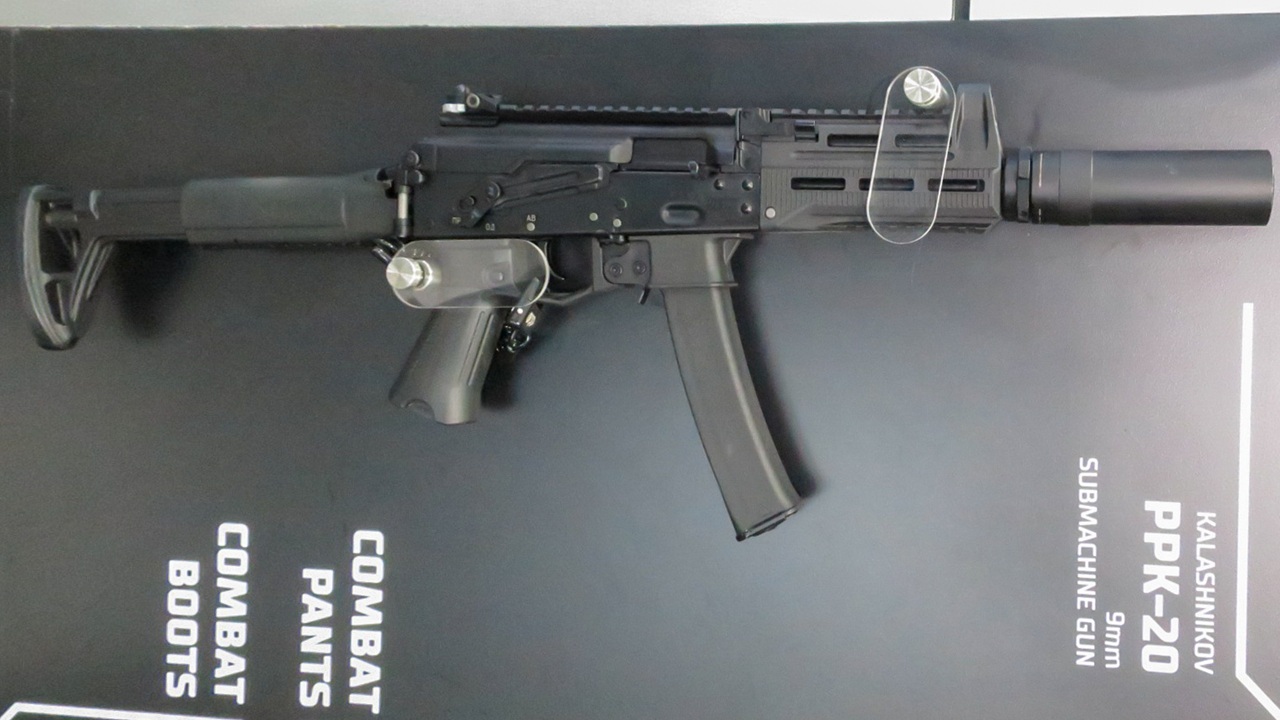
Unlike Bond’s weapon of choice, the Russian PPK-20 is a new submachine gun with an estimated firing rate of 800 rounds per minute.
The Kalashnikov Concern, the Russian state-owned arms conglomerate, has begun production of an upgraded model of its PPK-20. The firearm isn’t something that James Bond would probably carry; in fact, it has nothing to do with the Walther PPK handgun that the suave British secret agent made famous. Instead, the new gun is a compact submachine gun based on the Vityaz-SN, developed based on experience from the ongoing war in Ukraine.
“Kalashnikov has begun fulfilling its 2026 contractual obligations for the production of 9mm Kalashnikov PPK-20 submachine guns, upgraded based on its effective use in combat, including in the zone of the special military operation,” the Kalashnikov Concern said in a statement on the Telegram social messaging app, per TASS.
The company further stated that it had fulfilled its 2025 contracts, with the weapon now being supplied to Russian security agencies and for export.
The PPK-20 in the Crosshairs
The PPK-20, or Pistolet-Pulemyot Kalashnikova (“Kalashnikov’s Pistol-Submachine Gun”), is a straight blowback submachine gun that has an effective range of 50 to 100 meters, a practical rate of fire of 30 to 90 rounds per minute, and a cyclic rate of fire of 800 rounds per minute.
The new compact weapon can deliver fire in single- and auto-fire modes, and is equipped with a detachable sound/flame suppressor. The submachine gun is also outfitted with a right-side folding telescopic buttstock made of impact-resistant polymer. Scopes can be mounted on the PPK-20’s Picatinny rail on the dust cover, while other accessories can be attached to the Picatinny rails on the top and bottom of the handguard, as well as the M-LOK interface on the sides.
The SMG was further designed to utilize the special 9x19mm 7N21 high-impulse armor-piercing round, developed by the Central Research Institute of Precision Machine-Building (TsNIITochMash), a subsidiary of state tech corporation Rostec. The performance specifications of the new round suggest it could achieve a velocity of 480m/s with a bullet weight of 7g.
TsNIITochMash had previously developed a series of cartridges with high lethality. This ammunition included a 9x18mm SP7 cartridge with a plastic-core bullet and a 9x21mm SP12 round with a high-lethal-power bullet, adopted for service in Russia’s defense, security, and law-enforcement agencies.
The PPK-20 Submachine Gun’s Specifications
In addition to the 7N21 round, the PPK-20 can also fire most other 9x19mm Parabellum cartridges, the most common handgun cartridge in the world.
- Caliber: 9х19mm
- Weight (empty): 2.7kg (5.9 lb)
- Length:
- 600mm (23.6 in) with buttstock unfolded
- 475mm (18.7 in) with the buttstock folded, without suppressor
- Barrel Length: 181.5mm (7.14 in)
- Aiming range: 200 m (656 ft)
- Operation type: Straight blowback
- Fire modes: Single / full auto
- Rate of fire: ~800 rounds per minute
- Magazine Capacity: 30 rounds
- Muzzle Velocity (7N21): ~410 m/s (or up to 470 m/s in trials)
- Effective Range: Up to 200 meters
- Features: Picatinny rails, ambidextrous controls, folding adjustable stock, quick-detachable suppressor available, and designed for compactness.
Who Uses the PPK-20?
The exact units armed with the weapon haven’t been specified. Still, it is believed to include members of Spetsnaz, the SOBR (Spetsial’nyy Otryad Bystrogo Reagirovaniya, or Special Squad, Rapid Reaction) teams, as well as members of the Russian Federal Security Service (FSB)—the modern version of the former KGB.
So the PPK-20 isn’t something a tuxedo-wearing spy might carry—but it’s a more practical choice for a real-world special operator.
About the Author: Peter Suciu
Peter Suciu has contributed over 3,200 published pieces to more than four dozen magazines and websites over a 30-year career in journalism. He regularly writes about military hardware, firearms history, cybersecurity, politics, and international affairs. Peter is also a contributing writer for Forbes and Clearance Jobs. He is based in Michigan. You can follow him on Twitter: @PeterSuciu. You can email the author: [email protected].
Image: Wikimedia Commons / Mztourist.