
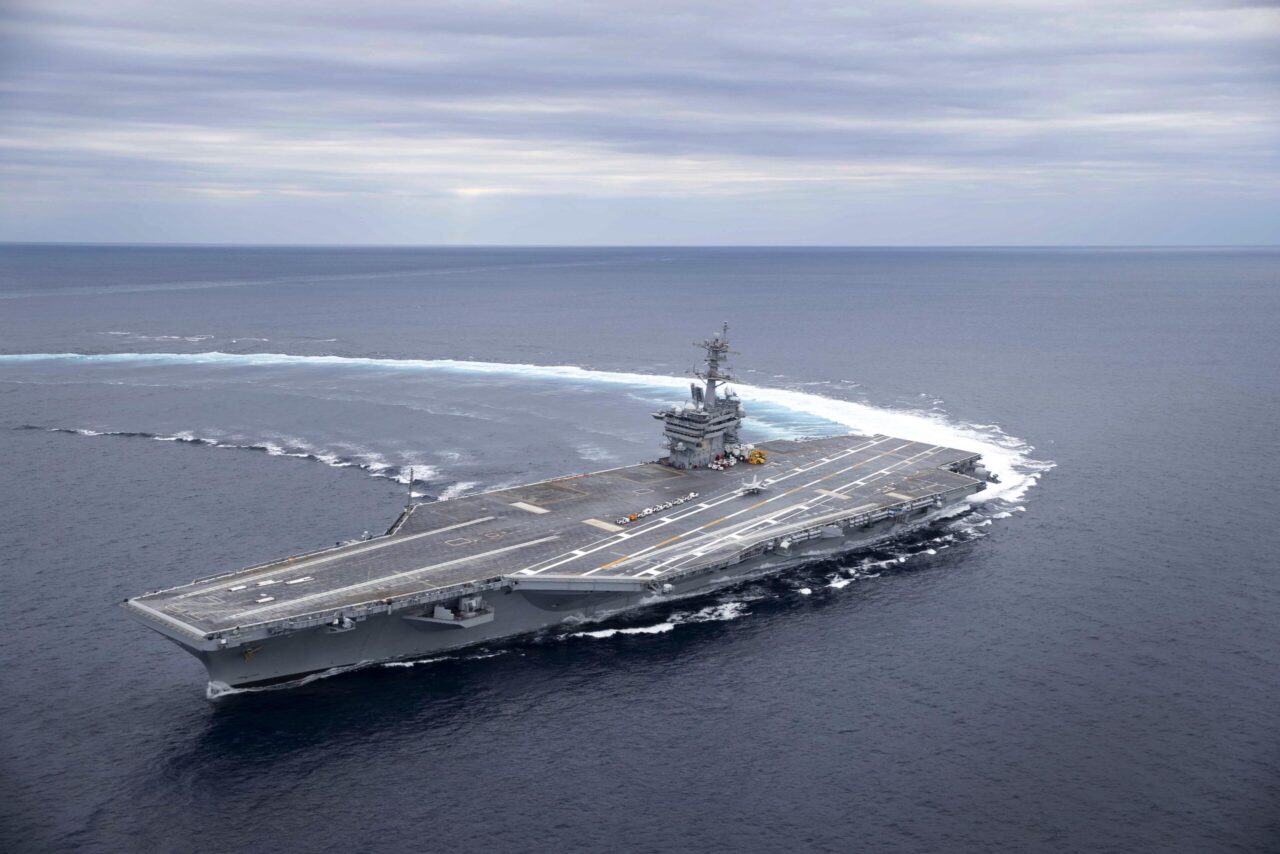
USS Abraham Lincoln serves as the flagship of Carrier Strike Group Three with Carrier Air Wing Nine.
Last week, the USS Abraham Lincoln aircraft carrier was spotted leaving San Diego for a scheduled deployment. Former Vice President Mike Pence took to X this morning to wish those aboard the Nimitz-class supercarrier good luck: “God Bless the @USNavy Officers, Naval Aviators and Sailors aboard the USS Abraham Lincoln @CVN_72, Fair Winds and Following Seas! Our Prayers Go With You.”
Last December, the Lincoln Carrier Strike Group returned to its homeport in San Diego after spending five months out at sea, which included combat operations in the Middle East. As of this month, the USS George Washington and the USS Nimitz remain deployed in the Western Pacific while the USS Gerald R. Ford is operating in the Caribbean Sea.
About the USS Abraham Lincoln
- Year Commissioned: 1989
- Number Built: 1
- Length: Overall: 1,092 ft (332.8 m) Waterline: 1,040 ft (317.0 m)
- Beam (Width): Overall: 252 ft (76.8 m)
- Displacement: 104,300 long tons (116,800 short tons)
- Engines: Two Westinghouse A4W nuclear reactors, four steam turbines, four shafts
- Top Speed: Over 30 knots
- Range: Unlimited distance; 20-25 years
- Armaments: Two Mk 57 Mod 3 Sea Sparrow, two RIM-116 Rolling Airframe Missile, two Phalanx CIWS
- Crew: 90 fixed-wing and helicopters; ~5,000-6,000 overall crew size
USS Abraham Lincoln serves as the flagship of Carrier Strike Group (CSG) Three with Carrier Air Wing Nine. The Arleigh Burke-class destroyers USS O’Kane, USS Spruance, and USS Frank E. Peterson Jr. are deployed as part of the CSG.
As a Nimitz-class supercarrier, Abraham Lincoln plays a leading role in the US Navy’s power projection strategy at sea. The behemoth of a carrier hosts cutting-edge capabilities, including the addition of a steam catapult that enables aircraft to launch over the carrier’s short flight deck. As explained by Popular Mechanics, “Steam is diverted from the ship’s boilers—steam boilers powered by the ship’s nuclear reactors—and piped up to just under the flight deck, where it is held and pressurized in special tanks. In the meantime, the front landing gear of a carrier aircraft is loaded onto a small, plate-sized shuttle. When the aircraft is ready for launch, the steam is suddenly released and, in a burst of power, accelerates the shuttle—and attached aircraft—down the flight deck to takeoff speeds.”
In total, the Abraham Lincoln and its sister Nimitz ships can lug around 60 airframes, including a combination of both fixed-wing and rotary-wing aircraft.
In terms of radars and sensors, the Lincoln and the rest of the Nimitz ships are set to be upgraded with the new SPY-6 shipborne radar in 2026.
While the Nimitz warships remain key players in the US military’s deterrence strategy, the Navy’s incoming Ford-class carriers are considered to be even more advanced. The sole commissioned Ford-class carrier, USS Gerald R. Ford, will be joined by the USS John F. Kennedy by the end of the decade.
About the Author: Maya Carlin
Maya Carlin, national security writer with The National Interest, is an analyst with the Center for Security Policy and a former Anna Sobol Levy Fellow at IDC Herzliya in Israel. She has over 1,000 articles published over the last several years on various defense issues. Carlin has bylines in many publications, including The National Interest, Jerusalem Post, and Times of Israel. You can follow her on Twitter: @MayaCarlin.
Image: Wikimedia Commons.
















#/media/File:USS_Abraham_Lincoln_(CVN-72)_underway_during_sea_trials_on_11_May_2017.jpg)