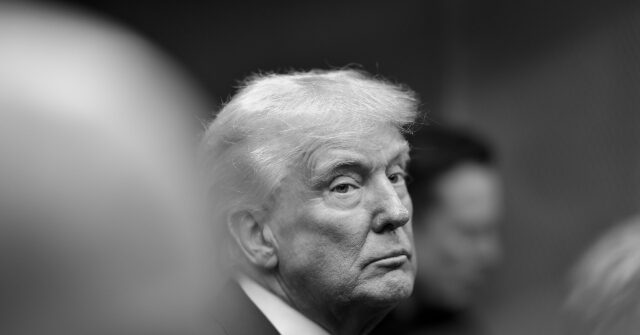
Israel’s Knesset Speaker Amir Ohana and House Speaker Mike Johnson on Tuesday unveiled what they called a first-of-its-kind global parliamentary bid to nominate President Donald J. Trump for the 2026 Nobel Peace Prize, declaring that “no one has ever deserved that honor more” and that “no person in the world has done more for peace over the past year.”
Meeting at the U.S. Capitol, Johnson hosted Ohana for a bilateral session in which the two speakers signed a formal letter to the Norwegian Nobel Committee and launched an effort to rally speakers and presidents of parliaments worldwide to join the nomination. House Majority Leader Steve Scalise also took part in the meeting.
In a press release announcing the move, Johnson said that by restoring the American doctrine of “peace through strength,” President Trump “made history by ending conflicts and encouraging order around the globe,” insisting that “no one has ever deserved that honor more.”
Ohana, calling the initiative “a cause that is just, moral, and as right as any can be,” said there is “not a single person in the world who has done more for peace over the past year than President Trump, and no one more deserving of recognition for the efforts and the results that have saved the lives of so many people around the world, including in Israel.”
The joint letter — addressed to the Nobel Committee in Oslo and signed by Johnson and Ohana as speakers of the U.S. House of Representatives and the Israeli Knesset — presents Trump as “an extraordinary leader whose pursuit of peace has changed the world,” and stresses that, for the first time in modern history, parliamentary leaders are uniting “in one voice” behind his candidacy.
The pair says they will now circulate the text globally and invite counterparts to add their signatures ahead of the January 31, 2026, nomination deadline.
Laying out the case, the letter cites eight specific diplomatic achievements it credits to Trump: his 20-Point Peace Plan for Gaza; the Abraham Accords; a ceasefire between India and Pakistan; a truce and peace agreement between Thailand and Cambodia; reconciliation between the Democratic Republic of the Congo and Rwanda; a peace agreement between Azerbaijan and Armenia; economic normalization between Serbia and Kosovo; and Trump’s role in easing tensions between Egypt and Ethiopia.
The document says this record reflects “exceptional statesmanship and uncommon courage in confronting long-standing hostilities with vision, creativity, and resolve.”
The speakers argue that Trump’s mediation has “changed the world” by bringing an end to bloody conflicts in “no fewer than eight regions” and by securing the return of all living hostages from Hamas captivity as part of his Gaza framework — an achievement Johnson has described as a “historic moment” that “deserves enormous credit and recognition on the world stage.”
In the letter, they contend that under the Nobel’s founding principles, “no individual did more to advance peace in 2025 than President Trump,” and that “few, if any, have done more in history to advance the cause of peace — and none are more worthy of this honor.”
Johnson framed the new push as the continuation of an effort he and Ohana first announced in mid-October, when the Israeli speaker told Trump in a special Knesset session that he would work with the House speaker to rally parliaments around the world behind a Nobel bid, declaring, “President Trump, you are the President of Peace.”
At the time, Johnson told reporters in Washington that “no one has ever deserved that prize more,” vowing to coordinate a broad international campaign among his counterparts.
The October appeals from civil society and political leaders set the early stage.
On October 6, families of Israeli hostages — together with relatives of those already returned — wrote to the Norwegian Nobel Committee “with momentous urgency,” urging it to award President Trump the Peace Prize and crediting his diplomacy with making possible what “many said was impossible.”
Days later, on October 9, world leaders, lawmakers, and public figures amplified the push in a separate appeal, arguing that “no leader has done more for peace” and warning that if Trump did not receive the prize, “no one deserves it.”
Those letters landed in the final days before the committee made its decision.
At that point, Trump’s Gaza framework was still being finalized, and the last hostages remained in Hamas captivity.
In the weeks that followed, that framework was implemented: all remaining living hostages held in Gaza were brought home, and — under the ceasefire and hostage-exchange arrangement — all known bodies but one were returned, as part of what officials in Jerusalem and Washington have described as a broader effort to end the war and lock in a more stable regional architecture.
With Phase One now essentially complete — short of the single remaining body still held in Gaza — officials say the process is shifting toward Phase Two of Trump’s 20-Point Peace Plan, with Prime Minister Benjamin Netanyahu scheduled to meet President Trump on December 29 to discuss the transition and outline the next steps.
On October 10, however, the Nobel Committee announced that it would award the 2025 peace prize to Venezuelan opposition leader María Corina Machado, a move widely seen in Israel as a snub of Trump’s record and of the appeals filed in the days prior.
Within hours of the Oslo decision, Israel Prize laureate Ronny Douek moved on a different track, formally nominating Trump for the Israel Prize for Lifetime Achievement and Special Contribution to Society and the State — the country’s highest civilian honor, often described as its “Israeli Nobel.”
In his nomination, Douek pointed to Trump’s then-ongoing efforts to secure the return of the hostages and bring the Gaza war to an end “in a way that will guarantee security and stability for Israel,” even as the captives were still being held, and urged Israel to honor him on the upcoming Independence Day.
He framed the case broadly, arguing that Trump “acted with great determination, courage, and a deep love for the people of Israel,” that he “paved a new path of hope and regional partnership,” and that thanks to his direct leadership, historic peace agreements were achieved, Israel’s security interests were preserved, and “genuine hope for a better future” was established.
Douek’s letter also pointed back to first-term milestones that, in his view, set the stage: U.S. recognition of Jerusalem as Israel’s capital and the 2018 embassy move; recognition of Israeli sovereignty over the Golan Heights in 2019; and the U.S.-brokered Abraham Accords, later joined by additional Arab states.
Taken together with Trump’s current diplomacy, he argued, that record makes the Israel Prize the natural venue to recognize a leader he called “more committed than any other in our generation” to Israel’s security and to peace in the region.
The Nobel panel has stood by its choice of Machado, citing her struggle to restore democracy in Venezuela.
But Johnson and Ohana say the coming year offers the committee a fresh opportunity — and that Trump’s record over the past year alone, capped by the hostage deal and Gaza framework, fits Alfred Nobel’s mandate to recognize those who have done “the most or the best work” to advance peace and fraternity between nations.
Their new parliamentary campaign is explicitly designed to put that question back on the committee’s desk for 2026.
Meanwhile, recognition of Trump’s peacemaking has broadened well beyond the Nobel track.
On Friday, FIFA President Gianni Infantino awarded Trump the inaugural FIFA Peace Prize at the 2026 World Cup draw in Washington, calling him a leader whose “exceptional and extraordinary actions” have promoted peace and unity across the globe — from Rwanda and the Democratic Republic of the Congo to India and Pakistan — and reading a citation crediting him with making “the world a safer place.”
Trump, calling the honor “truly one of the great honors of my life,” said that “beyond the awards … we saved millions and millions of lives.”
For now, Johnson and Ohana say their immediate goal is to convert what has been a patchwork of letters, endorsements, and symbolic honors into a single, coordinated parliamentary effort — one that, in their words, reflects “deep respect and sincere regard” for a president they present as uniquely responsible for “a monumental stride toward the realization of peace in our time,” and that will test whether the Nobel institution is prepared to follow suit.
Joshua Klein is a reporter for Breitbart News. Email him at jklein@breitbart.com. Follow him on Twitter @JoshuaKlein.