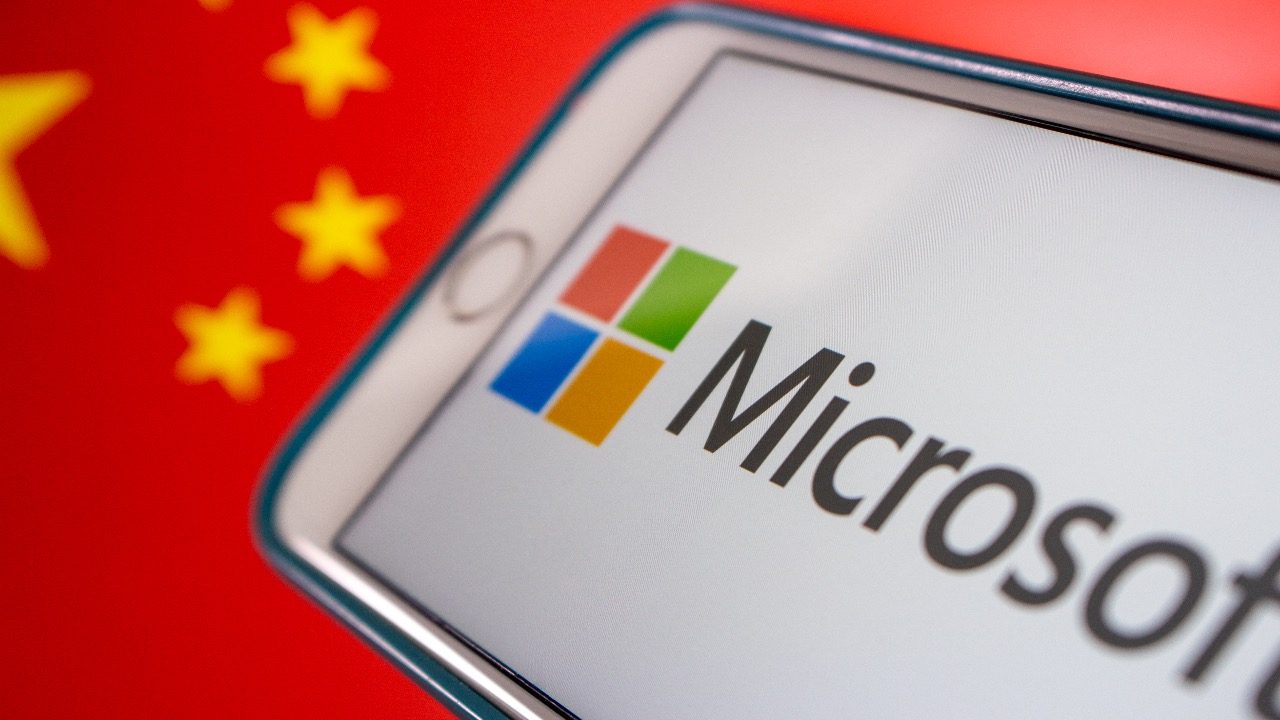
The US government should take stronger action to untangle big tech firms —including Microsoft—from decades of China ties that now pose national security risks.
A new report has been released highlighting Microsoft’s close relationship with the government of the People’s Republic of China (PRC). The report from Horizon Advisory comes after a bevy of reporting and news items have revealed the depth of Microsoft’s Chinese integration. The most notable of these was a series of ProPublica pieces that revealed that Microsoft had failed to tell the Pentagon that it had let China-based engineers “work on highly sensitive department systems.”
These reports come on the heels of other reports, articles, and books that have shed light on how closely entangled most American tech companies are with the PRC. Apple was the target of Patrick McGee’s “Apple in China,” which highlighted how Apple has pumped hundreds of billions of dollars—not to mention technical know-how—into China’s economy. And chip manufacturer Nvidia’s need for Chinese customers was made readily apparent by their fervent opposition to the Guaranteeing Access and Innovation for National Artificial Intelligence Act (GAIN AI Act), which would have forced them to sell to American companies first.
But Microsoft’s collaboration, as per the report, is deeper than was previously publicly known. The company’s“partnerships, joint ventures, and broader web of partners” have worked to aid the PRC’s police state, both in surveilling its people and in artificial intelligence (AI) development. Microsoft’s granting of “visibility” into the inner workings of its technologies has even aided Chinese hacking into American governmental agencies and operations.
How US Tech Companies Became Entangled with China
One can, on some level, sympathize with these companies. After all, they were, for decades, encouraged to integrate with China’s economy by American policy analysts and politicians. Scholars in the late 1990s were writing about how it was a practical certainty that China would democratize. One, in 1999, wrote that it would “remain relatively poor and authoritarian, or it will become rich and pluralistic,” and that to him, it apparently had “chosen the latter path.” Just two years later, in an effort to make this dream a reality, President George W. Bush granted permanent trade status to the PRC, in a move which the White House described as “welcoming China into a global, rules-based trading system.”
The dream, of course, did not come true. Thanks to foreign investment and the relocation of entire swaths of industry, China became rich and remained authoritarian, even more so under President Xi Jinping.
The United States government, however, was slow to recognize this reality. Private industry has been sluggish as well, and while it may be painful for them, the United States government needs to help them understand what time it is. After all, President Donald Trump has made opposing China—or at least restructuring America’s economy to not be so dependent upon them—a top priority ever since he announced his first presidential run over ten years ago. His first term was a constant stream of pushback on Beijing, from encouraging European allies not to include Huawei products in communications equipment to tariffs on key industries. These concerns have been bipartisan: while former President Joe Biden lambasted most of President Trump’s tariffs, he kept the duties on Chinese imports.
The Tech Sector Still Hasn’t Adjusted to the New China Reality
But companies like Microsoft, Apple, Nvidia, and others still do not get it. Nvidia’s statements opposing the GAIN AI Act argued that, while they sold chips to China, they, of course, always tried to sell them to Americans too. And Microsoft’s statement in response to ProPublica’s report was just that they “remain committed to providing the most secure services possible to the US government,” without delving into why they used China-based engineers in the first place.
It is past time for these companies to choose a side—and the United States government should help them make their choice.
What the US Government Should Do Next to Support Decoupling
The Trump administration is currently negotiating with China to end the long-running trade war between the two countries. This is a noble effort and should be pursued; though tariffs on China should remain, as it would be beneficial for both if the ongoing volatility were to cease. Legislation such as the GAIN AI Act—which has been tragically cut from the must-pass National Defense Authorization Act—should be passed to force recalcitrant companies to restrict sales to China.
On its end, the federal government should message against Chinese integration (as it once did in support of it) and should make clear that companies need to start decoupling, or at least need to stop the sort of “integration” companies such as Microsoft undertook. It should also encourage more investment and ensure that investment which has already been promised is actually undertaken by those companies, and does not end up as empty promises.
They should also punish companies that obfuscate their China connections. Microsoft claims it has changed from using China-based engineers. However, if this turns out not to be the case, or there are other duplicitous activities on Microsoft’s end, the Pentagon should contract with other companies instead.
Companies should be given time to decouple, of course. You cannot pull the ripcord on decades of integration in the span of a year or two. After all, the United States navigated the Cold War through careful planning and methodical action. America and America’s companies—including Microsoft—should walk the same path here.
But by the end of President Trump’s term, it should be clear that the path has been started on.
About the Author: Anthony J. Constantini
Anthony J. Constantini is a policy analyst at the Bull Moose Project and the Foreign Affairs editor at Upward News. His work has appeared in a variety of domestic and international publications.
Image: Koshiro K/shutterstock