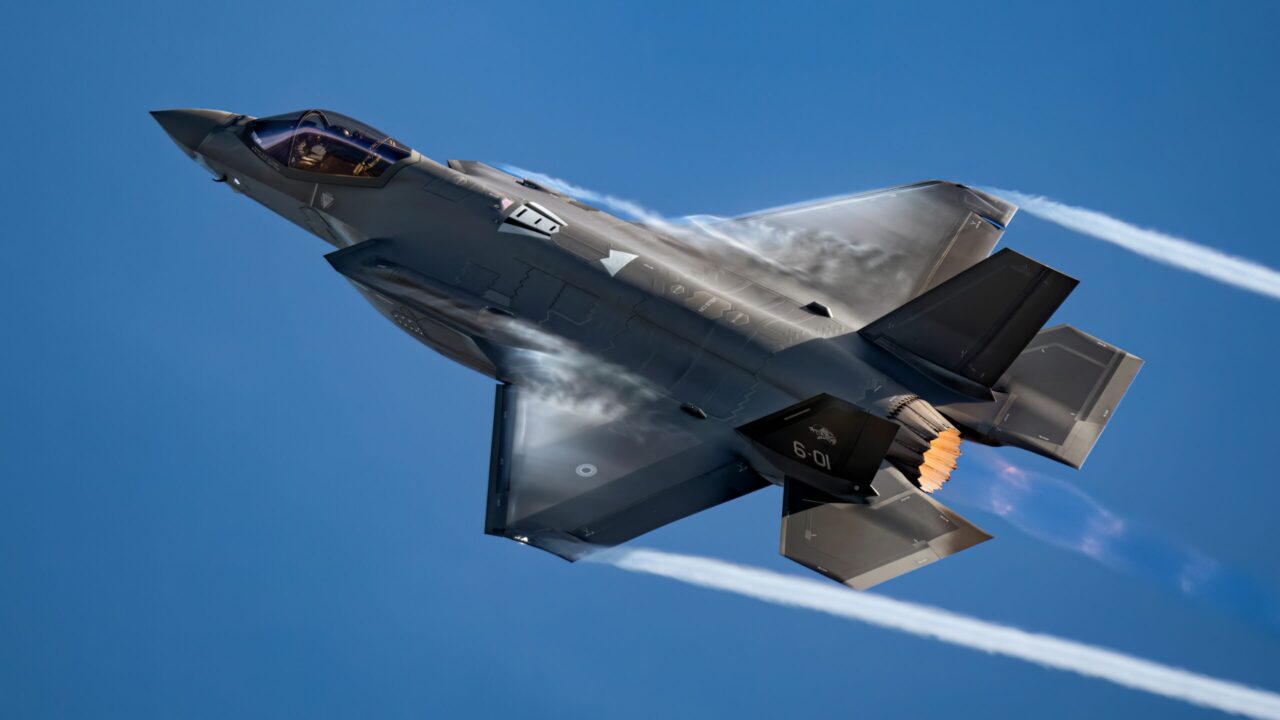
The Meteor is an advanced beyond-visual-range air-to-air missile with a range of 60 miles.
The F-35A Lightning II achieved an important milestone in increasing its lethality.
On December 3, Lockheed Martin, F-35 Joint Program Office, and MBDA completed the successful testing of the Meteor air-to-air missile on the F-35A fighter jet.
Meteor on the F-35A Lightning II
There is one ground test remaining before Lockheed Martin gives clearance to start flight testing.
The F-35 Joint Program Office released pictures of the Meteor integration with the F-35A, showing the air-to-air munition inside the stealth fighter jet’s internal weapons bay.
“The F-35’s sensor suite, coupled with Meteor’s kinematics, will give the UK and Italian operator the operational advantage they expect from their choice of weapon system,” the F-35 Joint Program Office said.
Developed by MBDA, the Meteor is an advanced beyond-visual-range air-to-air missile. It weighs around 400 pounds, has a range of 60 miles, and a top speed of 3,000 miles per hour. The European-made missile has one of the largest no-escape zones in the market, meaning that an enemy aircraft will have a pretty hard time evading an incoming Meteor that is flying at more than 3,000 miles per hour.
The Meteor is similar to the US-made AIM-120 Advanced Medium-Range Air-to-Air Missile (AMRAAM).
These recent developments on the F-35A and the Meteor come in the wake of the Royal Air Force’s announcement earlier in 2025 about the successful integration of the Meteor munition to the F-35B.
The Royal Air Force and Royal Navy jointly operate the F-35B, and the British military expects to add a limited number of F-35As in the future.
The F-35: Many Weapons for Many Missions
There are a couple of reasons why the F-35 needs to be able to carry a large variety of weapon systems.
First, the stealth fighter jet is an international aircraft. As of December, 20 countries from around the world operate or have ordered the F-35. Many of these countries have strong defense industries of their own, or their current fighter jet fleets operate US and non-US weapon systems. Thus, by making the F-35 compatible with a large gamut of weapon systems, Lockheed Martin increases its marketability.
The second reason has to do with the fifth-generation aircraft’s operational capabilities. In many ways, the F-35 is three aircraft in one. Lockheed Martin designed the stealth fighter jet to be able to competently conduct the following mission sets: strategic attack; air superiority; close air support; electronic warfare; intelligence, surveillance, and reconnaissance; suppression of enemy air defenses; and destruction of enemy air defense. To be able to do so many different mission sets, the F-35 needs to be able to carry a lot of different weapon systems.
Normally, it would take more than one type of aircraft to cover all these mission sets. For example, the A-10 Thunderbolt II specializes in close air support, while the F-22 Raptor specializes in air superiority, and the EA-18G Growler specializes in electronic warfare. But the F-35 can do the job of all three aircraft (even though not necessarily with the exact same effectiveness), thus reducing the need for three different platforms with separate maintenance and logistical needs.
About the Author: Stavros Atlamazoglou
Stavros Atlamazoglou is a seasoned defense journalist specializing in special operations and a Hellenic Army veteran (national service with the 575th Marine Battalion and Army HQ). He holds a BA from the Johns Hopkins University and an MA from the Johns Hopkins’ School of Advanced International Studies (SAIS). His work has been featured in Business Insider, Sandboxx, and SOFREP.
Image: Shutterstock.com / Maciej Kopaniecki.