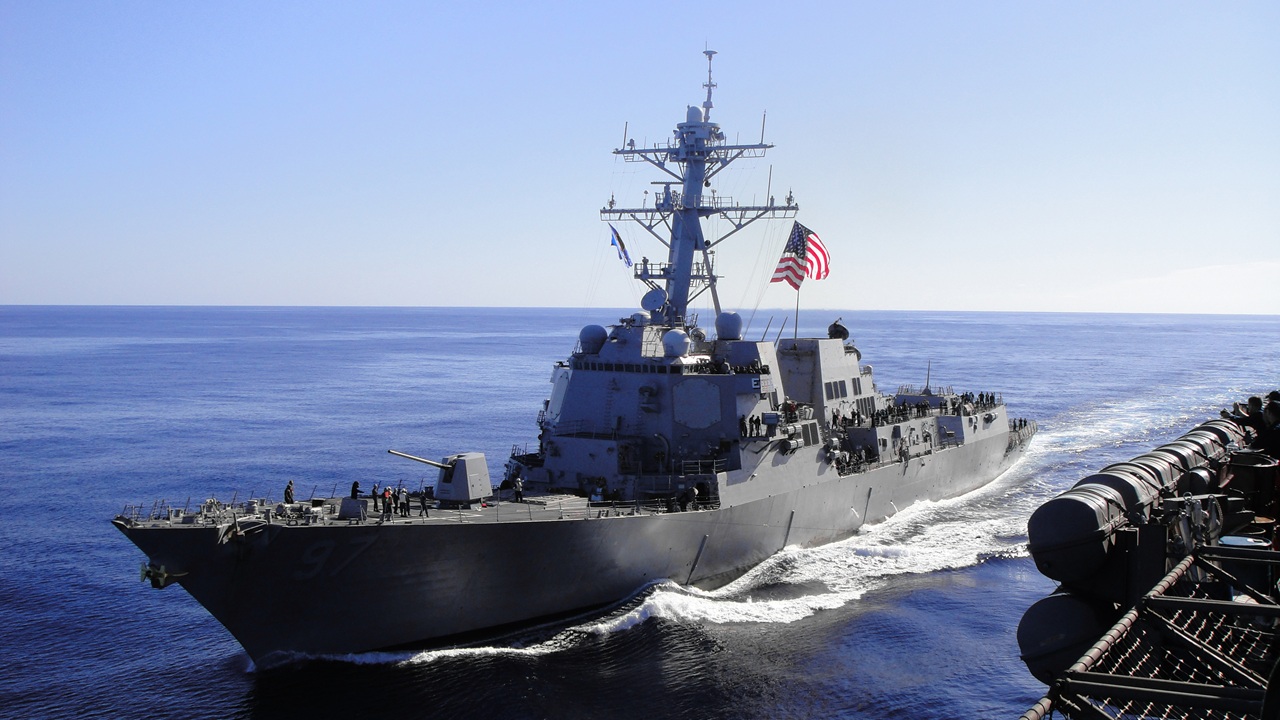
The Navy’s effort to build more manned ships is laudable, but mistaken. Instead, it should focus on the ability to dominate every prospective combat zone through autonomous warfare.
When I warned in 2022 that the US Navy was broken, it was not rhetorical flourish. The institution was structurally compromised. The people were exhausted, the ships were aging faster than they could be repaired, and the fleet’s readiness was slipping away. Three years later, the evidence is even clearer.
The Navy has not recovered. If anything, its fractures have deepened. Yet at the same time, the outline of a different Navy, one that could dominate the future fight, has begun to take shape. The service is still broken, and the urgency to pivot has only grown. Fortunately, with a new Chief of Naval Operations (CNO), the Navy has an opportunity to carve a new path forward, one based upon dominating the Seven Seas all at once.
How the Navy Went Wrong
To understand why the Navy is still in this position, begin with the decades of deferred readiness and overstretched resources. The United States has continued to demand more from the fleet than its budget, industrial base, and maintenance pipeline will support. The result is a Navy sailing too many old hulls, fighting through chronic maintenance delays, and struggling to generate ready forces at scale.
Layered on top of this is a pattern of acquisition failure. The Navy has cycled through transformational ideas that never became real programs and pursued fixes in shipbuilding that never solved the underlying engineering or industrial problems. It has continued to rely on legacy platforms that absorb resources without delivering the leap in capability that the threat now requires. Meanwhile, the personnel system remains stressed. Long deployments and heavy operational tempo have burned out sailors and strained a manning system already under pressure. A fully ready force cannot respond rapidly to simultaneous crises if its people lack rest and its ships lack depth.
The problems identified in 2022 have not been corrected. They have calcified.
In March of this year, I argued for a true 180-degree pivot. That pivot requires autonomy, AI, mass production, distributed lethality, and a move toward smaller, more numerous vessels that operate as a connected force. The US Army, under Secretary Driscoll, has since demonstrated what such a pivot looks like. It cancelled legacy programs, reshaped its aviation portfolio, committed to building one million drones, and demolished its bureaucracy so that innovation could move. The Navy should adopt the same playbook and move with speed.
Some argue that such a pivot is unnecessary. Steven Wills points to a future carrier air wing with 60 percent unmanned aircraft by 2040. A quick look at the math reveals the flaw in this argument. Eleven carriers, roughly 75 aircraft per ship, and a 15-year window translates into 33 unmanned aircraft per year. That is not transformation. Rebecca Grant argues that the FA-XX offers the needed breakthrough, since it provides 25 percent more range. Given its cost, its schedule, and its tight linkage to the current carrier system, the FA-XX does not transform the Navy. It locks the service into the past. The FA-XX is fundamentally an anti-transformation system.
At the same time, the Navy’s shipbuilding challenges continue. The service recently cancelled the Constellation-class frigate program, putting an entire production facility at risk. This follows the termination of the Littoral Combat Ship (LCS) program. The trend line is unmistakable. The Navy cannot escape its problems without a major strategic shift.
The Navy Has the Right Mindset—Now It Needs a New Strategy
The new administration is now one year old and it has proven that it is willing to take enormous risks to transform the military. What is missing for the Navy is an underlying strategy to build towards. As the saying goes, if you do not know where you are going, any road will get you there.
As such, the new CNO should pivot Trump’s strategy and declare that the Navy will dominate the Seven Seas all at once. This means walking away from the one-war strategy or pivoting to the Pacific. The Navy will scale up and become the global guarantors of the waters of the world. This pivot is possible now for several reasons.
The first is technological. Unmanned systems, AI, and autonomous surface and subsurface vessels have advanced at high speed. These systems offer both qualitative and quantitative advantage if the Navy chooses to adopt them quickly. Incremental repairs cannot keep pace with digital acceleration.
The second is industrial. The traditional acquisition and shipbuilding model remains expensive, slow, and vulnerable to concurrency failures. A move toward modular, scalable, unmanned platforms combined with an investment that transforms shipyards into factories for autonomous systems is the only viable path to real growth in fleet capacity.
Finally, the political environment has shifted. Nearly a year has passed since this administration began its stewardship of the Navy. The Department of Defense, through the drone memo and acquisition reform, has shown that it is invested in real change. Additionally, Congress has expressed a willingness to bankroll this new technology. Money and authority go a long way to enabling change.
Therefore, the Chief of Naval Operations and the Secretary of the Navy should abandon the current shipbuilding plan and redefine naval power. Naval power is not a 355-ship fleet. It is not carriers that take decades to build and require large strike groups to protect them. Naval power is the ability to dominate all seven seas at the same time through large numbers of autonomous vessels that are small, modular, networked, and rapidly produced. Such a force provides flexibility, redundancy, and distributed lethality.
To achieve this, the Navy’s strategy must shift. Navy leadership has the inherent authority to make this strategic pivot. The “Seven Seas at Once” strategy could be declared today with a stated goal to be ready to be executed by 2029 which is the end of the new CNOs term. The service must go big and go fast. The nation does not need the “one short war” Navy that the Biden administration envisioned. Inherent in the notion of peace through strength is a fleet capable of dominating the entire maritime battlespace. The Navy should take note.
About the Author: John Ferrari
Maj. Gen. John G. Ferrari is a nonresident senior fellow at the American Enterprise Institute. Over his 32-year US Army career, Ferrari, who is now retired, served as the director of program analysis and evaluation, the commanding general of the White Sands Missile Range, and a deputy commander for programs at the NATO Training Mission in Afghanistan. He has an MBA in finance and strategic management from the Wharton School at the University of Pennsylvania, an MA in national resource strategy and policy from the Industrial College of the Armed Forces (now called the Eisenhower School for National Security and Resource Strategy), and a BS in computer science from the United States Military Academy at West Point.
Image: Shutterstock / Photos_Footage_11111.