There is something about the Feast of St. Andrew that uplifts my heart every year. Perhaps it is simply because this feast day marks the commencement of the Advent season, more or less—not necessarily beginning on the first day of Advent (as it does this year), but always kicking off the first day of the twenty-five-day “Christmas Novena.” The season of joy has begun!
Of course, other than the fact that St. Andrew’s feast day happens to land twenty-five days before Christmas, there is really nothing linking him to the feast of Our Savior’s birth, per se. One could argue that it would make more sense to begin the Christmas Novena on December 8, the Feast of the Immaculate Conception. As great an idea as we might think that would be, it is not what has come to pass. St. Andrew is the one who spearheads this novena; he is the first to point the way to Jesus in the manger. So let’s see if we can understand just what makes this Apostle—who is only briefly mentioned throughout the Gospels—merit the honor.
The synoptic Gospels basically lump Andrew and Peter in the same category of “fishermen” who drop their nets and follow Jesus; Luke’s Gospel does not mention the call of Andrew in any specific way at all. For the synoptics, the important point to note is that Peter, James, and John were called in succession—the three members of Jesus’ “inner circle.” But if we look at John’s account of what has taken place, we see that there is more to the story:
As [John the Baptist] watched Jesus walk by he said, “Behold, the Lamb of God.” …Andrew, the brother of Simon Peter, was one of the two who heard John and followed Jesus. He first found his own brother Simon and told him, “We have found the Messiah” …Then he brought him to Jesus. (Jn. 1:36-40)
In John’s account, there are two disciples of John the Baptist who witness their teacher announce that Jesus is the One for whom he had been preparing the world; at this, these two disciples drop everything and instantly follow Jesus. They have not been verbally summoned by the Lord, nor have they been expressly sent by John the Baptist; they simply know in their hearts what they now must do. There is no debating, deliberating, weighing options, or even taking the time to pack and to say goodbye to family and friends.
Why not? For Andrew and this other unnamed disciple, they have already done this. Their time spent in the wilderness listening to and learning from their teacher, John the Baptist, has been one, lengthy exercise in preparation. These are men who have been baptized with water and who have spent their days in prayerful silence, asking God, “What does this mean?” They have received their answer in the temple of their hearts, and so on the day that John the Baptist points to Jesus, Andrew and his companion would not have blindly followed without having been invited by the Master.
And yet, they would have recognized Jesus the moment they laid eyes on Him; John’s words and pointed finger would have only confirmed for them what they had already known in their hearts to be true. God had answered their prayer long before, and so when the moment came, they would have been able to follow in haste and without hesitation. Like Mary, their obedience would have been carried out with eager anticipation; their hearts would have been bursting with joy! They did not need a verbal command or an invitation because God had already invited them, as well as sent them, in the silence of their hearts.
This is certainly a lot of extrapolating from these few short verses! How do we know that the synoptic Gospels are not the more “accurate” accounts—that is to say, the ones which remembered the series of events more precisely? Because Matthew, Mark, and Luke would not have “remembered” the events—they would have recorded them, as told to them by others.
But in terms of historical accuracy, the most qualified person to record a description of an event is the one who was personally there to witness it. Which is precisely why the Church traditionally ascribes the unnamed disciple who was standing by Andrew’s side to none other than the one who wrote the Gospel account himself: John the Evangelist. John the Beloved, in his humility, who so often refers to himself as “the one whom Jesus loved” or “the other disciple,” attributes no credit to himself for being the first disciple to come to Jesus. And so, that honor has forever been recorded as going to Andrew.
And herein lies the reason that our largely unnoticed beloved disciple Andrew is just so dear to our Church. Without Andrew’s time of preparation in the wilderness, Peter, our leader of the Church, may never have had eyes to recognize the One for whom he would one day give his whole life. Perhaps this is why we love his baby brother Andrew so much. Most of us are not called to be a St. Peter or a St. Paul. We are weak, poor souls, and we just do not have it in us to aspire to such a lofty goal. But there is something we can all do.
We can acknowledge our weaknesses and remain snuggled up next to Jesus, asking Him to help us always seek His hand of divine providence in our lives and in the lives of those around us, that we, in turn, may help others find their way to His embrace. Those saints-in-the-making need us! They rely on us to “be still,” remaining in our little prayer corners, knowing that God “is who is” (St. Catherine of Siena). It is our humble trust that welcomes the grace of conversion in the hearts of those who have been chosen for great work in God’s plan of salvation! It is our “hiddenness” that is quiet enough to notice who needs help and to recognize which “diamond in the rough” is in reality a St. Peter or a St. Paul in disguise.
Let us, then, be grateful for the example we have in our dear St. Andrew. Let us aspire to be just like him! And in this coming season of joy, let us prepare our hearts by bringing our thoughts to Jesus in the manger, the One who both invites us to nestle with Him in the stable, and who then sends us out to bring His light to a cold, dark world in need of His mercy.
Christmas Novena
Hail and blessed be the hour and moment in which the Son of God was born of the most pure Virgin Mary, at midnight, in Bethlehem, in the piercing cold. In that hour vouchsafe, I beseech Thee, O my God, to hear my prayer and grant my desires through the merits of Our Savior Jesus Christ, and of His blessed Mother. Amen.
Author’s Note: Excerpt from: The Safe Haven: Scriptural Reflections for the Heart and Home (Ordinary Time Weeks 29-34). To purchase, visit Amazon or The Catholic Company, where all other volumes currently in print are also available.
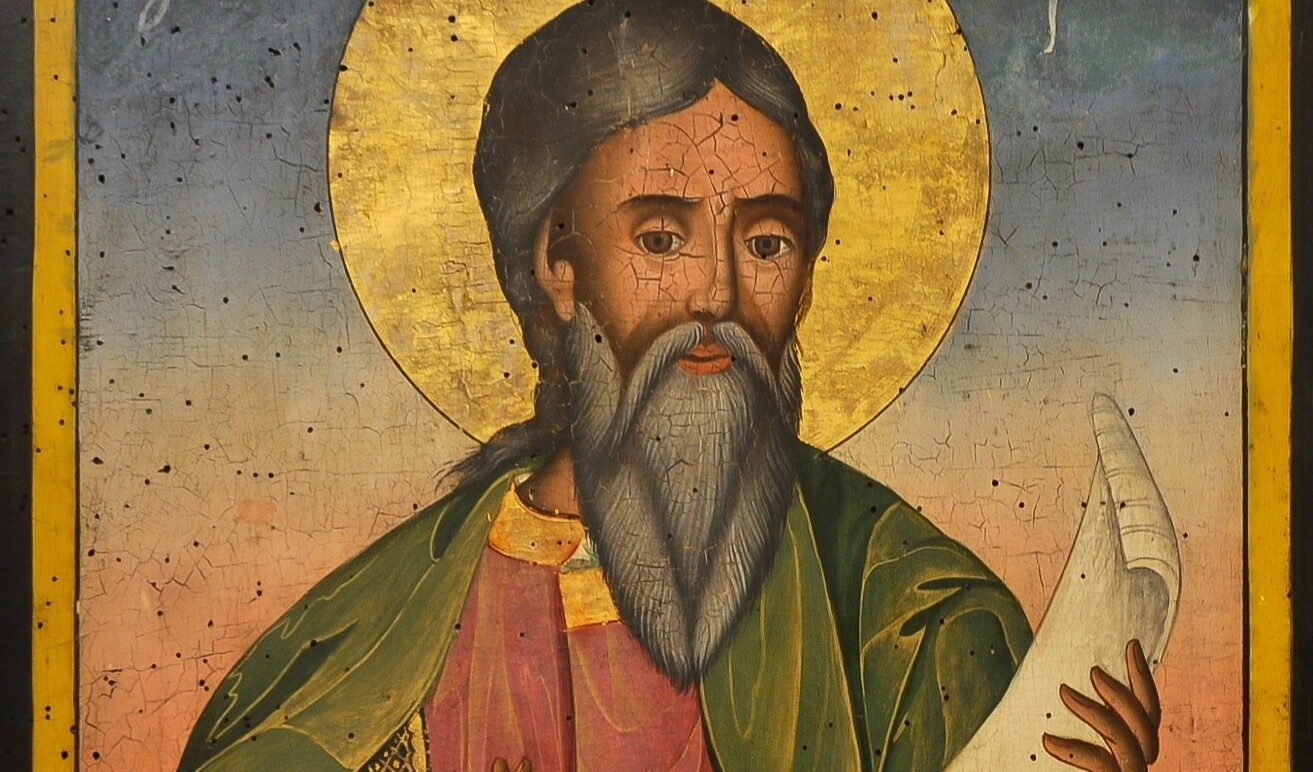
Image from Wikimedia Commons