|
Forwarded this email? Sign up for free to have it sent directly to your inbox.
|
|
|
Good morning,
Today, we’re looking at fraud in California, the future of Confederate monuments, and driverless cars in Washington, D.C.
Write to us at editors@city-journal.org with questions or comments.
|
|
|
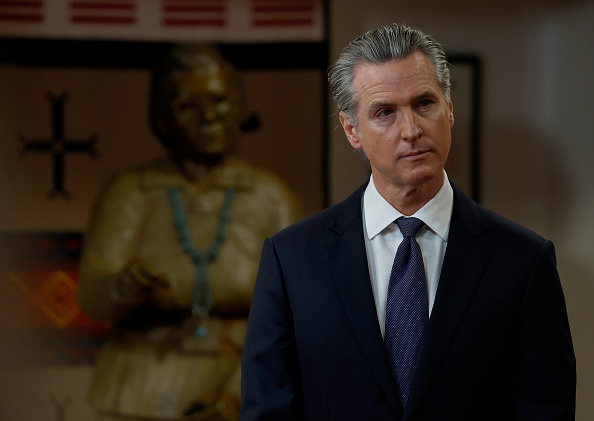
Photo credit: Justin Sullivan / Staff / Getty Images News via Getty Images
|
California has some of the nation’s highest income and business taxes and spends more than $300 billion a year.
You might be surprised by that figure, given that many areas in the state seem to be falling apart. Homelessness and drug addiction feel pervasive in some pockets of San Francisco and Los Angeles. The roads are crumbling. Neighborhoods destroyed by wildfires still haven’t been rebuilt.
So where is all the money going?
“On paper, it funds hospitals, universities, schools, prisons, infrastructure, and other public services,” Christopher F. Rufo, Ryan Thorpe, Kenneth Schrupp, and Haley Strack write. “But beneath the surface, something else is happening that California Governor Gavin Newsom does not want you to see: massive, systematic, brazen fraud.”
Read their investigation.
|
|
|
In 2020, numerous Confederate monuments were torn down around the country, based on the claim that commanders like Robert E. Lee and Stonewall Jackson simply represented white supremacy and that memorials to them had no other meaning or context.
But “The crusade against Confederate statues, which has enjoyed the unflagging support of the nation’s progressive media, reflects a flattening rather than a broadening of historical and cultural understanding,” Catesby Leigh writes. Wokedom’s “impact on the South’s public realm, as a vacuous exhibition of banished Confederate statues in Los Angeles attests, has been disastrous. The sooner Americans—North and South, black and white—see this authoritarian mindset for what it is, the better.”
Read more.
|
|
|
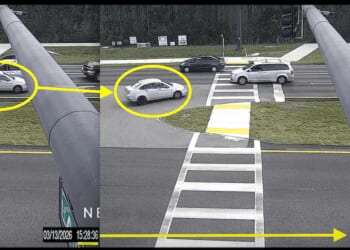
Waymo has been testing its driverless cars in Washington, D.C. since 2024, but the vehicles still aren’t operating fully autonomously. City council members say they’re waiting on a report from the Washington, D.C. Department of Transportation. But at least one of them has said the service isn’t safe enough.
“These nebulous safety fears aren’t tied to any meaningful metric or standard by which Waymo could operate in the district,” Joshua Levine writes. “Instead, they serve effectively to ban AV technology in perpetuity.”
Read more about the procedural delays and why the safety concerns don’t add up.
|
|
|
“It always instills such confidence in our government when the very people who’ve never built anything or run a business—or, for that matter, ever done a hard day’s work not on the government dole—get to set the rules for how entire industries will operate. What could go wrong?”
|
|
|
A quarterly magazine of urban affairs, published by the Manhattan Institute, edited by Brian C. Anderson.
|
|
|
Copyright © 2026 Manhattan Institute, All rights reserved.
|
|
|
|
Source link