Pour forth we beseech thee, O Lord,
Thy grace into our hearts
That we to whom the Incarnation
Of Christ thy Son, was made known
By the message of an angel
May by His Passion and Cross
Be brought to the glory of His resurrection.
That is the Collect, the Opening Prayer for last Sunday’s Mass, prayed for centuries on the 4th Sunday of Advent. It is the conclusion of the centuries-old prayer known as the Angelus.
So, the Sunday before Christmas, there is mention of Christ’s Passion and Cross. Isn’t that interesting? As Bishop Sheen liked to remind us: the little baby placed in the wooden manger was born to die on a wooden cross.
The Only “Mary” of the Old Testament
It’s interesting because centuries beforehand baby Moses was placed in a little wooden basket and pushed out into the river. That was done to save him. In a primitive form of population control, or genocide, the Egyptian government had mandated that all Hebrew baby boys be killed. It was Moses’ mother who gave him away in order to save him. And afterward, she gave her daughter, Moses’ sister, an important mission.
What was Moses’ sister’s name? It was Miriam—the Hebrew word for Mary. She was the only “Mary” in the Old Testament.
Per her mother’s instructions, the young Miriam was to stand off at a distance and watch her brother floating on the water. When Pharaoh’s daughter found the baby and had compassion on him, Miriam approached. With great poise and wisdom, the young virgin asked Pharaoh’s daughter a question, “Shall I go find a Hebrew woman to nurse this baby for you?” (Ex. 2:7). Pharaoh’s daughter thought that was a great idea. Who then did Miriam go fetch for the job? Her own mother—Moses’ mother!
Miriam cooperated with her brother Moses and his mission to free his people. Centuries later, the Virgin Mary would cooperate with her son, the new Moses, to free His people. About seven hundred years before that happened, Isaiah prophesized: The virgin shall conceive and bear a son. And the gospel writer Luke, who documented these events, wrote, And the virgin’s name was Mary.
Mary in the New Testament
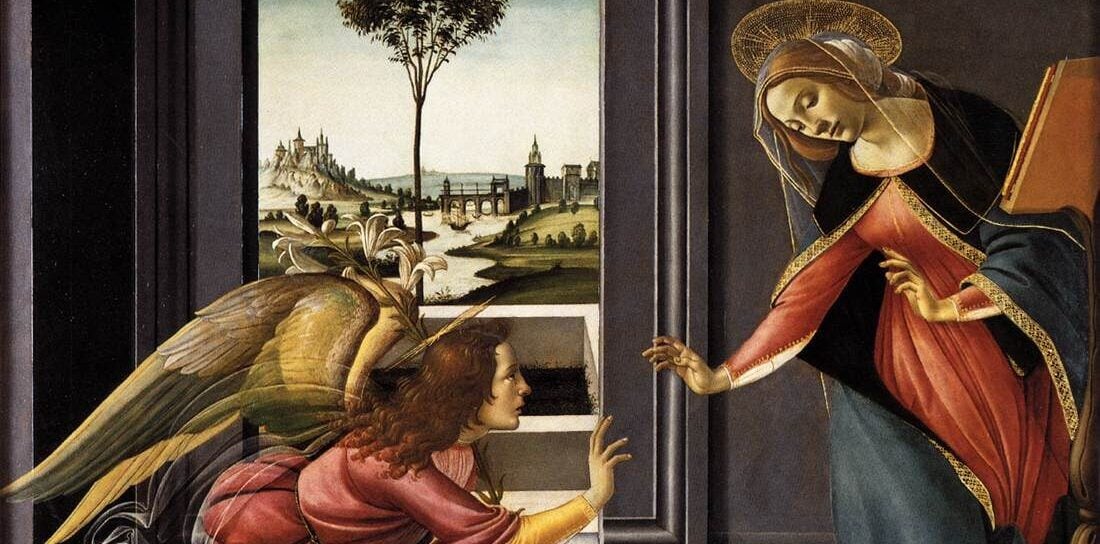
The Virgin’s cooperation officially began at the Annunciation, when she told the Angel Gabriel, “May it be done to me according to thy word.” In the Garden of Eden Eve said no, but here the New Eve says yes. How wonderful then to be God’s chosen vessel.
We might ask, what young woman would say “no” to such an honor? Well, a lot of women would. Saying “yes” to God comes with a price; a price many people are unwilling to pay.
Consider what happened after the Virgin said “yes.” She had to tell her husband (with whom she had not had relations) that she was with child. Can you picture that conversation? Was it full of joy and happiness? More likely it featured confusion and sadness, maybe some tears, as the righteous man, St. Joseph, decided to divorce Mary quietly.
What about Our Lady’s cooperation at the wedding feast of Cana, the site of Christ’s first miracle? The Virgin informed her Son that the wine had run out. Then she just stared at Him. It was a motherly stare that said, “Do something.” And He did.
Changing water into wine at Cana catapulted Christ into public ministry. Did that make the Virgin Mary a proud mother? Did she brag about it to everyone back in Nazareth? No, because the prompting broke her heart. Not only did she just give her Son away to the world, she started Him on His road to Calvary. He knew this, and so did she. And so, 150 gallons of water were changed into the best of wine at a marriage feast. Perhaps during one of the numerous wedding toasts, Christ and His Mother raised their glasses and gave each other a knowing, loving, and bittersweet look.
Mary’s Titles and the Eucharistic Jesus
Speaking of bittersweet: Rome recently instructed us to stop referring to the Virgin Mary as co-redemptrix. It’s interesting that our new synodal, listening, and democratic Church did not poll the Catholic faithful on this. It’s also interesting that the US Bishops Conference these last few years spent something like $25 million on the Eucharistic Revival. Polling showed that kneeling to receive the Eucharist on the tongue was important to people and strengthened their faith in the Real Presence. Yet certain bishops are now all but forcing the lay faithful to receive Holy Communion standing and in their hands. Kneeling is divisive, they say, and therefore altar rails need to be dismantled. Perhaps we should ask for our $25 million back, since the evidence is quite clear: standing to receive the Holy Eucharist with unconsecrated hands has damaged, not helped, belief in what Vatican II called the “source and summit” of our Faith.
The evidence is quite clear in Sacred Scripture that the Holy Eucharist is truly Christ’s Body and Blood. It is also clear that the Virgin Mary cooperates in a unique manner with Christ in our redemption. She’s prefigured in the beginning of the Bible as the woman at enmity with the serpent, and she appears at the end of the Bible as the woman clothed with the sun. It is hardly inappropriate to have great devotion and reverence for both these things.
Cooperating with the Mission
And so, here we are, poor banished children of Eve, as we pray at the end of the Rosary. Here we are, sinful and sorrowful, living in this valley of tears. But we do not live without hope. We have hope that if we die with Him, we will rise with Him. Rising is easy; it’s the dying part that is hard. That is why Christ gave us a hard religion—one that has teeth, one that comes with a cross. He did that to prepare us for battle, so that, when the time comes (and, my friends, it’s here), we will say “yes” to Christ when the rest of the world is saying “no.”
This is why the Virgin Mary is so important to us. For she is the New Eve, who reversed the curse by saying “yes.” In doing so, she gives us her Son, and, as He hangs on the cross, He gives her back, saying, “Behold your mother.”
Let us review: the young Miriam looked out for her brother Moses. She cooperated in Moses’ mission—from his time lying in the basket on the river, to the end of his forty-year journey up on Mount Nebo, where, just east of the Promised Land, Moses died. The Blessed Virgin, a new Miriam, looked out for the new Moses, her Son, and cooperated in His mission—from His time lying in the crib in the stable, to the end of His journey up on Mount Calvary, where He died.
Holy Mary’s mission continues at Holy Mass. At Mass, our Mother, standing at a distance, approaches her Son. With great poise and wisdom, she looks at Him as if to say, “Do something.” And He does. He makes time stand still, goes to Calvary, and turns wine into His Blood. There He drinks the bittersweet cup of suffering for our sins.
So we hail the cross, our only hope. And we hail Mary, full of grace; she who uniquely cooperates with Her Son in our redemption. We pray that by Christ’s Passion and Cross we will be brought to the glory of His resurrection.
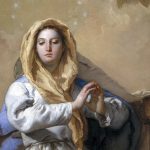
Image from Wikimedia Commons