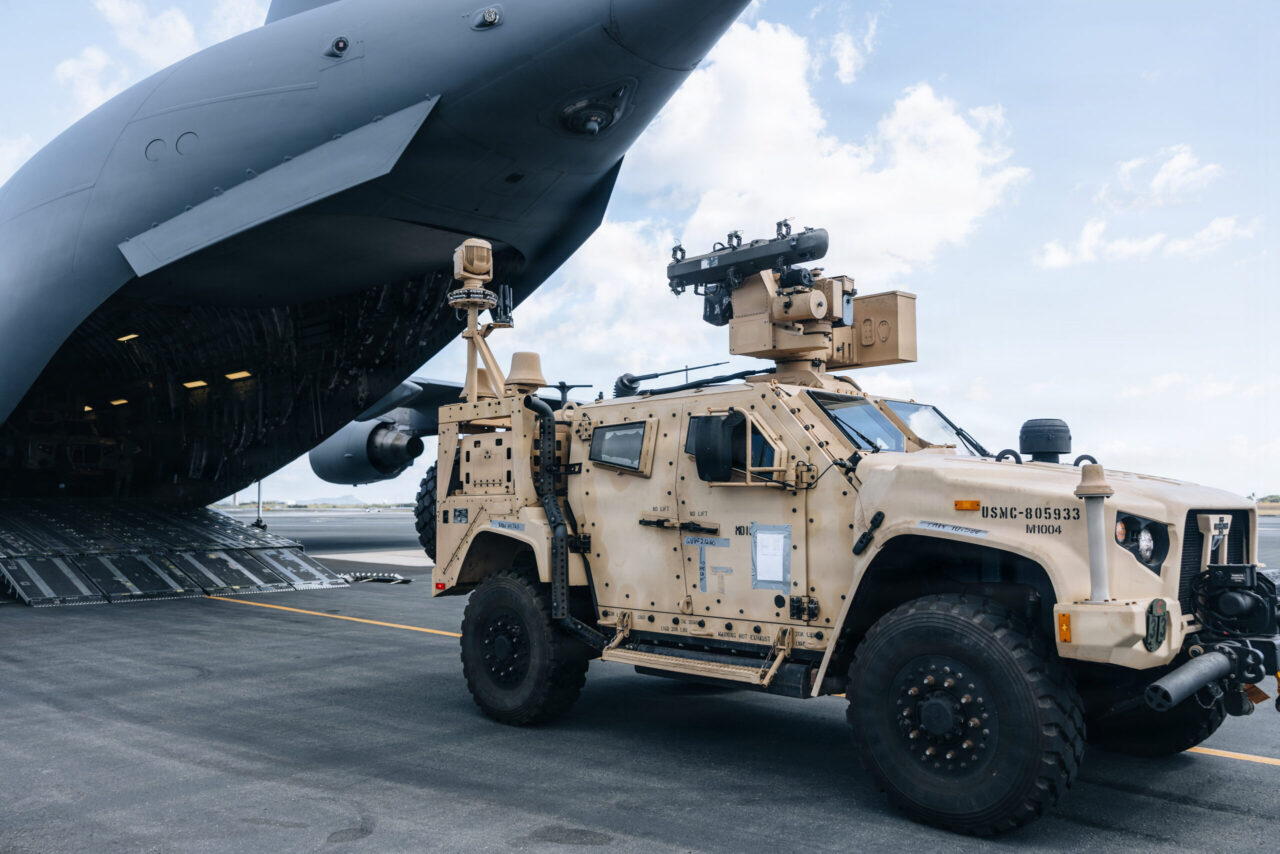
The MADIS is designed to provide expeditionary air defense and rapid capabilities to Marine commanders.
The US Marine Corps has a new drone hunter-killer tactical vehicle.
The service announced that the Marine Air Defense Integrated System (MADIS) has been in production since September.
Meet the MADIS Drone Hunter-Killer Vehicle
According to the service, after several weeks of intensive new equipment training and a live-fire exercise at the Marine Corps Air Ground Combat Center, the MADIS is now operational. Marine units now have a reliable weapon system to deal with enemy unmanned aerial systems at low altitudes.
The MADIS is equipped with a 30mm autocannon and FIM-92 Stinger air defense missiles, offering tactical commanders a variety of kinetic options to engage enemy drones.
It is based around two types of Joint Light Tactical Vehicles, which are designed to work in tandem and engage both manned and unmanned aerial threats.
“Having supported the GBAD community for the last 22 years, from the schoolhouse to the program office, it’s clear that MADIS brings a critical new capability to the warfighter,” Marine Corps master sgt. Brandon Meadors said in a service press release.
“Marines have always said, ‘Anytime, anyplace,’ and this system helps us get there. It provides a state-of-the-art, mobile defense that directly supports our forces in the field,” the senior non-commissioned officer added.
The MADIS is designed to provide expeditionary air defense and rapid capabilities to Marine commanders. The Marine Corps, after all, is an expeditionary force designed to take the fight to the enemy. So, its weapon systems need to be flexible and mobile enough to deploy to the frontlines.
The Tactical, Operational, and Strategic Value of Drones
Warfare is changing, and unmanned aerial systems are playing an increasingly larger role in tactical, operational, and even strategic settings.
On a tactical level, unmanned aerial systems provide commanders with accessible kinetic options, as well as important reconnaissance capabilities. For example, a dismounted mechanized platoon can rely on drones to scout a suspected enemy position and, if necessary, deploy one-way attack unmanned aerial systems to soften up or neutralize the threat.
On an operational level, senior commanders can use unmanned aerial systems for intelligence, surveillance, and reconnaissance missions to get a better understanding of the battlefield and the movements of the adversary. In addition, suicide drones can also be useful in an operational setting by targeting and attacking important enemy positions, such as command and control centers, ammunition depots, railways, artillery positions, and air defense systems.
Finally, on a strategic level, senior commanders and policymakers can use drones for both reconnaissance missions and strategic strikes deep behind the front lines. For example, suicide drones can target an adversary’s oil processing stations or major air bases. Moreover, governments can use drones to create diplomatic incidents in support of foreign affairs and military objectives.
The US military has been paying close attention to the conflict in Ukraine and how the two combatants have been using unmanned aerial systems to maximize their lethality on and off the battlefield. The development of the MADIS drone hunter-killer tactical vehicles is a direct result of that lessons learned process.
About the Author: Stavros Atlamazoglou
Stavros Atlamazoglou is a seasoned defense journalist specializing in special operations and a Hellenic Army veteran (national service with the 575th Marine Battalion and Army HQ). He holds a BA from the Johns Hopkins University and an MA from the Johns Hopkins’ School of Advanced International Studies (SAIS). His work has been featured in Business Insider, Sandboxx, and SOFREP.
Image: DVIDS.