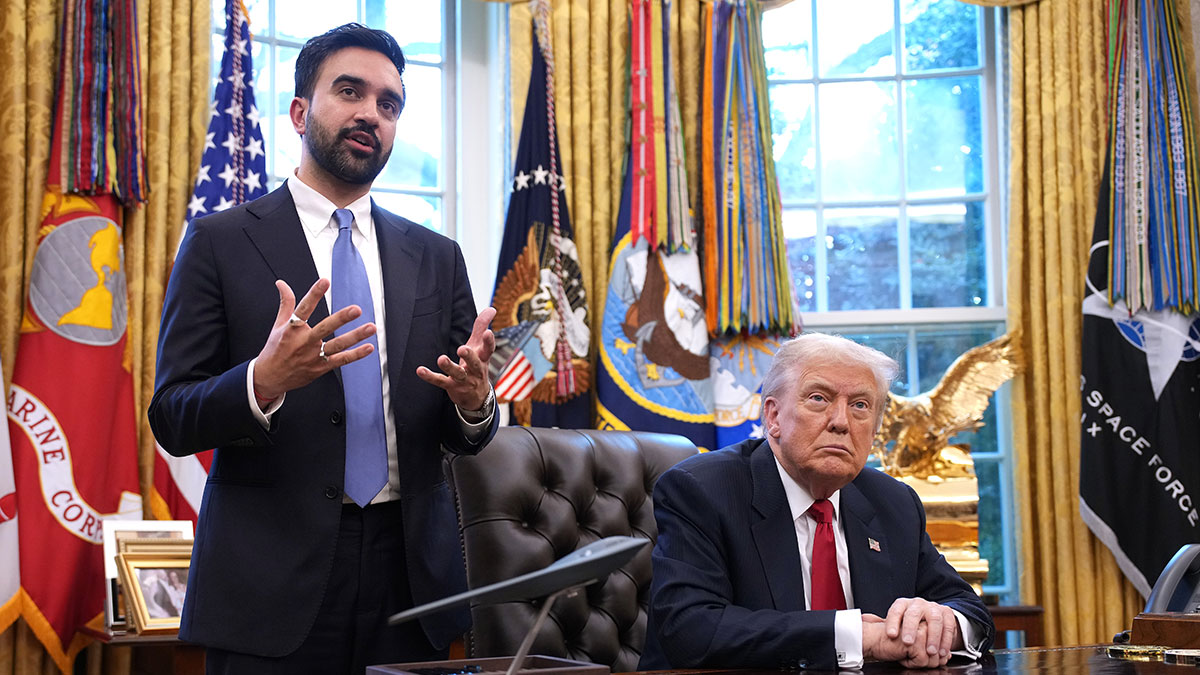
Last week’s White House meeting between President Donald Trump and New York mayor-elect Zohran Mamdani brought together two opposing personalities—and set two irreconcilable visions of immigration enforcement on a collision course.
Despite their cordial meeting, the two leaders have viciously denounced one another. Trump has lambasted the mayor-elect as a “communist lunatic” and threatened to withhold federal funds from New York City. Mamdani, a self-described democratic socialist and a former state assemblyman, campaigned on a promise to “Trump-proof” New York.
Finally, a reason to check your email.
Sign up for our free newsletter today.
Those tensions will inevitably shape future battles between Gotham and Washington on immigration enforcement. Each side has tools to frustrate the other’s agenda. The result of this clash could define Mamdani’s mayoralty.
Gotham has long been shaped by its immigrant identity. Over a third of the city’s more than 8 million residents were born abroad. Roughly 5 percent of its population—around half a million people—are illegal immigrants.
In the past few years, the city has seen an unprecedented influx of migrants. Since the spring of 2022, the city has counted more than 237,000 asylum-seekers using public services.
Mayor Eric Adams declared a state of emergency in October 2022, but that hasn’t solved the problem. On one night in January 2024, the city reported 69,000 migrants in its shelters.
During the surge, a series of high-profile incidents have raised New Yorkers’ fears about migrant crime. These fears appear to be substantiated. In January 2024, a group of illegal immigrants attacked NYPD officers in Times Square. Two months later, eight suspected migrants were found squatting in a Bronx apartment that contained illegal guns and drugs—six of whom walked free without bail after arrest. In Midtown Manhattan precincts, as many as 75 percent of recent arrestees have been migrants, often cited for offenses like robbery or assault. According to a May 2024 poll, over 70 percent of New Yorkers believe the migrant influx is affecting the city’s crime rate.
From the mayor-elect’s perspective, the Trump administration’s hardline immigration agenda has sown confusion and fear. Mamdani has argued that keeping migrants in a “state of limbo” helps no one—not New York and not the families they’re trying to support. Yet the mayor-elect has offered no clear vision of what, exactly, he expects of migrants in New York that would be any different from anywhere else.
On immigration, Trump and Mamdani both have legal and tactical tools at their disposal to thwart the other’s agenda.
Gotham’s “sanctuary” laws strictly limit city officials’ ability to cooperate with federal immigration authorities, even when dealing with alleged offenders. Since 2014, New York City law has barred the NYPD and city jails from honoring ICE detention orders, except in cases of recent “violent or serious crime” convictions. The city also prohibits officers from inquiring about the immigration status of people they encounter, whether as victims, witnesses, or suspects.
Trump’s administration appears poised to flood the zone in New York. Federal officials have already signaled that they will ramp up immigration enforcement operations in Gotham, which could mean more ICE raids at homes and worksites, more agents patrolling city streets, and higher-profile arrests of illegal immigrants.
Section 287(g) of the Immigration and Nationality Act could become a battleground between Trump and Mamdani. Authorized by a 1996 amendment, 287(g) allows ICE to deputize local law enforcement officers to act as immigration agents. Under a 287(g) agreement, the federal government trains local police or sheriff’s deputies and allows them to identify, detain, and even begin deportation paperwork for illegal aliens.
New York City has never made a 287(g) agreement—and Mayor-elect Mamdani never will—but counties near the city, such as Nassau, have done so. Trump officials may seek to do an end-run around city hall by leaning on county executives and the governor when Mamdani resists.
Even without 287(g), federal law enforcement has tools to pressure New York. One of them is 8 USC § 1373, a 1996 federal statute that bars local governments from preventing officials from sharing a person’s immigration status with federal authorities.
One vulnerability for the city is its arrest data. The NYPD Patrol Guide technically calls for recording an arrestee’s country of birth and citizenship on paperwork. But in practice, officers don’t inquire about immigration status in deference to city policy. The Trump administration could exploit this by issuing subpoenas or using federal grand juries to get information on noncitizen detainees. Additionally, ICE could issue detainer requests asking that individuals arrested by NYPD who are potentially deportable be held for pickup.
The final issue is money. Trump has mused about cutting off federal funding to punish New York, but stripping federal funds is easier said than done—when Trump attempted broad sanctuary-city defunding in 2017, courts largely blocked his efforts as unconstitutional. Still, the White House has levers to pull. It could deny New York City discretionary grants, delay infrastructure projects, or attach new conditions to federal aid requiring cooperation on immigration enforcement.
How should Mayor-elect Mamdani handle these looming confrontations?
First and foremost, he should make clear that no one—citizen or not—has a free pass to commit crimes in New York. In practice, this means cooperating with federal authorities to remove dangerous individuals, regardless of their legal status.
Second, Mamdani should ensure that New York isn’t willfully failing to record important data, such as arrestees’ immigration status, that could help guide city policy. Even if he has no intention of handing data over to Washington, collecting it would allow Mamdani to identify the places that need more policing and control.
If Mamdani refuses to draw these lines, he risks walking in to precisely the fight Trump wants: a made-for-TV showdown between Washington and a “sanctuary city” mayor who appears more interested in defying the feds than in removing dangerous offenders from New York’s streets. That’s a losing frame for Mamdani—and for the millions of New Yorkers who simply want to live and work in safety.
Editor’s note: The article has been corrected to reflect that Nassau County is not in New York City.
Photo by Andrew Harnik/Getty Images
City Journal is a publication of the Manhattan Institute for Policy Research (MI), a leading free-market think tank. Are you interested in supporting the magazine? As a 501(c)(3) nonprofit, donations in support of MI and City Journal are fully tax-deductible as provided by law (EIN #13-2912529).
Source link