For New York residents concerned about the city’s still-elevated crime rates, the question since Election Day has been: which Zohran Mamdani will we get? Will the next mayor be the allegedly more moderate Mamdani, who apologized publicly to the NYPD and said that “police have a critical role to play”? Or will it be the Mamdani who labeled the NYPD “racist, anti-queer & a major threat to public safety” amid calls for defunding them in 2020?
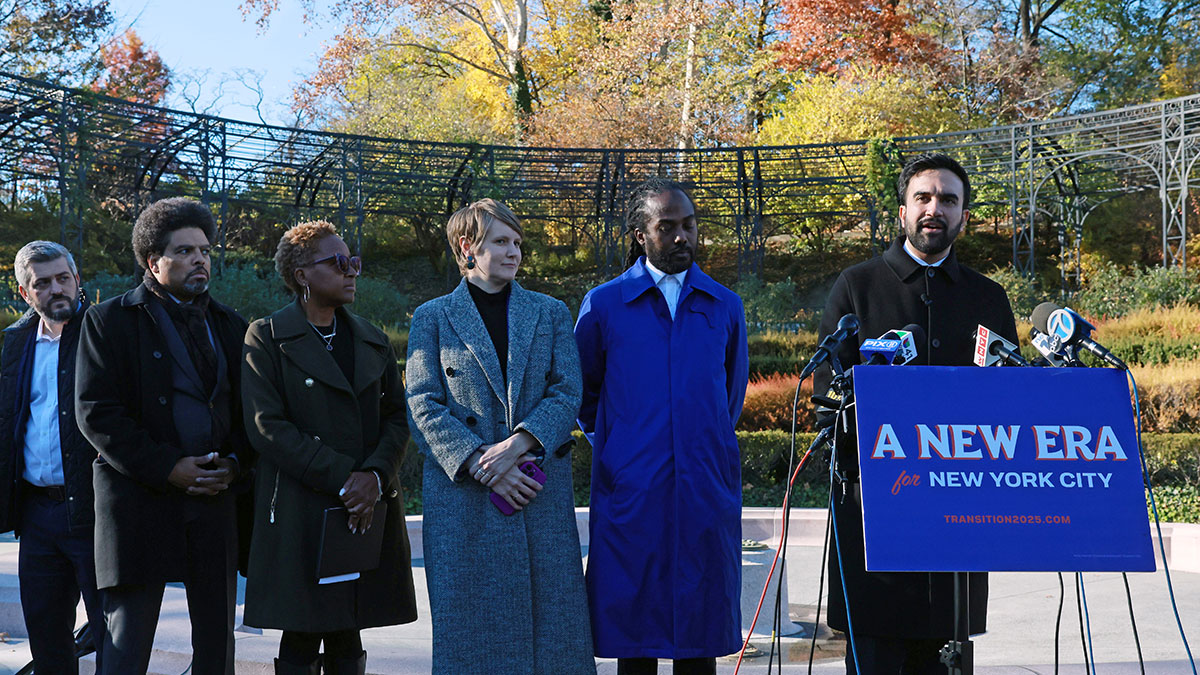
While a few signs have suggested that it will be the moderate—most obviously the reappointment of NYPD commissioner Jessica Tisch—Monday brought alarming evidence in favor of the radical. Obscured amid the 400 people Mamdani appointed to 17 advisory committees are several extremist additions to his “Committee on Community Safety.” These include Alex Vitale, arguably New York City’s most prominent police abolitionist, and Kassandra Frederique, director of the Drug Policy Alliance, the nation’s leading advocate for drug legalization.
Finally, a reason to check your email.
Sign up for our free newsletter today.
If these are the people Mamdani listens to on public safety, then it doesn’t matter what moderate pieties he mouths. The policies and appointments they will push will put the safety of New York City in serious doubt. Mamdani should find new advisors with all haste.
Why? Take Vitale, who on Monday night wrote on X that he was “excited to announce that I have been asked to join the Mamdani Transition Team to work on community safety issues.” Vitale is a professor at Brooklyn College, where he coordinates the Policing and Social Justice Project. He is also the author of The End of Policing, a 2017 book in which he advocates for full police abolition. The book attracted significant attention during 2020’s “defund” moment; in an interview with Jacobin a few weeks after George Floyd’s death, Vitale comfortably asserted that policing is “fundamentally a tool of social control to facilitate our exploitation.”
Of course, abolishing the police isn’t Vitale’s only proposal. During the campaign, writing in The Nation, Vitale advised Mamdani to “confront” the NYPD. In that proposal, as my colleague Rafael Mangual noted in City Journal, Vitale endorses shutting down the NYPD’s gang database, which Commissioner Tisch has said is essential to her success. And he calls on Mamdani to let the NYPD’s sworn force size decline by attrition—an achievable proposition, when the department is already losing 300 officers per month on average. As a bonus, Vitale is an ardent supporter of “decriminalizing” prostitution, a topic on which Mamdani dodged questions throughout the campaign.
Yet all this only scratches the surface of Vitale’s militant ideas. As my colleague Stu Smith has been documenting on X, Vitale has branded cops “violence workers” and “natural enemies of the working class”; has called police reform (as opposed to abolition) “misguided” and “laughable”; has endorsed replacing police with “person-to-person organizing of our daily lives”; and joked that “we should give teachers guns so parents quit harassing them about what books they assign.”
What about Frederique and drug legalization? Mamdani was a signatory of the New York City Democratic Socialists of America’s 2021 “decarceration agenda,” which included an endorsement of drug decriminalization. But he was mostly silent on the issue during the campaign.
Not Frederique. Her organization, the Drug Policy Alliance, is the nation’s most outspoken advocate for ending the “criminalization” of drugs. That stance applies not only to users but also to drug dealers, whom the organization has said we need to “rethink” as part of its campaign for the “legal regulation of drugs.”
Frederique is also an advocate for New York City’s controversial supervised consumption sites. This despite the minimal impact the sites have had, in New York and elsewhere. Late in the campaign, Mamdani, for his part, reversed his support for expanding the program, instead saying that he would just maintain the sites as they are.
Like Vitale, Frederique is no fan of the cops. Praising the city for declaring “racism” a “public health crisis,” she claimed her organization had seen “racist drug enforcement destroying communities and providing a pretext for police violence.”
Frederique and Vitale are perhaps the most visible radicals, but they’re far from the only ones. Others on the transition team include Jasmine Budnella, who directs drug policy at VOCAL-NY, a group that has explicitly endorsed defunding. Daniela Gilbert works on “redefining public safety” for the Vera Institute, which has included efforts to highlight “the social costs of policing.” And there’s also Tamika Mallory, a friend of famed anti-Semite Louis Farrakhan. The list goes on.
To be sure, Mamdani’s public safety advisors are not all radicals. There is, for example, Elizabeth Glazer, the former director of the Mayor’s Office of Criminal Justice, who now runs the publication Vital City. Glazer is a sensible center-leftist who balances concerns for justice and safety. The team also includes several career police officers, as well as Tom Harris of the Times Square Alliance Business Improvement District.
Charitably, Mamdani’s advisory committee represents a “team of rivals.” But it is a preposterous, to say the least, to frame as a coalition on the one hand police officers, and on the other hand people who have called policing a racist, violent institution that should be abolished as soon as possible. No synthesis is possible here: either policing is essential to keeping New York City safe, or it isn’t.
There is still time, of course, for Mamdani to make different decisions. He doesn’t have to listen to the leftists. The city has many reasonable progressives in the mold of Glazer—people like John Jay college’s Peter Moskos or former state Deputy Secretary for Public Safety Thomas Abt—who could offer the incoming mayor a vision of reform moderated by a commitment to public safety.
But of course, Mamdani picked people like Vitale and Frederique for a reason. One suspects the obvious: that Mamdani said what he knew he had to say to get elected, but that deep down, he’s still the same guy who thought the NYPD was “racist, anti-queer & a major threat to public safety.”
If so, the city may be in for four years of the public safety experiment it got only a taste of under Bill de Blasio. With luck, figures like Commissioner Tisch can still wield influence. But it seems increasingly likely that it’s people like Vitale, not Tisch, who will be calling the shots in a Mamdani administration.
Photo by Spencer Platt/Getty Images
City Journal is a publication of the Manhattan Institute for Policy Research (MI), a leading free-market think tank. Are you interested in supporting the magazine? As a 501(c)(3) nonprofit, donations in support of MI and City Journal are fully tax-deductible as provided by law (EIN #13-2912529).
Source link