The United States has positioned around one-fourth of its total military strength in the Caribbean—and is waiting for the Maduro regime to make the wrong move.
When the United States deploys around 25 percent of its combat power to a single region—supported by 15,000 US Marines, no less—it is no longer engaged in a routine naval rotation. It is making a statement of intent.
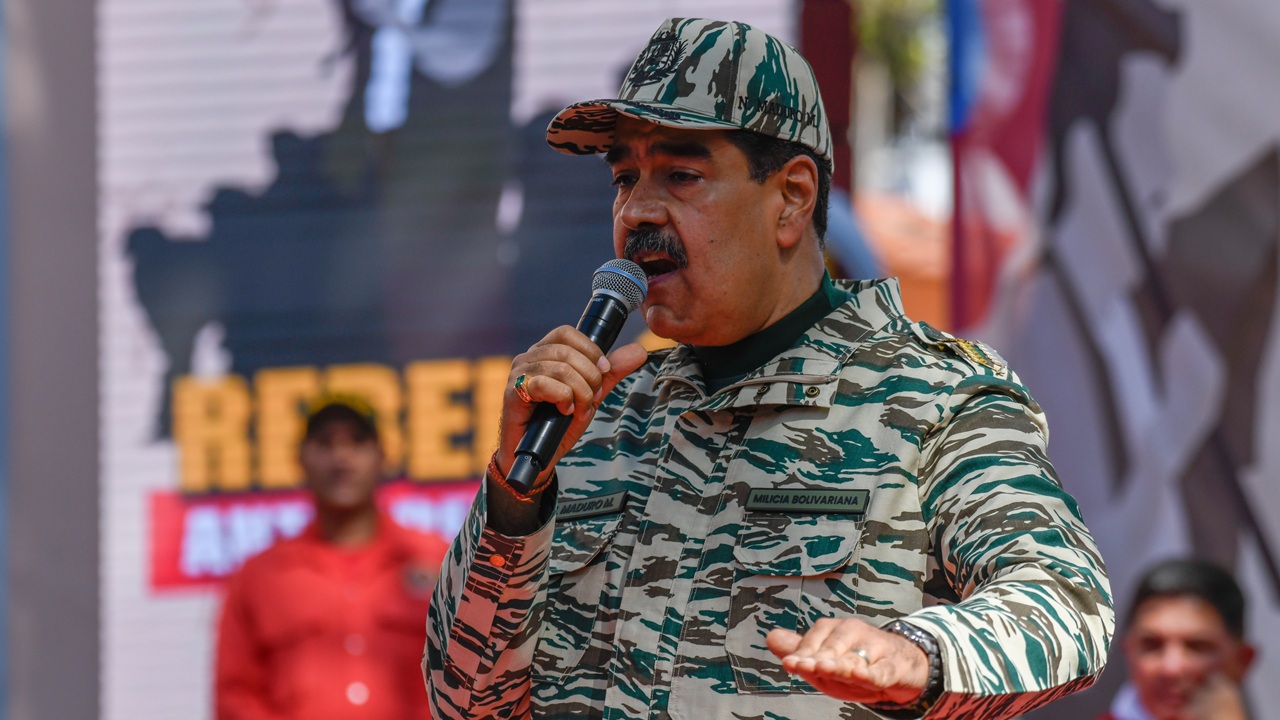
Right now, Washington’s intent is to topple the ailing socialist regime of Nicolas Maduro in Venezuela…and those intentions are being read as such by every leader from Ankara to Beijing to Caracas and Moscow, and in every other major capital.
Trump’s Show of Force Off Venezuela’s Doorstep
The Caribbean has become a parking lot for American firepower. And every moment—every joint sail, every maneuver, every “exercise” undertaken—is being interpreted through a new, hard-edged strategic lens.
Essentially, the United States is engaged in a slow-but-sure reorientation of its grand strategic posture away from distant areas of responsibility—such as European Command, Central Command, and even Indo-Pacific Command—to the Western Hemisphere.
That’s why the recent US-Guyana joint operations near Guyana’s Essequibo region—which recently became the subject of an irredentist claim by the flailing Maduro government in order to whip up domestic support—should not be misread as just another counternarcotics patrol. They are part of a rapidly evolving military chess match driven by the crisis in Venezuela, the ongoing collapse of the Maduro regime, and the scramble for dominance in the Western Hemisphere.
On November 22, 2025, the guided-missile destroyer USS Mahan (DDG-72) conducted joint maritime operations with the Guyana Defense Force patrol ship GDFS Shahoud off Guyana’s eastern coast.
This comes on the heels not just of the ongoing US military buildup in the Caribbean, but of a similar patrol conducted in March of this year between the USS Normandy and another GDF patrol vessel in Guyana’s Exclusive Economic Zone (EEZ).
The exercises focused on communications, maneuver drills, and interoperability. This wasn’t happenstance. It was preparation.
These operations dovetail with the Trump administration’s 2025 push under Operation Southern Spear, ostensibly framed as a counternarcotics and anti-trafficking campaign across the Caribbean. But Southern Spear is far more than a policing operation. It is the strategic umbrella under which Washington is reasserting hemispheric primacy—and positioning forces whatever comes next in Venezuela.
This is why Washington keeps making comments about things not being over with Venezuela, but the mission against Maduro being the start of a larger campaign of political reorganization for Latin American states, like Colombia, Nicaragua, Ecuador, Mexico, and others.
Essequibo Could Become a Flashpoint for a US-Venezuela Conflict
For months, US officials privately feared that Maduro might attempt a military gambit against the oil-rich (and sparsely populated) Essequibo region of Guyana. ExxonMobil is in Essequibo.
So are Chinese interests. And Maduro understands that control of that resource jackpot could buy him much political and economic oxygen.
That is why Washington responded with unmistakable clarity—insisting that Guyana would not become Maduro’s lifeline.
Reinforcing Guyana’s defense posture by pairing its small navy with US guided-missile destroyers serves two purposes. First, it is a deterrent that reminds Caracas that any misadventure across the border would be suicidal.
Second, it gives greater preparation to both Guyana and the US Navy operating in the Caribbean by ensuring the US and Guyana can operate seamlessly if push comes to shove. In the past, Washington has defended Guyana diplomatically. It is now doing so on an operational level, at sea, well within striking range of Venezuela.
The White House’s “Counternarcotics” Mission Is a Cover Story
The official justification for the US buildup is narcotics interdiction. Yes, the Caribbean is a major drug and human trafficking corridor. Yes, interdiction is necessary.
But let’s be honest. You don’t deploy cruisers, destroyers, special operations units, and autonomous naval platforms to stop cartel “go-fast” boats. You deploy the assets the Navy has arrayed in the Caribbean today to dominate a battlespace—or to deter a hostile state actor from doing something reckless.
Some analysts insist Southern Spear is a smokescreen for a far more muscular objective that involves containing Venezuela, protecting regional oil infrastructure, and signaling to China and Russia that the Caribbean is still an American lake.
And they’re right. Maduro has cultivated deep ties with Moscow. Beijing is deeply invested in Venezuela’s oil and mineral sectors. A collapse in Caracas—or a Venezuelan grab for Essequibo—would become a geopolitical feeding frenzy. The United States cannot allow for that. So Operation Southern Spear should be understood less as a “counternarcotics mission” and more as a 21st century revival of the Monroe Doctrine, replete with a modern, robotic, precision-guided twist.
A Strategic Tropical Storm Is on the Way in South America
With US firepower surging, Venezuelan politics melting down, and Essequibo sitting on a trillion-dollar oil frontier, the Caribbean is entering the most dangerous phase of its modern history. Any number of small incidents could touch off a conflict that will envelop the entire region:
- A Venezuelan naval patrol getting too close to Guyana’s EEZ
- A trigger-happy commander on any side misreading a radar return
- A drone buzzing the wrong US ship
- Maduro making a last-ditch territorial gamble for Essequibo
Washington is betting that overwhelming force will keep Maduro on the backfoot. Maybe it will.
But when any nation deploys this much steel and firepower into a confined region teetering on political collapse, it is not trying to prevent a crisis—it is waiting for one to begin. The Caribbean is now one bad decision away from becoming the most dangerous flashpoint in the Western Hemisphere since the Cuban Missile Crisis.
If Maduro lunges for Essequibo, or if Southern Spear becomes something more than a “policing mission,” America won’t just be patrolling the hemisphere. It will be fighting for control over it.
Oh, and my colleague, Andrei Martyanov, the great Russian military analyst, warned me on my Rumble podcast National Security Talk: the Russian military (and the Chinese military) would love nothing more than to bog the US military down in a fight in Venezuela. And, over the last few months, that’s precisely what they have been helping the Venezuelan Armed Forces and their Bolivarian militias prepare to do.
About the Author: Brandon J. Weichert
Brandon J. Weichert is a senior national security editor at The National Interest. Recently, Weichert became the host of The National Security Hour on America Outloud News and iHeartRadio, where he discusses national security policy every Wednesday at 8pm Eastern. Weichert hosts a companion book talk series on Rumble entitled “National Security Talk.” He is also a contributor at Popular Mechanics and has consulted regularly with various government institutions and private organizations on geopolitical issues. Weichert’s writings have appeared in multiple publications, including The Washington Times, National Review, The American Spectator, MSN, and the Asia Times. His books include Winning Space: How America Remains a Superpower, Biohacked: China’s Race to Control Life, and The Shadow War: Iran’s Quest for Supremacy. His newest book, A Disaster of Our Own Making: How the West Lost Ukraine is available for purchase wherever books are sold. He can be followed via Twitter @WeTheBrandon.
Image: Shutterstock / StringerAL.