There are four great stars in the heavenly constellation of saints from seventeenth-century France. Saint Francis de Sales (1567-1622) was a highly respected bishop, writer, and spiritual director. Saint Jane Frances de Chantal (1571-1641) was a widow before she founded the Order of the Visitation of Holy Mary (also known as the Visitandines). Saint Vincent de Paul (1581-1660) was a priest and religious founder who established many works for the poor.
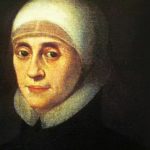
And Saint Louise de Marillac (1591-1660) was a widow who, with the help of Saint Vincent, founded the Daughters of Charity.
Since their lives overlapped and since they all lived in France, it should not surprise us that they knew one another. The first three even helped Louise discern her vocation and become a saint.
Although Louise’s father was Louis de Marillac, a son of the French nobility, he was not married at the time of Louise’s birth. Louis’ first wife had died childless after five years of marriage, and he had not yet remarried.
But he did acknowledge Louise as his illegitimate daughter and sent her to a school run by Dominican nuns. Louise became a devout, well-educated girl, but she never learned her mother’s name.
The de Marillac family was powerful and wealthy. Unfortunately, Louise’s father died when she was thirteen years old, and some of her relatives attempted to deprive Louise of the income that her father had granted her in his will. It took several years and a court battle before that was settled in Louise’s favor.
Raised by nuns, Louise felt attracted to religious life. Each time she tried to enter a religious community, she was rejected because of her poor health. However, the de Marillac family already had plans for her life. On January 15, 1613, she married Antoine Le Gras, who was serving as a secretary to the French queen mother. She was twenty-two years old.
Louise then became known as Mademoiselle Le Gras (at that time, the title of Madame was reserved for nobility, and Antoine was not from a noble family). From a financial and social perspective, it was a good match for Antoine because of Louise’s income and noble connections.
More importantly, for the first time in Louise’s life, she knew love and security in a real home of her own.
Ten months later, she had her first and only child, Michel. Now Louise seemed to have every blessing: a loving marriage, a son, her own household, a fashionable social life, and financial stability. However, worldly success did not distract her from her duties to God. She ran her household so devoutly that two of her servants left her home to become nuns. She read the spiritual writings of the famous bishop of Geneva, Saint Francis de Sales, and was personally guided by him.
After seven happy years of marriage, everything began to change. Her husband became chronically ill and chronically irritable, and he required constant care. Her son experienced what we would call developmental delays; one biographer calls him “slow-witted”.1 Political winds shifted dramatically in the French court, and the de Marillacs became persona non grata. Louise found herself falling into doubts and worries about her family, her financial future, and her past decision to marry rather than enter religious life.
But she did not stop praying, and she eventually came to a sense of peace about her situation, trusting that God would help her. She even begged Him to send her a spiritual director. Shortly afterward, she met Saint Vincent de Paul, and she immediately recognized him as the director God intended for her.
Father Vincent had already become famous throughout France. He was from a poor family but had developed good relationships with the French nobility. He was highly intelligent, able to deal graciously with both princes and peasants, and devoted to bringing the people of France back to Christ and His Church, particularly those who were poor.
After a long illness, Louise’s husband died. Vincent helped her grieve and guided her as she established a new spiritual plan of life as a widow. Because of her reduced income, she took several steps down the social ladder and moved to a much smaller home, but that did not faze her. She frequently considered entering religious life, but Vincent kept telling her to wait. Vincent’s biographers repeatedly state that he was very cautious about making important decisions.
Louise had already become a member of the Ladies of Charity, an association of pious, wealthy women who financially supported Vincent’s ministries. While these duchesses and noblewomen generously provided him with money and social connections, they were not the sort of women who could enter the poorest neighborhoods of Paris and care for the sick.
Two decades previously, Saint Jane Frances de Chantal had founded the Order of the Visitation of Holy Mary with the help of Saint Francis de Sales. The order of nuns they established was considered innovative because it accepted women who were older or who had poor health, not just young, healthy, unmarried women. Instead of living an ascetic, contemplative life in a cloister, the Visitandine nuns cared for the poor in their communities. Vincent, who had already established an order of priests and religious brothers for missionary work, now wanted to do something similar with his own group of sisters, although they were initially called “permanent volunteers”.
Vincent believed that young peasant girls, the sort of girls with whom he had grown up, were the right women to do this important work for the Kingdom. They were used to hard work, spoke the language of the poor, and loved Christ with a strong but simple faith.
But he needed a woman to guide these sisters on a day-to-day basis. He needed a woman who possessed the gift of leadership, who was both wise and well-educated, who could deal with people from both ends of French society, and who could handle endless administrative tasks. He needed a woman who shared his zeal for serving the poor with the heart of Christ, and he recognized that Mademoiselle Le Gras was that woman.
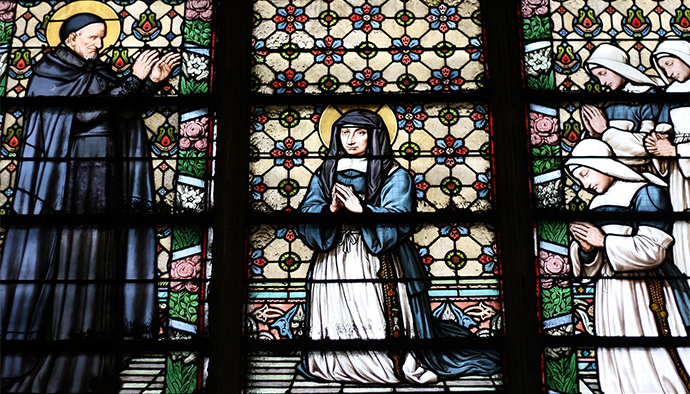
After Vincent agreed that it was time to begin, Louise gathered four young women in a small home. She trained them, guided them, and begged for the food and supplies that they needed as they visited the sick each day. Her guidance was eminently practical, from the basic steps to follow when making a visit to a sick person, as well as gentle suggestions about how to direct that person to turn to God in their suffering.
Over the years, as the number of sisters increased, the sisters did more than provide what we would call home health care. The sisters—now known as the Daughters of Charity—served galley slaves, nursed soldiers, ran soup kitchens, cared for the sick during epidemics, and taught children. Louise even wrote a catechism for them to use. They also cared for orphans.
Seventeenth century France did not have legal abortion, but it did have widespread child abandonment. Illegitimate children and children of prostitutes were often simply left at churches and in the streets. In Paris, the government had established a home for these infants called La Couche. But La Couche was woefully underfunded, and had no oversight. The children—all of them—eventually died of starvation and lack of medical care, and were sometimes given to anyone who would take them.
Louise and Vincent agreed that something must be done for these poor children, so they established orphanages. Louise went into debt to find the food, clothing, housing, and wet nurses required for her sisters to care for these abandoned children.
The traditional habit of the Daughters of Charity—a simple gray dress and a white bonnet—may look like a nun’s habit to us, but it was the typical outfit of a peasant at the time. The distinctive white cornette worn by the sisters for centuries may have inspired a corny TV show, but it was initially simply a peasant girl’s headdress.
Being the superior over religious sisters meant that Louise was constantly dealing with personality differences, training new sisters, and even discerning when it was time to ask a sister to leave the community. Louise knew Jane Frances de Chantal from her membership in the Ladies of Charity and corresponded with her for mutual support.
Because of the heavy demands on Vincent’s schedule, Louise and Vincent generally discussed decisions about the Daughters of Charity through letters. They had a marvelous friendship because they understood one another so well. Together, they inspired the sisters with a zeal for serving Christ in the poor, or as one of the sisters described her own vocation:
“Oh, if I had the strength I would want to serve the poor for the rest of my life and even until the end of time, that God might be glorified!”2
Louise loved her son deeply and found it much more difficult to be detached from the ups and downs of his life than the ups and downs of her sisters. As a young man, Michel vacillated for years over whether to become a priest. He eventually married and became a father.
Because of Louise’s frequent health problems, Father Vincent insisted that she wear a (warmer) black bonnet rather than the typical white cornette. Louise’s lifelong health problems finally caught up with her when she was sixty-eight years old. She gradually grew weaker for months before she peacefully passed away on March 15, 1660. The Daughters of Charity had forty homes in France at the time and have since spread all over the world.
Saints Francis, Jane, and Vincent helped their friend Louise to find her vocation in grief, joys, riches, and poverty. Every saint reveals to us a different attribute of God, and Saint Louise de Marillac’s life teaches us how to love the poor with the Heart of Christ.
Endnotes:
1 Joseph I. Dirvin, CM, Louise de Marillac (New York: Farrar, Straus & Giroux, 1970), 57.
2 Sister Vincent Regnault, DC, Saint Louise de Marillac: Servant of the Poor (Charlotte: TAN Books, 1983), 120.
If you value the news and views Catholic World Report provides, please consider donating to support our efforts. Your contribution will help us continue to make CWR available to all readers worldwide for free, without a subscription. Thank you for your generosity!
Click here for more information on donating to CWR. Click here to sign up for our newsletter.