The British government has banned an end-of-Ramadan protest march through central London, with Police citing “extreme tensions” over the Middle East in the city leading to the risk of “serious public disorder” between protest and counter-protests.
UK Home Secretary [interior minister] Shabana Mahmood has approved a recommendation by the Metropolitan Police to ban the annual Al Quds march through central London. Commencing today, the ban on the march and any related protests including counter-protests will remain in force for one month.
Police say this is the first time a march has been banned in London since 2012, but note there is no law in Britain to prevent a static demonstration, which will be going ahead despite the ban.
Mahmood said in a statement that she was satisfied approving the unusual ban is “necessary to prevent serious public disorder, due to the scale of the protest and multiple counter-protests, in the context of the ongoing conflict in the Middle East” and that she expects to “see the full force of the law applied to anyone spreading hatred and division instead of exercising their right to peaceful protest”.
March organisers say they will challenge the ban in court and intend to go ahead with an Al Quds day protest with a static demonstration.
Explaining their decision to apply for a ban, London’s Metropolitan Police said in a statement that Al Quds is “uniquely contentious” and “raises unique risks and challenges”. Citing a high number of protesters and counter-protesters anticipated at a time of “extreme tensions between different factions”, the force said the conflict in Iran was likely to contribute to the possibility of unrest. Even with a ban on a march in place, police said they were aware a legally immune static demonstration was still going ahead and the force stated they were bringing in extra officers from across the country to deal with “a challenging, potentially violent weekend” of “serious disorder”.
Addressing the protesters directly, police said: “We urge the organisers to comply with our conditions or face arrest”. Of those organisers, the Metropolitan Police said the Islamic Human Rights Commission (IHRC), is an “organisation supportive of the Iranian regime” and the Al Quds march “originated in Iran”. Of the threat from Iran more broadly, the police said:
…the security services have been publicly clear about the threats we are facing on UK soil from the Iranian regime. In the last year MI5 and Counter Terrorism Policing have foiled over 20 Iranian state-backed attacks on the UK. Last week counter-terrorism officers arrested four people under the National Security Act after they allegedly spied on Jewish communities for the Iranian regime and, separately, at the weekend a man was reportedly stabbed by someone who had opposing views on the Iranian regime.
The IHRC dismissed these claims and criticised the police for banning their event. In a statement announcing a static protest and their intended legal challenge, the body accused the police of a political decision. They said:
If it was not clear already, the police have brazenly abandoned their sworn principle of policing without fear or favour, and have capitulated to the pressure of the Zionist lobby. The Metropolitan Police unashamedly regurgitate Zionist talking points about IHRC without a shred of evidence. They cannot present evidence because there is none – we are an independent NGO. In essence, this is a politically charged [decision]; not one taken for the security of the people of London.
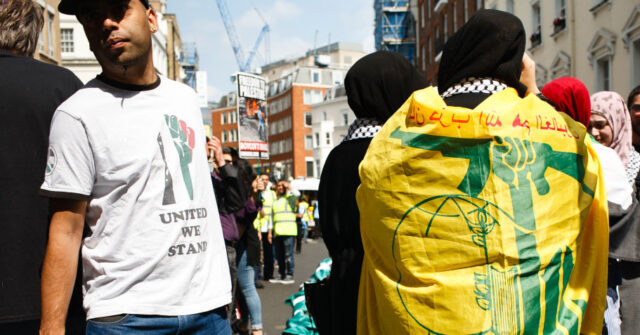
Breitbart News has long reported on the annual Al Quds day march and the efforts undertaken by those attending to remain just about on the right side of the law, timed to coincide with the end of Ramadan, and held to call for the destruction of Israel. In 2016, signs carried at the London protest included “Israel is a cancer we are the cure”, and “we are all Hizbullah”.
In 2017, for instance, those carrying or wearing the flag of Hezbollah had a small addendum stapled to their clothes stating “this flag is to show my support for the political wing of Hizbullah”, a dodge given the UK government at the time considered there was a meaningful distinction between Hezbollah’s military and political sides.
The UK later banned Hezbollah as a terrorist organisation outright in 2019. More recent editions of the march saw the Hezbollah flag replaced with the Palestine colours.