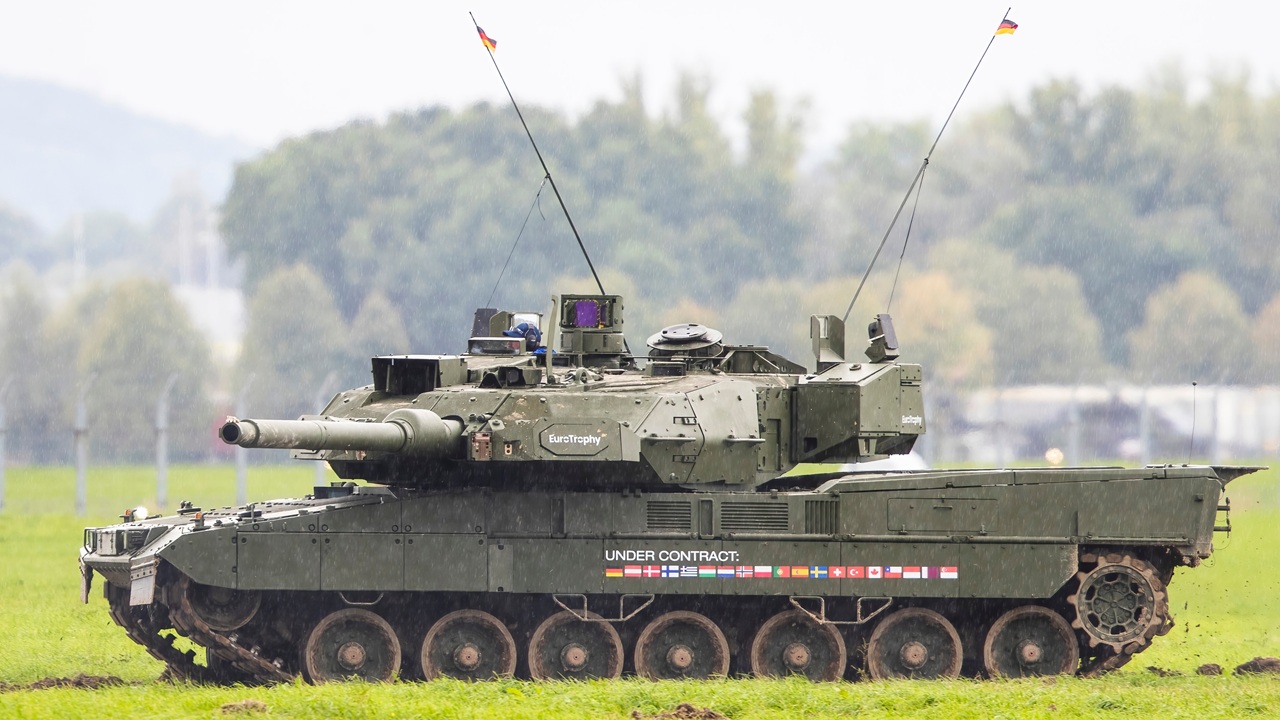
Germany’s Leopard 2A8 tank is unlikely to live up to its promises—but its construction is at least a worthwhile investment in the country’s ailing defense industrial base.
Germany wants everyone to know that it is leading the way for European rearmament, as the continent apparently believes the Russians are going to blitz the whole region after Moscow’s forces take Ukraine. The Leopard 2A8 was officially rolled out earlier this month at the KNDS Deutschland facility in Munich, Germany, marking Germany’s first brand-new Main Battle Tank (MBT) built for the Bundeswehr since 1992.
Germany has placed an initial order of 123 tanks of this variant, with deliveries scheduled between 2027 and 2030. It’s a bit strange that even though the Europeans are apparently convinced that a Russian invasion of Europe is imminent, all their defense projects will not mature until at least two years—and likely longer—from now. Either European threat assessments are wildly inaccurate, or the Europeans just aren’t that serious about rearmament.
What to Know About the New Leopard Tank
At the unveiling, Germany’s defense minister also announced Berlin’s intention to order another 75 Leopard 2A8s, bringing the total up to around 200. The vehicle incorporates a number of cutting-edge features, including an active protection system (APS)—the Israeli-origin Trophy Active Protection System (or equivalent) that detects and intercepts incoming anti-tank projectiles and drones. These newer tanks also integrate upgraded digital architecture and have an excellent sensor fusion suite that allows for battlefield network-centric operations.
The new Leopards continue employing the Rheinmetall L/55A1 120mm smoothbore main gun as part of the weapons package. However, the cannon is now embedded within a modernized turret and totally new vehicle architecture.
Initial deployment plans indicate that the first units to receive the Leopard 2A8 will be to the German Bundeswehr brigade permanently stationed in Lithuania, which is rapidly becoming a key area of contention in the growing Euro-Russian rivalry.
Germany is clearly committed to the MBT—which is odd, given that these systems are increasingly being relegated to secondary or support roles in modern conflicts due to the growing presence of accurate anti-tank missiles and drones. Of course, the Russians and Ukrainians have made effective use of older Soviet-era systems, notably the T-72 MBT. But these systems are largely expendable, and in no way represent the high cost and complexity that the new Leopard 2A8 MBTs do.
Could Germany not have developed cheaper, expendable, unmanned ground drones to replace the MBT?
Germany Is Missing the New Revolution in Military Affairs (Again)
This problem is by no means confined to Germany. NATO as a whole appears blind to the kind of radical tactical changes that have occurred in modern warfare, thanks to the Ukraine War. The Netherlands, Norway, Czechia, Lithuania, and other NATO members are also planning to order the Leopard 2A8.
This procurement will strengthen NATO’s logistical and operational cohesion. It will not, however, significantly contribute to war-winning capabilities.
Still, Germany is using the development of this new tank system as a means of regenerating the domestic heavy-armor manufacturing base (via KNDS Deutschland) after decades of limited new MBT production. Having a next-generation MBT developed and built domestically enhances strategic autonomy.
In classic fashion, though, while the tanks are ordered their full operational deployment is still years away, if they ever are fully operationalized by that time. Testing, initial units, soldier training, and logistics chains all need time to mature. Managing production, supply chain, and cost will be crucial for Berlin. Early reports indicate that the cost per unit will be around €20 million per vehicle.
And the Leopard 2A8 is not a finalized MBT that will endure for decades. The Germans are already working on its replacement, the Leopard 3.
Germany’s next-generation MBT represents a major step in Germany’s defense posture. Nevertheless, the broader challenge will be integration, production scaling, cost, and ensuring that such a platform retains relevance in the evolving threat environment of drones, precision fires, and hybrid warfare.
About the Author: Brandon J. Weichert
Brandon J. Weichert is a senior national security editor at The National Interest. Recently, Weichert became the host of The National Security Hour on America Outloud News and iHeartRadio, where he discusses national security policy every Wednesday at 8pm Eastern. Weichert hosts a companion book talk series on Rumble entitled “National Security Talk.” He is also a contributor at Popular Mechanics and has consulted regularly with various government institutions and private organizations on geopolitical issues. Weichert’s writings have appeared in multiple publications, including The Washington Times, National Review, The American Spectator, MSN, and the Asia Times. His books include Winning Space: How America Remains a Superpower, Biohacked: China’s Race to Control Life, and The Shadow War: Iran’s Quest for Supremacy. His newest book, A Disaster of Our Own Making: How the West Lost Ukraine is available for purchase wherever books are sold. He can be followed via Twitter @WeTheBrandon.
Image: Shutterstock / Karolis Kavolelis.