The Lebanese government pushed for a ceasefire between Israel and Hezbollah this week, citing the vast number of civilians displaced from southern Lebanon by the fighting.
Israel has thus far been cool to the proposal, expressing little confidence in the Lebanese government’s will or ability to disarm Hezbollah by force.
Lebanese President Joseph Aoun presented a four-point proposal on Tuesday that would include a “complete truce,” logistical support for the Lebanese Army to disarm Hezbollah, and “direct negotiations under international auspices” to get Israeli forces out of Lebanon. Direct negotiations with Israel have previously been a forbidden subject for Lebanese leaders.
Aoun denounced Hezbollah’s attack on Israel as “a trap, and an almost overt ambush for Lebanon, and the Lebanese state, and the Lebanese people.” He said Hezbollah and its paymasters in Tehran were trying to “buy the fall of the Lebanese state” without concern for the price, which included “destroying dozens of our villages and the fall of tens of thousands of our people for the sake of the Iranian regime’s calculations.”
Aoun said over 700,000 Lebanese citizens have been displaced by the fighting, including 200,000 children, creating a massive humanitarian crisis.
“Some of them are on the roads. They have no shelter and not even the most basic necessities of life,” he said.
The president’s criticism of Hezbollah was unusually sharp, as the Iran-backed terrorist group is also a potent political force in Lebanon. He slammed Hezbollah as an “armed faction” that gave “no weight to Lebanon’s interests, or to the lives of its people.”
Aoun also voiced his support for countries like Saudi Arabia, Qatar, and the United Arab Emirates (UAE) that have been “treacherously and reprehensibly targeted by the Iranian regime.”
Israeli officials did not leap to accept Aoun’s offer, noting that his government did not do enough to seize Hezbollah’s weapons after the 2024 ceasefire agreement — as evidenced by Hezbollah’s ability this week to shower Israel with rockets at Tehran’s command.
On Thursday, Lebanon reportedly sought help from the U.S. and European nations to persuade Israel to consider Aoun’s ceasefire proposal, but Israel once again rejected the proposal, even after Lebanon suggested asking the United States to sponsor the talks and Cyprus offered to provide hosting services.
The Jerusalem Post on Friday reported that an increasingly desperate Aoun has “begun appointing a negotiating delegation, and in some private meetings, he went as far as to say he was ready to move toward normalizing ties” with Israel.
“Everything is on the table,” said a source familiar with Aoun’s position.
Israeli and American officials were cool toward Aoun’s overtures because they felt Beirut had no “credibility” left, and “nothing tangible to offer at the negotiating table” when it came to eliminating the Hezbollah threat.
“The current problem is that dialogue with the Lebanese government cannot stop the fire from Lebanese territory,” said Israeli Foreign Minister Gideon Saar in an interview this week.
According to the Financial Times (FT), Israel did not completely reject the offer of talks with Lebanon, but said the negotiations must occur “under fire” — meaning the Israel Defense Forces (IDF) will continue their campaign to neutralize the Hezbollah threat. Some Israeli officials said they were prepared to continue the campaign against Hezbollah even after the war with Iran is concluded.
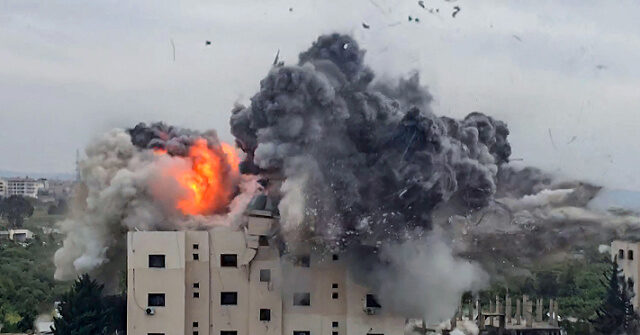
Israeli airstrikes struck central Beirut on Thursday, marking a significant escalation in the campaign against Hezbollah. Hezbollah fired another large salvo of rockets at Israel on Wednesday night.