The lawfare attempts to derail the populist National Rally in France may backfire, with a survey this week finding that Le Pen deputy Jordan Bardella would win the next presidential election against any other major opponent.
In March, three-time presidential candidate Marine Le Pen was handed a “political death sentence” of a five year ban from seeking any public office over alleged misuse of EU funds. While the National Rally leader has filed for appeal and is hopeful to have the penalty overturned before the 2027 presidential election, she has vowed to support her longtime second in command Jordan Bardella should the ban remain in place.
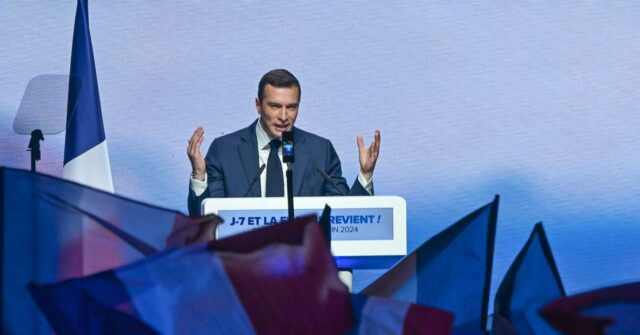
According to a survey from Odoxa, which did not factor in the currently banned Le Pen, the 30-year-old Bardella leads the entire field of top prospective candidates to replace President Emmanuel Macron, who is also precluded from running in 2027 due to being term limited.
The poll found that Bardella would secure between 35 and 36 per cent of the vote depending on the field of candidates in the first round of the two-round election. Furthermore, Bardella’s support is more than double that of any other likely opponents, with former Prime Minister Édouard Philippe trailing in a distant second at 17 per cent, Le Figaro reported.
However, the French system was intentionally designed in the wake of the Second World War and Algerian War of Independence to be stacked against populist candidates, by allowing disparate establishment parties to throw their collective weight behind the candidate with the best chance to take down any outsider who make it to the second round.
Yet the effective firewall, which stymied candidates like Marine Le Pen, appears vulnerable to being broken down by the charismatic and fresh faced Bardella. The Oxoda survey found that the National Rally president would comfortably best any likely challenger in the second round of voting.
According to the poll, Bardella would beat centrist Philippe by a margin of 53 to 47 per cent as well as against liberal ex-PM Gabriel Attal by 56 to 44 per cent. The populist leader would fair even better should a leftist advance to the second round, beating socialist Raphaël Glucksmann by 58 to 42 per cent and far-left leader Jean-Luc Mélenchon by 74 per cent to 26.
While the poll will be encouraging to National Rally supporters, the election is likely a year and a half out and nearly a third of those polled said that they remain undecided. It remains to be seen, however, if President Macron will reach it to the end of his second and final term, with the public growing increasingly weary of the frequent government collapses and the deadlock in the National Assembly preventing nearly all legislation.
Indeed, a separate survey from CSA for Le Journal du Dimanche found this week that 67 per cent of French voters want an early presidential election to replace Macron. This jumped to over nine in ten when narrowed to National Rally supporters.
Nevertheless, the year and a half before the vote may allow for Bardella to solidify his position at the helm of the sovereigntist movement in France.
His potential election in 2027 could also be the first in a domino chain of likely populist wins in Western Europe, with Brexit boss Nigel Farage standing as the odds on favourite to win the next general election in Britain and the AfD surging to the top of the polls in Germany.