The Last Adieu: Lafayette’s Triumphant Return, the Echoes of Revolution, and the Gratitude of the Republic, by Ryan L. Cole (Harper Horizon, 449 pp., $32)
In his stirring new book, The Last Adieu: Lafayette’s Triumphant Return, the Echoes of Revolution, and the Gratitude of the Republic, Ryan L. Cole charts the unfolding of an early episode of American mass hysteria: the nationwide reception, in 1824 and 1825, of the visiting Marquis de Lafayette, the French general who led Continental Army troops in the Revolutionary War and won the hearts of Americans everywhere. These passions, happily, were not destructive ones. On the contrary, as the author shows, the enthusiasm prompted by the French general’s return to the scenes of his former glory unified the nation by reminding its people of the inestimable price and, indeed, preciousness of freedom.
Finally, a reason to check your email.
Sign up for our free newsletter today.
One irony of what might be called the “Lafayettemania” to which Lafayette’s return gave rise is that it was an echo of his own effusive love for America when he first came to the country in 1777 as a 19-year-old nobleman enamored of George Washington and his “glorious cause.” General Lafayette’s conduct, both at Monmouth and during the Yorktown campaign—where he fought in tandem with the brilliant Comte de Rochambeau—entirely confirmed Washington’s confidence in the courage and good sense of his protégé. As Washington told Lafayette after the war, his “first impressions of esteem and attachment” had burgeoned into “perfect love and gratitude.” If Lafayette had had this effect on the aloof Washington, it is no wonder he inspired so much fondness in Washington’s countrymen.
After the war, when he returned to France, Lafayette was met by an ancien regime not altogether comfortable with his delight in republicanism, though it had assented to his pleas for naval support for the colonies at a time when France’s coffers could hardly afford it. As Robert and Isabelle Tombs observe in That Sweet Enemy: Britain and France: The History of a Love-Hate Relationship, the Court might eventually have lionized Lafayette along with most of his countrymen, but the revolutionary hero “embodied . . . values that implicitly passed judgment on the frivolous routine of Versailles.” Lafayette, fleeing the Jacobins during the Terror, was captured by Austrian and Prussian forces and spent five miserable years (1792–1797) in state prisons. Thus, the man at the center of Cole’s history knew the real blessings of freedom, having suffered their abrogation under the most lacerating circumstances.
That Lafayette could unite America’s political factions, however fleetingly, was another irony, since reaction to his role in the French Revolution had sharply defined those factions in the past. “The rioting in Paris and elsewhere,” Gordon Wood argued in Empire of Liberty: A History of the Early Republic 1789-1815, “the horrific massacres in September 1792 of over fourteen hundred prisoners charged with being enemies of the Revolution, the news that Lafayette had been deserted by his troops and his allies in the Assembly and had fled France—all these events convinced the Federalists that the French Revolution was sliding into popular anarchy”—and that America would surely follow if it did not repudiate the Revolution. John Adams, for one, had no illusions about what this anarchy portended: “Dragons’ teeth have been sown in France and will come up as monsters.” For Thomas Jefferson and the Republicans, however, such anarchy had to be tolerated if the Revolution’s egalitarian goals were to be achieved.
When Lafayette revisited America after an absence of 40 years, these abiding divisions were set aside. The old French general was met with adulation by Americans weary of political wrangling and desperate for reassurance that their country was worthy of its founding. In New York, these same Americans turned Castle Clinton into a resplendent ballroom with lighting out of the Arabian Nights and an enormous cake with Ever Welcome La Fayette inscribed upon it in sugar plums. In Philadelphia, they refurbished the East Room of the old State House to receive the honored Frenchman with windows covered in red and blue drapery and portraits along the walls of all the revolutionary heroes with whom Lafayette had fought, including Washington, Jefferson, Adams, John Hancock, James Madison, and James Monroe. Before his tour was complete, Lafayette had visited every one of the 24 states, and each had shown him the same exuberant gratitude.
It was President James Monroe who extended the formal invitation to General Lafayette to return to America. Politically wracked over the divisive issues that the addition of slave-owning Missouri introduced into the country, Monroe hoped that the 67-year-old Lafayette would exemplify what became known as his Era of Good Feeling. No bet ever paid off more spectacularly. Eighty thousand people met Lafayette’s ship when it docked in New York. Alabama spent nearly $17,000 celebrating Lafayette’s return—more than it was prepared to devote to a new statehouse. A local newspaper nicely captured the avidity behind such extravagance by confessing that “We gaze upon the object of our affections with a mixture of love, gratitude and admiration. Our feelings are so blinded and confused that we find it impossible to analyze them, and rapt in the intensity of our sensations, we become lost and absorbed in a dreamy state of mind.”
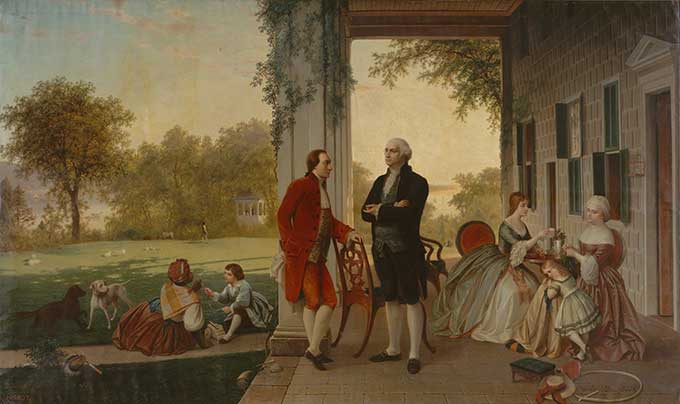
Everywhere the old general visited, he was received with maenadic affection. Indeed, as the historian Daniel Walker Howe remarks in What Hath God Wrought: The Transformation of America 1815-1848, “Lafayette’s Second Coming evoked rhetoric usually reserved for that of Christ.” Moreover, Americans of every political party saw his return as a boon to the country.
Ryan Cole does his marvelous theme the justice it deserves by packing it with the four qualities essential to any good history: thorough research, good style, good judgment, and inspired storytelling. Apropos the progress that America had made in Lafayette’s absence, Cole quotes a speech delivered by Horace Holley, president of Fayette County, Virginia’s Transylvania University. Founded in 1790, it was the first college established west of the Allegheny Mountains. Where, the president told the old French general, “a few years since, wolves howled and buffaloes congregated, you find a community of six hundred thousand civilized, cultivated and generous Freemen.” Some naysayers, Holley conceded, might look upon the celebrations of Lafayette’s return as “a popular pageant for the gratification of publick curiosity,” or worse, idolatry. But Holley knew otherwise. “We identify you,” he told Lafayette, “as we do Washington, with the same cause, the sentiments, the institutions, the blessings, which the recollection, and still more the sight of you, can never fail to embody. . . . Your presence is the Jubilee of Liberty.”
If some bits in the book read like a riveting travelogue, others pay an almost novelistic attentiveness to the various people who made up this commemorative history. When Lafayette goes to Albany and visits with Napoleon’s exiled brother Joseph, Cole describes the prince’s embarrassment as his exquisite home—full of statues by Canova and paintings by David—is overrun by American rustics eager to lay eyes on his honored guest. In Boston, the fastidious Charles Francis Adams looks upon the exultant reception given Lafayette with Brahman disdain. “It was a singular scene,” he confessed to his diary, “and for a quantity of rogues, knaves and whores matched almost any in the world,” though later, after hearing a speech by Edward Everett, one of nineteenth-century America’s best orators, he had to admit that “the passages I heard were really fine.” Cole quotes one in which Everett addresses the old French general directly: “You have looked round in vain for the faces of the many who would have lived years of pleasure on a day like this with their old companion-in-arms and brother in peril.” The men invoked by such words, Cole reminds his readers, were such heroic figures as Alexander Hamilton, Nathaniel Greene, and Henry Knox—and by 1824 they were, indeed, all gone. As was Washington, whom Cole describes as “in eternal repose on the banks of the Potomac River” and thus “unable to welcome his adopted son home once more.”
Throughout this moving history, Cole captures the pathos of such scenes. One of his best portraits is of Daniel Webser haranguing his auditors at the Bunker Hill Monument. “Let us cultivate a true spirit of union and harmony,” the orator exclaimed, “and in pursuing these great objects . . . act always with the feeling that the 24 States are united as one Nation.” After Webster’s speech, Cole writes, one of the veterans was heard to say, “We have not another fifty years meeting to look forward to here.” Intimations of mortality gave the otherwise celebratory proceedings a grave air. Toward the book’s end, Cole quotes The Wyoming Herald, which reported how Lafayette’s final departure from New York left old soldiers and spectators alike in tears. If Lafayette’s tour had begun in hysteria, it ended in a meditative calm. “When the old veteran left the dock,” the paper told its readers, “the immense concourse of people were silent at death and the solemn stillness was only broken by the loud peals of artillery, as the last salute in New York was fired in honor of the beloved ‘National Guest.’”
With the nation’s semiquincentennial approaching next year and Americans deeply polarized, the story of Lafayette’s return is timely. Ryan Cole’s ebullient book should remind us of how a reverence for freedom helped earlier Americans recover their national unity.
Top Photo by Pierce Archive LLC/Buyenlarge via Getty Images
Source link