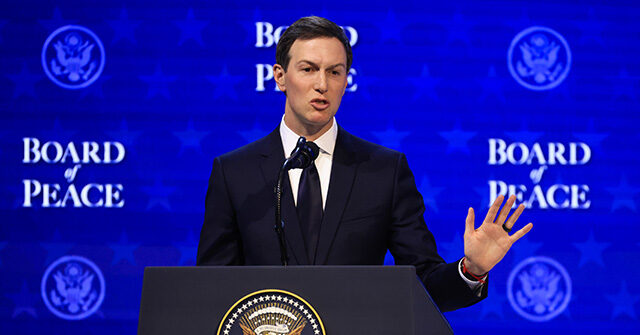
Jared Kushner on Thursday unveiled a sweeping U.S.-backed vision at Davos to rebuild the war-torn Gaza Strip into a “New Gaza” economic hub by 2035, outlining a phased redevelopment plan centered on infrastructure, investment, and employment — contingent on Hamas demilitarization and the surrender of its weapons.
Speaking at the signing ceremony for President Donald Trump’s newly launched Board of Peace on the sidelines of the World Economic Forum in Davos, Switzerland, Kushner — a senior White House adviser and the president’s son-in-law — laid out a phased “master plan” beginning in Rafah, a city on Gaza’s southern border, before moving northward in stages toward Gaza City.
Kushner said the administration deliberately chose to plan for what he described as “catastrophic success,” rejecting incremental or fallback approaches to Gaza’s future and insisting that the framework moving forward is singular and fixed.
Looking ahead, Kushner said the top priority of the plan is security, warning that without it reconstruction cannot begin. “Without security, nobody’s going to make investments,” he said, describing parallel efforts with Israel focused on de-escalation and with Hamas centered on demilitarization.
Kushner framed the initiative as a deliberate break from Gaza’s decades-long dependence on outside assistance, noting that for much of that time the territory’s economy has been overwhelmingly sustained by foreign aid — a reality he argued has left residents without “dignity” or “hope.” The administration, he said, wants to reverse that model by applying free-market economic principles to Gaza, using the same mindset and approach President Trump is implementing in the United States.
Addressing humanitarian conditions, Kushner rejected claims of famine and said the food needs of Gaza’s population are being met, pointing to more than 55,000 aid trucks and over 1.4 million pallets delivered during the war — which he described as one of the largest humanitarian operations ever conducted in an active conflict zone.
Kushner also highlighted the newly formed National Committee for the Administration of Gaza (NCAG), a Palestinian technocratic body tasked with restoring civil life in the territory. He pointed to its mission statement committing to security, essential services, and governance rooted in transparency and accountability.
“This is the first time it’s technocratic,” Kushner said, crediting Arab partners with helping assemble the committee and urging critics to give it a chance.
At the core of the plan is a demilitarization-first sequencing that ties rebuilding to verified weapons collection, with incentives designed to accelerate compliance.
Under the framework Kushner presented, Hamas’s heavy weapons would be decommissioned immediately, while small arms would be collected sector-by-sector by a newly formed Palestinian police force. Reconstruction would begin only in fully disarmed areas.
Hamas operatives who agree to surrender their weapons would be offered amnesty, reintegration, or safe passage, according to the plan, with some potentially eligible for integration into the new police force following rigorous security vetting.
Once demilitarization is completed and independently verified, the IDF would withdraw to a security perimeter surrounding Gaza, with further withdrawals tied to progress on the ground.
Kushner said the next 100 days will focus on humanitarian relief, temporary shelter, and clearing rubble — laying the groundwork for longer-term redevelopment.
He added that the administration will host an international investment conference on Gaza in Washington in the coming weeks, where donor commitments and private-sector opportunities will be announced.
“I know it’s a little risky to be investing in a place like this,” Kushner said, urging governments and business leaders to step forward and invest.
Throughout his remarks, Kushner repeatedly emphasized that the entire blueprint hinges on Hamas disarmament.
“Without that, we can’t rebuild,” he said. “If Hamas does not demilitarize, that will be what holds back Gaza and the people of Gaza from achieving their aspirations.”
Seeking to cool regional tensions, Kushner urged critics to pause public attacks and allow the plan to move forward.
“I see people criticizing Israel, or Israelis criticizing Turkey or Qatar,” he said. “Just calm down for 30 days.”
“The goal here is peace between Israel and the Palestinian people,” Kushner added. “Everyone wants to live peacefully. Everyone wants to live with dignity.”
The plan projects more than $25 billion in investment and envisions Gaza’s GDP exceeding $10 billion by 2035, with average household income rising above $13,000 — supported by major infrastructure projects including a port, an airport, workforce housing, industrial zones, and a tourism corridor along the Mediterranean coast.
Kushner’s presentation came a day after President Trump issued a stark warning to Hamas during his own remarks at Davos, saying the terrorist group must follow through on its commitment to disarm.
“Hamas has agreed to give up their weapons,” Trump said. “If they don’t do it, they’ll be blown away very quickly.”
That warning stands in contrast to statements made by Hamas’s senior leadership abroad. In December, Hamas chief Khaled Mashal openly rejected disarmament, declaring that “the resistance and its weapons are our honor and glory,” even as the group continued to posture against the framework underpinning Trump’s Gaza plan.
Still, Kushner insisted Thursday that the administration is moving forward based on the original framework already agreed to.
“People ask us what our plan B is,” he said. “We don’t have a plan B. We have a plan.”
Whether that plan moves forward now hinges on Hamas’s willingness to follow through on the demilitarization phase in the coming weeks.
Joshua Klein is a reporter for Breitbart News. Email him at jklein@breitbart.com. Follow him on Twitter @JoshuaKlein.