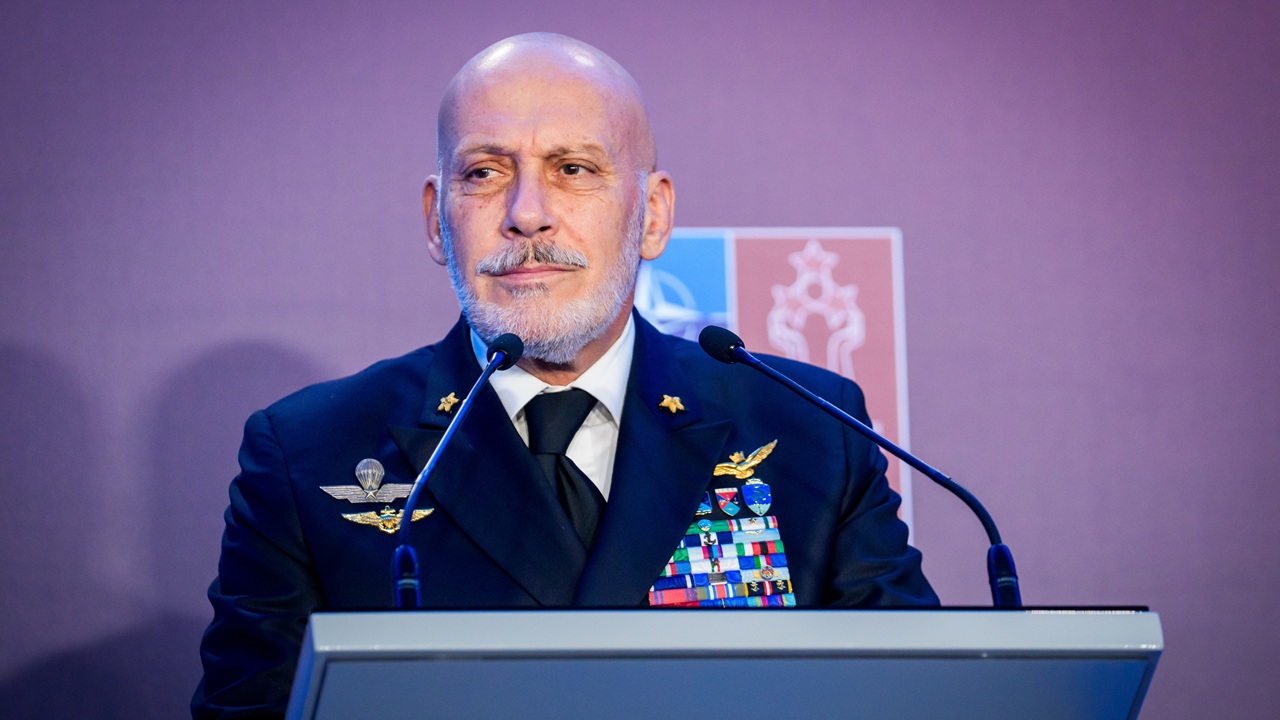
An Italian admiral speculated that military action against Russia could still be considered “defensive” in nature, considering Russian hybrid warfare actions against the West.
The Kremlin responded to comments made by NATO’s top military leader after he said that alliance members could consider launching “preemptive strikes” against Russia.
Italy’s Admiral Giuseppe Cavo Dragone, the chairman of NATO’s military committee, said in a recent interview with the Financial Times that the international military alliance was reevaluating how it could be “more aggressive [or] proactive instead of reactive” in response to cyber and sabotage operations carried out by Moscow.
Maria Zakharova, a spokesperson for Moscow’s Foreign Ministry, said Dragone’s remarks were “an extremely irresponsible step, indicating the readiness of the alliance to continue to move toward escalation.”
She added, “The people making such statements should be aware of the risks and possible consequences, including for the alliance members themselves.”
The Best Defense Is a Good Offense, NATO Commander Says
Even as Russia has criticized Dragone’s comments, the Italian admiral has stood by them. Moreover, he had suggested that such a move should still be considered “defensive” in nature, even as it would be a significant change in how the alliance has operated in the past.
“We are studying everything. On cyber, we are kind of reactive. Being more aggressive or proactive instead of reactive is something we are thinking about,” Dragone said.
In January 2025, NATO launched its “Baltic Sentry” initiative to enhance its military presence in the Baltic Sea and to improve the ability to respond to “destabilizing acts.” The increased focus on countering repeated sabotage to undersea cables and other infrastructure may already be showing results.
“From the beginning of Baltic Sentry, nothing has happened. So this means that this deterrence is working,” Dragone explained.
NATO had previously been on high alert following nearly a dozen incidents in which vessels in the Baltic Sea allegedly dragged anchors to damage energy and communications cables. The marked increase in NATO military presence with Baltic Sentry has resulted in no additional “malign damage” being reported.
Russia Is Already Pushing Europe’s Boundaries
Although the undersea threats have slowed, the past few months have seen numerous aerial incursions into NATO airspace. Alliance aircraft that were part of the Baltic Air Policing (BAP) mission were scrambled in September after Russian fighters violated Estonian airspace. A Dutch Lockheed Martin F-35 Lightning II also shot down a Russian drone that had crossed into Polish airspace this fall. It marked the first time that any Western-made aircraft had fired on the drones.
The Kremlin has attempted to downplay these incidents and criticized Dragone’s claims of Russian aggression.
“We see in it a deliberate attempt to undermine efforts to overcome the Ukrainian crisis,” added Zakharova. “The people making such statements should be aware of the risks and possible consequences, including for the alliance members themselves.”
However, some experts have said that Russia is attempting to deflect from its ongoing war in Ukraine.
“Given Russia’s unilateral invasion of Ukraine in 2022, the idea that Russia is warning about NATO being irresponsible is laughable,” Carrie Filipetti, executive director of the Vandenberg Coalition and a former senior State Department and official at the US mission to the United Nations, told Fox News Digital on Monday. “Putin has been given numerous opportunities to end the war peacefully and has refused them all because of his own expansionist goals. NATO is simply reacting to his aggression.”
Filipetti explained that NATO’s famed Article 5 “merely states that an attack on one is an attack on all. NATO adopting a more assertive position does not obligate the US to do the same. We are only required to take ‘such action as [we] deem necessary’ – and that, only in the case of an attack on a NATO state.”
What is also clear is that—for better or worse—Dragone’s statements have gotten Russia’s attention.
About the Author: Peter Suciu
Peter Suciu has contributed over 3,200 published pieces to more than four dozen magazines and websites over a 30-year career in journalism. He regularly writes about military hardware, firearms history, cybersecurity, politics, and international affairs. Peter is also a contributing writer for Forbes and Clearance Jobs. He is based in Michigan. You can follow him on Twitter: @PeterSuciu. You can email the author: [email protected].
Image: Shutterstock / Gints Ivuskans.