Though rocket artillery had its origins in the Cold War, the platforms are still highly relevant on the modern battlefield—as seen in Ukraine.
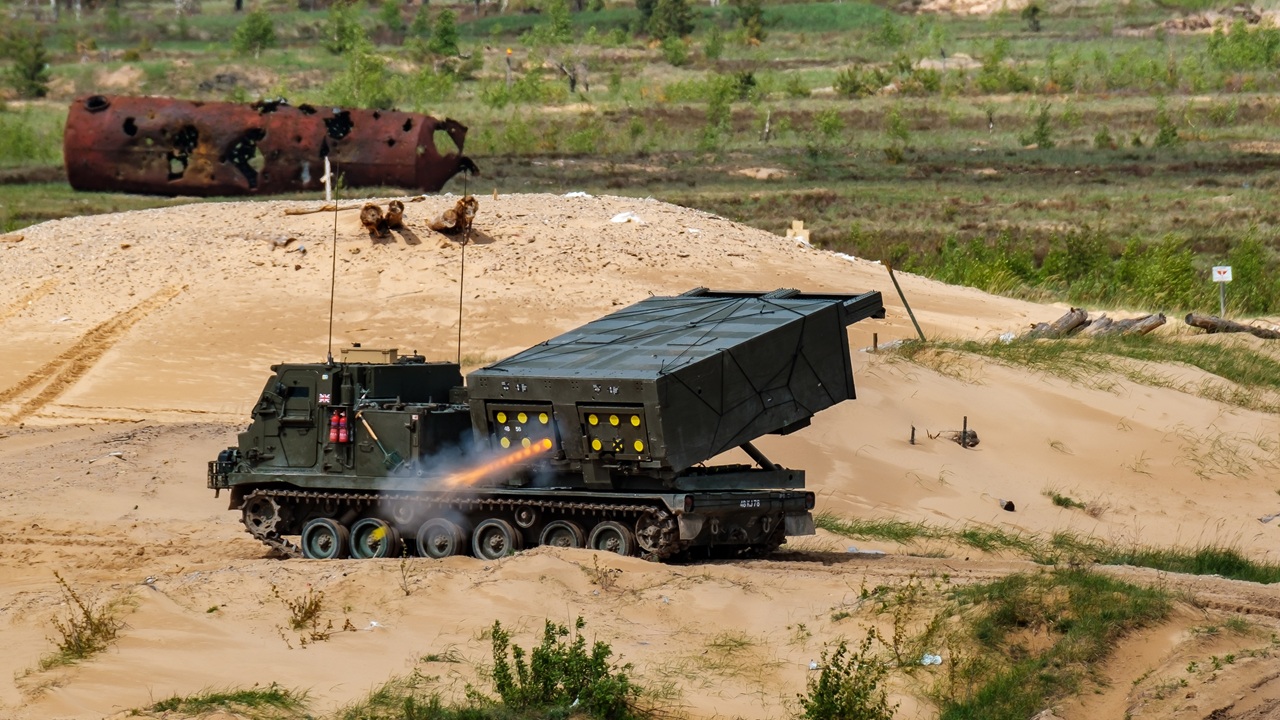
In December, the US Army held a large-scale firing drill to test fire its new M270A2 Multi Launch Rocket System (MLRS) on the Korean Peninsula.
The M270 Launches “Steel Rain” on America’s Enemies
Earlier in December, Charlie Battery, 1-38 Field Artillery Regiment, 210 Field Artillery Brigade, became the first unit stationed on the Korean Peninsula to live fire the new M270A2 MLRS during a large-scale test firing drill.
The M270 MLRS is a rocket artillery system that can fire missiles dozens of miles away with pinpoint precision.
“To be able to [be the first battalion to shoot the new launcher systems] in Korea sends a strong signal of how the U.S. Army is continuing to modernize, continuing to transform, with more modern up-to-date capabilities in technology,” US Army Lieutenant Colonel Daniel Han, the commanding officer of 1-38 FA, said in a command press release.
The latest version of the M270 MLRS comes with a new 600-horsepower engine, updated fire control systems and software, an improved and enlarged armored cab, and the ability to fire the latest available munitions, including the Precision Strike Missile (PrSM). The Army aims to eventually upgrade its entire fleet of approximately 225 M270 MLRS to the “A2” variant.
“It also tells our allies, the ROK Army, that as they’re modernizing their long-range precision shooter platforms we’re right there side by side with them going through the same type of transformation to say that ‘we’re all in this together,’” the Army officer added.
The exercise was designed to test the unit’s readiness and ability to execute an effective and precise mission under pressure, simulating realistic battlefield conditions.
“Being able to get out there, conduct rehearsals, conduct a live fire, very proficiently within a short, condensed amount of time that we had speaks a lot to Charlie battery, their team and all the preparation that they’ve done up to this point,” Han added.
The M270 MLRS is a tracked rocket artillery system with a three-man crew (driver, gunner, and section chief). It can carry up to 12 MLRS/GMLRS rockets or 2 MGM-140 Army Tactical Missile System (ATACMS) ballistic missiles (double the total payload of the M142 HIMARS). Depending on the munition used, it can hit targets 20 to almost 200 miles away.
Artillery remains the most important weapon on the battlefield. The war in Ukraine has shown that even in modern warfare, artillery can account for as many as 85 percent of battlefield casualties.
Rocket Artillery Is a Child of the Cold War—but Still Relevant Today
Although a weapon system designed, developed, and first produced during the Cold War, the M270 MLRS remains a strong artillery option for modern militaries. The war in Ukraine has been a great marketing opportunity for the rocket artillery system and its wheeled cousin, the M142 High Mobility Artillery Rocket System (HIMARS).
Both artillery weapon systems have been in use by the Ukrainian forces since the early months of the war. Initially, they made a significant difference on the battlefield as the Russian military had little to counter them. They were able to destroy with near impunity Russian high-value targets, including command and control posts, air defense systems, artillery positions, ammunition depots, and communication lines.
At some point, the Russian military managed to restrict the deadly effect of the M270 MLRS and M142 HIMARS by pulling its high-value assets outside of range. But the two rocket artillery systems continue to remain useful for the Ukrainian military in the great artillery duel that characterizes the war. Indeed, the M270 MLRS and M142 HIMARS are exacting heavy personnel and materiel losses from the Russian forces.
About the Author: Stavros Atlamazoglou
Stavros Atlamazoglou is a seasoned defense journalist specializing in special operations and a Hellenic Army veteran (national service with the 575th Marine Battalion and Army HQ). He holds a BA from the Johns Hopkins University and an MA from the Johns Hopkins’ School of Advanced International Studies (SAIS). His work has been featured in Business Insider, Sandboxx, and SOFREP.
Image: Shutterstock / Karlis Dambrans.