For most of aviation history, bombs were “dumb”—that is, unguided and inaccurate. Precision strike was either technologically unavailable or too expensive to deploy at volume.
The Joint Direct Attack Munition (JDAM) changed that—not by inventing a new bomb, but by adding guidance to existing bombs. The result was a cheap and reliable “smart” bomb with all-weather precision, making the JDAM one of the most important weapons in modern air combat.
What Exactly Is a JDAM?
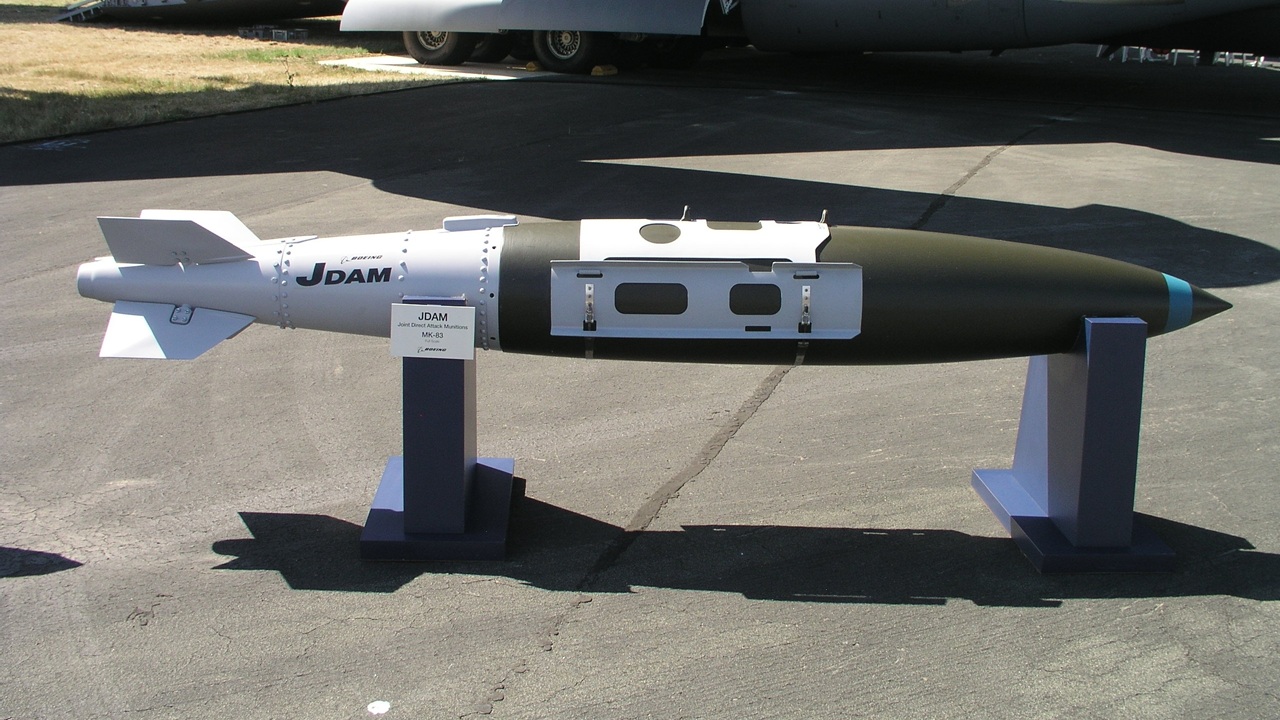
JDAM—developed jointly by the US Navy and US Air Force, hence its name—is not itself a bomb. Instead, it is a guidance kit that converts unguided “dumb” bombs into GPS-guided precision weapons. JDAM is compatible with 500-, 1,000-, and 2,000-pound bomb bodies and is used by US and allied aircraft. The JDAM emphasizes simplicity and mass availability, offering precision without exorbitant cost.
The JDAM kit consists of a tail guidance kit, control fins, a GPS primary guidance system and an Inertial Navigation System (INS) backup guidance. The weapons receive target coordinates before release. Then, after release, the bomb flies autonomously; the GPS updates correct for wind drift and release errors, while the INS allows for continued accuracy in the event of GPS jamming. While the JDAM does not offer a seeker head with terminal guidance, typical accuracy usually falls within 5 to 10 meters of the target.
The JDAM is a simple system, reliable and cost-effective and available for use at scale. There are no imaging sensors, no data links, no propulsion. Instead, the JDAM relies on aircraft sensors and pre-planned targeting—and it works at day or night, or in bad weather. The brilliance of the system is that it uses existing bomb stocks; minimal new aircraft integration is required. This design choice reduces costs and speeds production, allowing the JDAM to remain replaceable and scalable, favoring quantity over exquisite capability.
How Has the US Military Used the JDAM?
JDAM is an excellent option against fixed targets, infrastructure, bunkers, etc. Successful deployment requires accurate coordinates, so the JDAM is often paired with ISR assets and/or forward observers. Because the JDAM can be released from medium to high altitudes, it can be released from outside many air defenses. JDAM is used to support rapid strike and based attacks, which are ideal for pre-planned targets. As one can imagine, the munitions are less effective against moving targets unless updated coordinates are available.
Strategically, JDAM served to democratize precision strike capability; the technology has reduced sortie counts and collateral damage relative. The lower cost supports sustained campaigns where precision becomes routine and expected. The effect was a change in targeting doctrine, the enablement of large-scale air campaigns. Because of JDAM, precision was no longer limited to elite units, which allowed for the reshaping of air power globally.
The technology is not flawless, however. JDAM is reliant on GPS, which is vulnerable to jamming and spoofing. The lack of a terminal seeker means the JDAM cannot adjust to last-second movement. So the system is dependent upon strong ISR and is not ideal for mobile targets, which limits the JDAM’s universality. Still, continued upgrades, especially improved INS and anti-jam GPS, will help with moving target engagement. And one can expect that the JDAM will remain relevant well into the future—because it is cheap, because it works, and because future wars will still need affordable precision at scale.
About the Author: Harrison Kass
Harrison Kass is a senior defense and national security writer at The National Interest. Kass is an attorney and former political candidate who joined the US Air Force as a pilot trainee before being medically discharged. He focuses on military strategy, aerospace, and global security affairs. He holds a JD from the University of Oregon and a master’s in Global Journalism and International Relations from NYU.
Image: Shutterstock / Flying Camera.