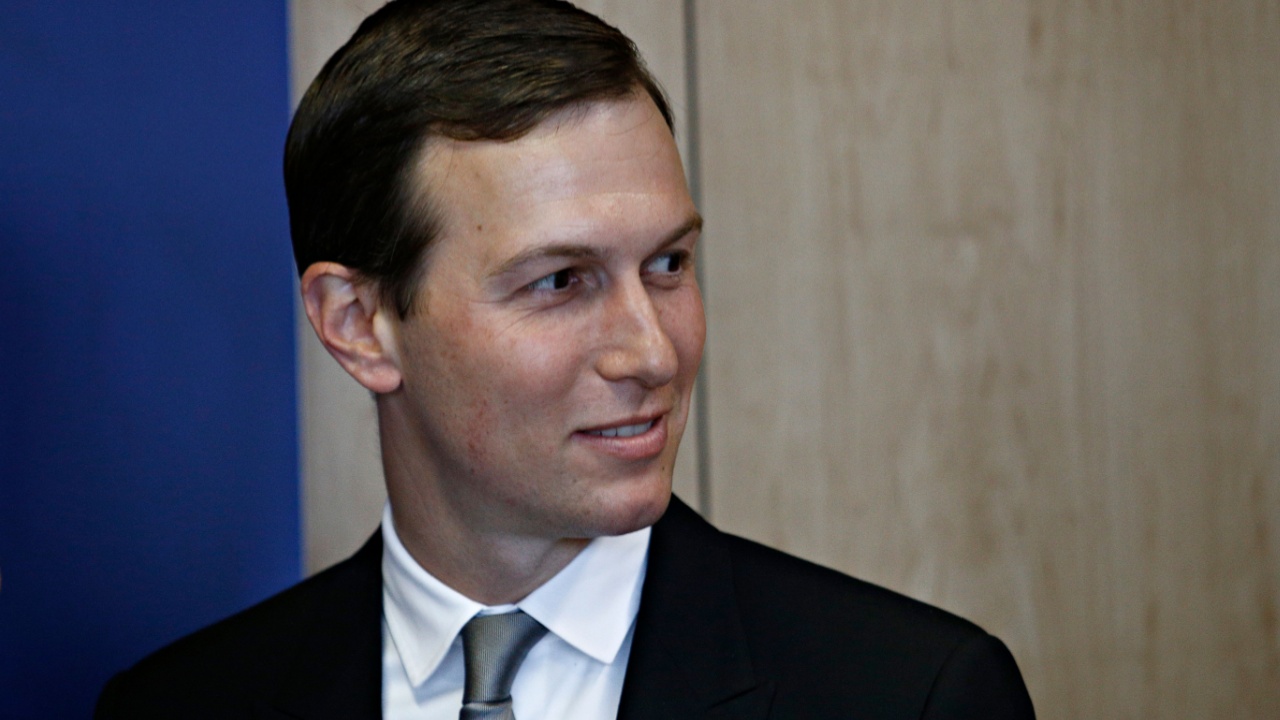
The man behind the Donald Trump administration’s Middle East policy understands the region far better than his critics.
In the summer of 2017, far from cameras and headlines, Jared Kushner met quietly with a group of congressional interns. It was part of an off-the-record lecture series—no spectacle, no slogans, no applause lines. Just questions, answers, and something rare in Middle East diplomacy: honesty without illusion.
During the exchange, Kushner outlined his approach to negotiations in the Middle East. He did not claim to possess a miracle solution. Instead, he said something far more unsettling—and far more truthful. Based on extensive research, he explained that “little has been accomplished in the last 40 or 50 years.” After speaking with countless leaders and citizens, one conclusion was unavoidable: “the situation is extremely tense.”
Then came the line that revealed his method—not emotional, not ideological, but relentlessly focused on outcomes:
So, what do we offer that’s unique?…I’m sure everyone that’s tried this has been unique in some ways, but again we’re trying to follow very logically. We’re thinking about what the right end state is. And we’re trying to work with the parties very quietly to see if there’s a solution. And there may be no solution, but it’s one of the problem sets that the president asked us to focus on.
Few realized at the time that this mindset—quiet, methodical, immune to fashionable pessimism—would give birth to one of the most consequential diplomatic breakthroughs of our generation: the Abraham Accords. Their genius was not merely in imagining peace where cynicism had ruled for decades. It was in sustaining that peace when politics, ideology, and violence all conspired to undo it.
The Endurance of the Abraham Accords
In 2020, President Joe Biden won the election. In American politics, policy continuity is never guaranteed—especially when a signature initiative belongs to the previous administration. I repeatedly heard from Biden’s inner circle that the Abraham Accords were “just a trade agreement” that lacked depth and was destined to fade.
Yet while critics dismissed them, Kushner never stopped working outside of government, without titles or press releases. Two years later, reality imposed itself. The accords were not fading. Biden’s advisers eventually understood what they had underestimated: this was not transactional diplomacy, but a structural shift in the Middle East.
Then came October 7, 2023—a date that will forever scar our collective conscience. A terrorist massacre so brutal that it should have shattered any remaining belief in coexistence, dialogue, or hope. For many, it did. But not for Kushner. What followed was not denial, nor moral confusion. It was the ability to hold multiple truths at once: compassion for the Israeli people who suffered an unspeakable crime; determination to save the Palestinian people held hostage by a terrorist organization; and respect for Arab public opinion caught between grief, anger, and exhaustion.
In the aftermath of horror, Kushner chose construction over collapse. He traveled across the region speaking not the language of vengeance, but of rebuilding—of futures rather than funerals, of dignity rather than despair.
Naming the Muslim Brotherhood Disease
Peace cannot be built on illusions. Before reconstruction, before economic corridors, before master plans, there is a prerequisite that too many leaders avoid naming: the ideological infrastructure that sustains terrorism.
Here, credit must be given where it is due. President Donald Trump’s National Security Council team understood that no future was possible without confronting the source. Figures such as Sebastian Gorka, Senior Director for Counterterrorism, and Nancy Dahdouh, Director for Counterterrorism and a well-known expert on global Sunni extremist threats, worked to expose extremist networks, including the Muslim Brotherhood and its affiliates—organizations that have radicalized generations by glorifying grievance and sanctifying death. Liberation begins in the mind.
For decades, the region was trapped between false choices: authoritarian stagnation or revolutionary chaos; repression or terror; silence or martyrdom. October 7 did not merely shock the world—it shattered these illusions within the region itself. Arab societies are exhausted. Their youth want opportunity, not ideology. Their economies need growth, not endless war. Quietly but decisively, leaders understand that Gaza cannot remain a launchpad for conflict without condemning an entire generation to misery.
Palestinians—who carry the heaviest burden—understand this most of all. Hamas did not liberate them. It imprisoned them.
Why the Davos Gaza Plan Is Not a Dream
When Jared Kushner presented a plan for Gaza’s reconstruction at the Davos Forum last week, he did not show a fantasy of towers and resorts, nor a Western projection imposed on a broken land. It was a hard-headed response to regional reality. The master plan begins with a simple but radical premise: reconstruction must replace resistance as the organizing principle of Palestinian life. Not slogans. Not martyrdom. But housing, energy, schools, ports, technology, and jobs.
Gaza is envisioned as a demilitarized, reconstructed economic space—connected to Israel, Egypt, and the Gulf through infrastructure rather than Hamas tunnels and integrated into regional trade rather than isolated by perpetual war. Security comes first, but not as a form of punishment, rather as a foundation that allows life to restart.
Critics argue the plan avoids politics. In reality, it acknowledges something deeper: people cannot wait for perfect political solutions to start living. Stability creates the conditions for politics; it does not follow them. Prosperity does not magically appear after peace—it often creates the environment in which peace becomes possible. This is why the plan is not naïve. It is necessary.
The Middle East is no longer choosing between justice and peace. It is choosing between life and endless ruin. After decades of failure, exhaustion has produced clarity. The people of the region understand that rebuilding is not betrayal, that hope is not weakness, and that choosing life is no longer optional.
For the first time in generations, the future is not being postponed. It is being planned.
About the Author: Ahmed Charai
Ahmed Charai is the publisher of The Jerusalem Strategic Tribuneand serves on the boards of directors of the Atlantic Council, the International Crisis Group, the Center for Strategic and International Studies, the Foreign Policy Research Institute, and the Center for the National Interest.
Image: Alexandros Michailidis / Shutterstock.com.