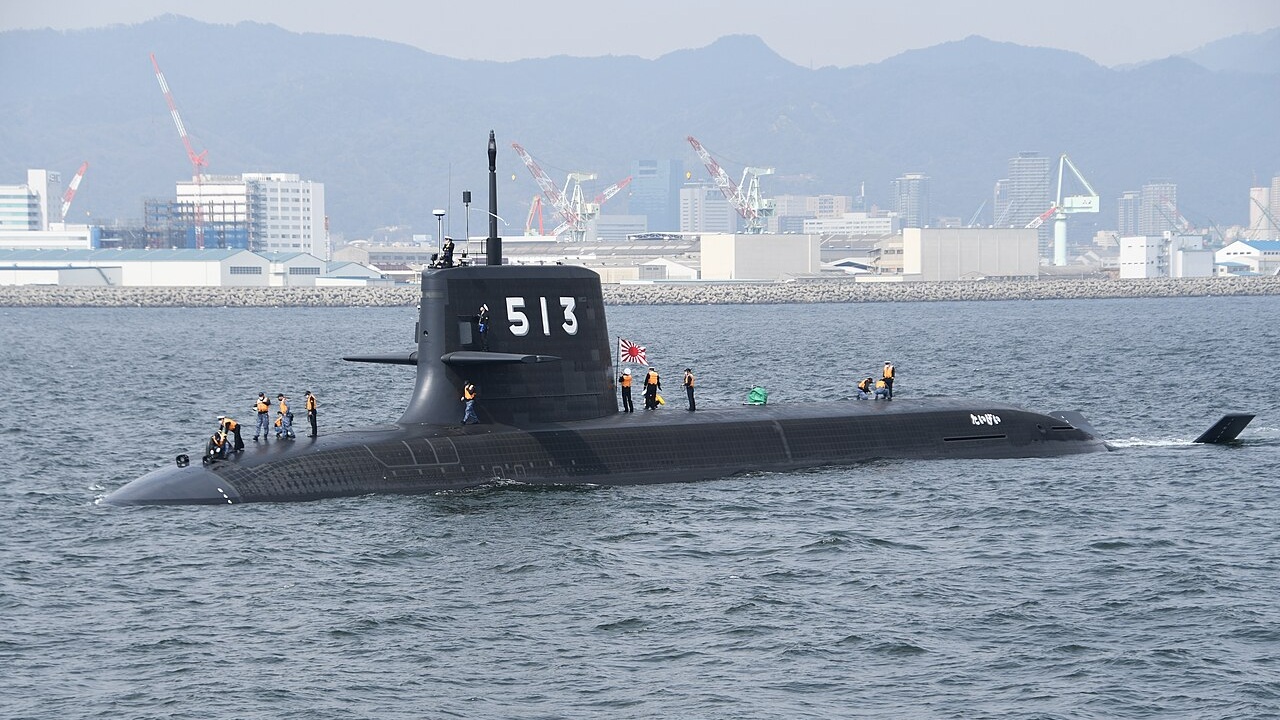
Japan now operates five cutting-edge Taigei-class submarines, in addition to its 12 Soryu-class and 6 Oyashio-class vessels.
The Japan Maritime Self-Defense Force (JMSDF) commissioned its fifth Taigei-class diesel-electric fast attack submarine this week, with the boat officially handed over at a ceremony on Tuesday, March 10, at Mitsubishi Heavy Industries’ Kobe Shipyard.
The current program of record calls for the JMSDF to operate eight of the advanced attack submarines. The JS Choegi (SS-517) will serve with Submarine Division 2 of the JMSDF’s Submarine Flotilla 2, homeported at Yokosuka naval base in Kanagawa Prefecture.
The base is also the homeport for the US Navy’s only forward-deployed nuclear-powered supercarrier, the USS George Washington (CVN-73).
About the Taigei-Class Submarines
- Year Introduced: 2022
- Number Built: 5 (10 planned)
- Dimensions:
- Length: 84 m (275 ft)
- Beam (Width): 9.1 m (29.85 ft)
- Draft: 10.4 m (34.12 ft)
- Displacement: ~3,000 tonnes (2,950 tons)
- Propulsion: Diesel-electric, 1 shaft, with Lithium-ion batteries (supplied by GS Yuasa).
- Speed: ~20 knots (underwater)
- Armament: Six 533 mm (21-inch) torpedo tubes (Type 89 or Type 18 torpedoes), UGM-84 Harpoon anti-ship missiles.
- Crew: ~70
The lead boat, JS Taigei (SS-513), was commissioned in March 2022, and each year since, an additional submarine of the class has entered service with the JMSDF. The first submarine in the class was commissioned in March 2022, while Tokyo approved funding for the full eight boats in fiscal year 2024 (FY24).
All of the boats of the class incorporate “gei” (whale) into their names, and “Taigei” translates to “big whale.” The submarines were developed to supplement, and eventually replace, Japan’s aging Soryu class, which have been in service since 2005. They will also be supplemented by the JMSDF’s six Oyashio-class subs—bringing the present sub strength of the service up to a total of 23 vessels.
Although similar in size to the Soryu class, the new JMSDF boats feature a reduced wheelhouse that is partially integrated into the ship’s hull, which could reduce the hydrodynamic resistance when driving in a submerged position. That, in turn, could further improve battery performance.
The diesel-electric Taigei-class submarines were developed as the S9SS class, named after the 29th year of then-Emperor Akihito’s reign in Japan.
“The engine is designed to work with an updated snorkel system that improves power generation efficiency and battery charging performance, particularly for the submarine’s lithium-ion battery system,” Naval News explained.
In addition, the capabilities of its sonar and combat command systems have been improved, and the submarine has been fitted with improved acoustic-absorbent materials and a floating floor structure to reduce noise.
Each Taigei-class submarine is operated by a crew of 70, but the JS Chogei is noted for its female-only accommodation compartments, which provide living space for up to six women sailors.
The Taigei Class Are True Attack Submarines
The Taigei-class fast attack submarines are armed with six 533mm tube launchers for torpedoes and cruise missiles and are also outfitted with Torpedo Counter Measures (TCM), which can be used to eject decoys to evade enemy torpedoes and improve survivability. The submarine will have a crew of around seventy sailors.
As previously reported by Maya Carlin for The National Interest, “The (Taigei-class) submarines are able to launch Japan’s newest Type 18 heavyweight torpedoes or Mitsubishi-built Type 89 heavyweight homing torpedoes via their six 21-inch bow torpedo tubes. Additionally, the Taigei can launch UGM-48 Harpoon anti-ship missiles. The missile range of the Harpoon is 248 km—enough to provide Japan with a ‘counterattack’ capability.”
About the Author: Peter Suciu
Peter Suciu has contributed to dozens of newspapers, magazines and websites over a 30-year career in journalism. He regularly writes about military hardware, firearms history, cybersecurity, politics, and international affairs. Peter is also a contributing writer for Forbes and Clearance Jobs. He is based in Michigan. You can follow him on Twitter: @PeterSuciu. You can email the author: [email protected].