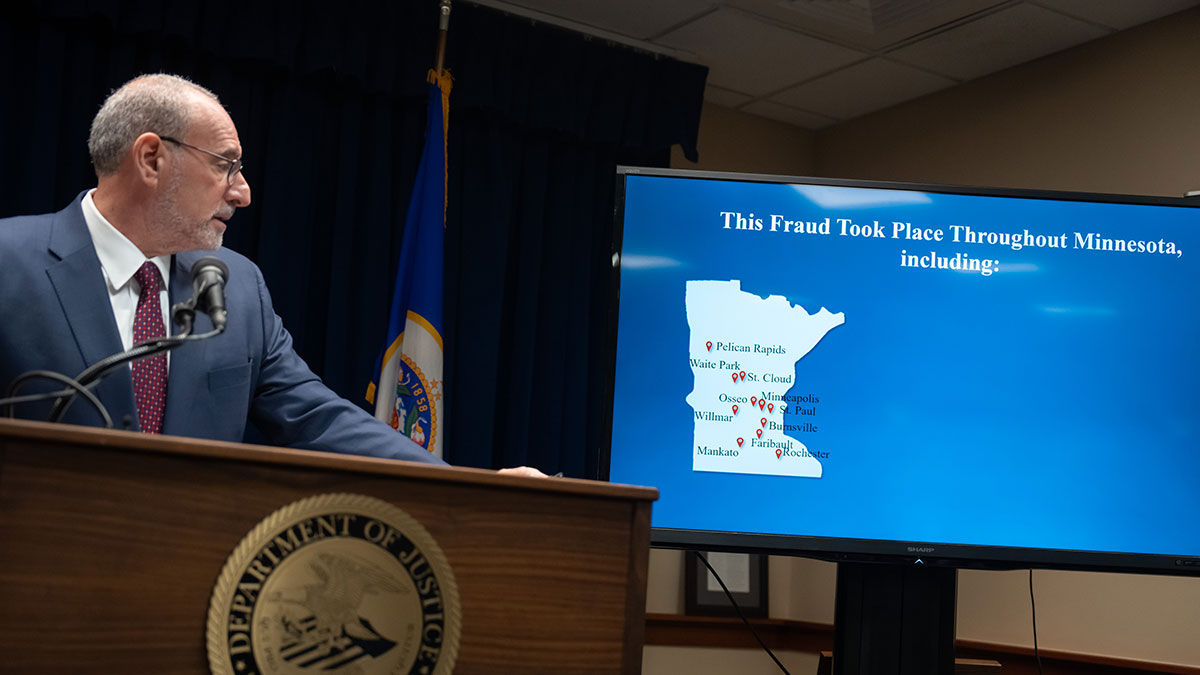
Last week, my colleague Ryan Thorpe and I broke a story about widespread fraud committed by Somalis in Minnesota. Members of the state’s Somali community participated in complex schemes related to autism services, food programs, and housing, which prosecutors estimate have stolen billions of taxpayer dollars. Even worse, some of the cash has ended up in the hands of Al-Shabaab, a terrorist organization in Somalia.
The story quickly reached the White House. Within days, President Trump announced that he was revoking the Temporary Protected Status (TPS) for all Somali migrants in Minnesota.
Finally, a reason to check your email.
Sign up for our free newsletter today.
Progressives have suggested that our reporting and the subsequent policy change were “racist.” While many of those indicted in these schemes are Somali, these critics argue, the federal government should not hold Minnesota’s Somali community corporately responsible for the actions of individuals.
This criticism is superficially appealing, but it isn’t persuasive on closer inspection.
First, a description of the facts should not be measured as “racist or not racist,” but rather as “true or not true.” And in this case, the truth is that many members of a relatively small community participated in a scheme that stole billions in funds. This is a legitimate consideration for American immigration policy, which is organized around nation of origin and, for more than 30 years, has favorably treated Somalis relative to other groups. It is more than fair to ask whether that policy has served the national interest. The fraud story suggests that the answer is “no.”
Second, the fact that Somalis are black is incidental. If Norwegian immigrants were perpetrating fraud at the same scale and had the same employment and income statistics as Somalis, it would be perfectly reasonable to make the same criticism and enact the same policy response. It would not be “racist” against Norwegians to do so.
Further, Somalis have enormously high unemployment rates, and federal law enforcement have long considered Minneapolis’s Little Mogadishu neighborhood a hotspot for terrorism recruitment. We should condemn that behavior without regard to skin color.
The underlying question—which, until now, Americans have been loath to address directly—is that of different behaviors and outcomes between different groups. Americans tend to avoid this question, rely on euphemisms, and let these distinctions remain implied rather than spoken aloud. Yet it seems increasingly untenable to maintain this Anglo-American courtesy when the Left has spent decades insisting that we conceptualize our national life in terms of group identity.
The reality is that different groups have different cultural characteristics. The national culture of Somalia is different from the national culture of Norway. Somalis and Norwegians therefore tend to think differently, behave differently, and organize themselves differently, which leads to different group outcomes. Norwegians in Minnesota behave similarly to Norwegians in Norway; Somalis in Minnesota behave similarly to Somalis in Somalia. Many cultural patterns from Somalia—particularly clan networks, informal economies, and distrust of state institutions—travel with the diaspora and have shown up in Minnesota as well. In the absence of strong assimilation pressures, the fraud networks aren’t so surprising; they reflect the extension of Somali institutional norms into a new environment with weak enforcement and poorly designed incentives.
The beauty of America is that we had a system that thoughtfully balanced individual and group considerations. We recognized that all men, whatever their background, have a natural right to life, liberty, property, and equal treatment under the law. We also recognized that group averages can be a basis for judgment—especially in immigration, where they can help determine which potential immigrant groups are most suitable and advantageous for America.
These principles are in tension but not in contradiction. As a sociological matter, a policy of equal rights for all individuals will result in unequal outcomes among groups. This is not a sign of injustice per se; it is an inevitability. No two groups are the same, and therefore, no two groups will have the same outcomes in a system of individual liberty and equality.
The firestorm around the Somali fraud story was so intense precisely because it forced this question into the spotlight. For decades, America has given Somali immigrants special privileges through TPS. We have expected Somalis to play by the rules, contribute to the country, and assimilate into the culture. Some individuals have certainly done so, but as the fraud story shows, many others have not. A rational government would amend its policies accordingly.
We can see the same process playing out in other parts of the world. In the United Kingdom, mass immigration from incompatible cultures is creating a civilizational crisis. Rather than replicate the policies of our sister country, we should accept reality and adopt a more thoughtful policy, which recognizes cultural norms as a reasonable measure of capacity to assimilate and to contribute.
The president should stand firm. Little Mogadishu in Minneapolis has a real problem, and it is about time that our government began facing it.
Photo by Glen Stubbe/Star Tribune via Getty Images
City Journal is a publication of the Manhattan Institute for Policy Research (MI), a leading free-market think tank. Are you interested in supporting the magazine? As a 501(c)(3) nonprofit, donations in support of MI and City Journal are fully tax-deductible as provided by law (EIN #13-2912529).
Source link