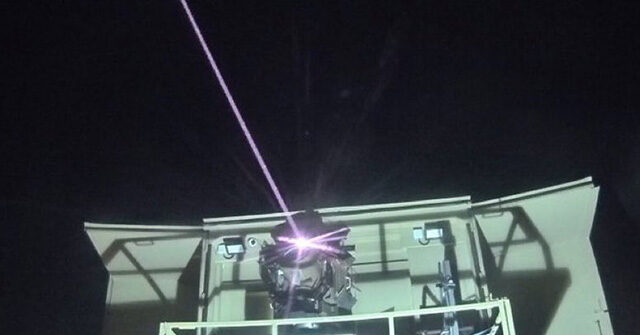
Israel will deploy its first full-power Iron Beam laser defense battery by year’s end, with senior defense officials declaring the system will “fundamentally change the rules of engagement on the battlefield” as the Jewish state braces for continued clashes with Iran and its terror proxies.
Speaking on Monday at the DefenseTech conference in Tel Aviv, Brig. Gen. (Res.) Dr. Danny Gold — head of the Defense Ministry’s Directorate of Defense Research & Development (DDR&D) — said the high-energy laser system, known in Hebrew as Or Eitan, has completed development and will be handed over to the IDF on December 30.
Gold said his directorate is “prepared to deliver initial operational capability” to the military, emphasizing that Israel is “already advancing the next generations” of laser defenses even as the first battery enters service.
Maj. Gen. (Res.) Amir Baram, Director General of the Defense Ministry, used the same stage to frame Iron Beam’s rollout directly within the war sparked by Hamas’s October 7, 2023, massacre and the sustained regional confrontation with Hezbollah and other Iran-backed militias.
“For years Israel was known as a cyber nation,” Baram said, warning that “all fronts are still open and our enemies are learning and preparing day by day,” and insisting that Israel has now become a “defense-tech nation” built on combat-driven innovation.
Baram described what he called a “direct feedback loop from the frontline to engineers,” arguing that Israeli soldiers under fire are now shaping weapons programs in real time. He cited the decision last year to push a lower-power Iron Beam prototype into emergency field use within days of a deadly Hezbollah drone strike on a Golani Brigade base in northern Israel.
That wartime gamble quickly paid off. Defense officials say the laser system proceeded to shoot down dozens of Hezbollah drones over a matter of weeks, convincing the ministry to accelerate the move from limited trials to full-scale deployment of the 100-kilowatt version now being turned over to the IDF.
According to technical specifications published by the Israeli business daily Globes, the flagship Iron Beam 450 uses a 100-kilowatt high-energy laser fired through a 450-millimeter aperture to burn through rockets, mortars, and drones at ranges of roughly 10 kilometers. Unlike missile interceptors, no projectile ever leaves a launcher — the beam hits incoming threats at the speed of light — and Globes reported that each laser shot costs only a few dollars, compared to tens of thousands for an Iron Dome interceptor.
Israeli engineers acknowledge the laser’s limitations in heavy haze, dust, and cloud cover, and officials are careful to stress that Iron Beam will not replace the country’s missile defenses. Instead, the laser is being integrated as another layer alongside Iron Dome, David’s Sling, and the Arrow systems, with Iron Beam expected to handle smaller, short-range threats while missile batteries take on heavy barrages and long-range launches.
To protect both civilians and maneuvering forces, the program is structured as a family of systems. As Globes noted, the heaviest Iron Beam units will guard borders, bases, and strategic infrastructure, while more mobile versions mounted on trucks and armored vehicles will follow Israeli forces and intercept drones at the tactical edge.
Globes also reported that Rafael envisions pairing its lighter “Lite Beam” configuration with the Trophy active-protection system — the anti-tank missile shield mounted on Israeli and U.S. armored vehicles — to create a combined defense against both drones and anti-armor fire for maneuvering units.
In remarks reported by Jewish Insider ahead of an upcoming Misgav Mideast Horizons podcast episode, Rafael Chairman Yuval Steinitz called the program a “laser revolution,” stressing that major powers spent decades trying to make battlefield lasers practical. “For the first time in human history, we are able to shoot down missiles, rockets, even artillery shells and mortar shells — not with projectiles, not with missiles or artillery shells, but with light,” Steinitz said, adding that smaller Iron Beam variants have already intercepted roughly 50 Hezbollah UAVs in recent fighting.
Israeli officials also say the laser’s speed-of-light engagements could sharply reduce the need for Israelis to sprint to shelters during many attacks, since rockets and drones can be destroyed almost immediately after launch, often while still over enemy territory. Gold said the system is expected to “fundamentally change the rules of engagement on the battlefield,” calling Iron Beam a central pillar of Israel’s future defensive doctrine.
Baram emphasized that the laser shield is entering service amid a much broader defense-tech build-up aimed at countering Iran’s missile and drone network. He highlighted 21 government-to-government defense agreements signed in 2024 and said the ministry has invested 1.2 billion shekels in startups, with more than 300 companies working with DDR&D and over 130 pulled directly into wartime operations since October 7. Tel Aviv, he noted, now ranks among the world’s top defense-tech hubs, with Israeli firms signing major deals across Europe, Asia, and North America for systems stress-tested in combat.
As Breitbart News previously reported when Israel first confirmed Iron Beam’s operational use earlier this year, the system is meant to give Jerusalem both a technological edge and an economic answer to the region’s expanding rocket and drone arsenals. By turning low-cost enemy fire into targets for a near-zero-cost laser shot, Israel aims to sustain a long war without absorbing the crushing interceptor costs that defined past conflicts.
With the December 30 handover of the first full-power battery — and work on what officials describe as “next-generation surprises” already underway — Iron Beam is moving from a field-tested concept to a central pillar of Israel’s defensive doctrine. Officials say the speed-of-light shield represents a strategic shift in modern warfare, positioning Israel to confront a more volatile regional landscape in which adversaries are rapidly investing in rockets, drones, and precision weapons designed to overwhelm traditional defenses.
Joshua Klein is a reporter for Breitbart News. Email him at jklein@breitbart.com. Follow him on Twitter @JoshuaKlein.