From the Suez Crisis to the Iran War, both conflicts reveal Israel’s startling dependence on the United States.
There is a particular kind of historical vertigo that comes from watching the same drama staged twice in the same theater, with only the costumes changed. Those of us who have spent careers studying the intersection of Israeli strategy and great-power politics are now experiencing that vertigo.
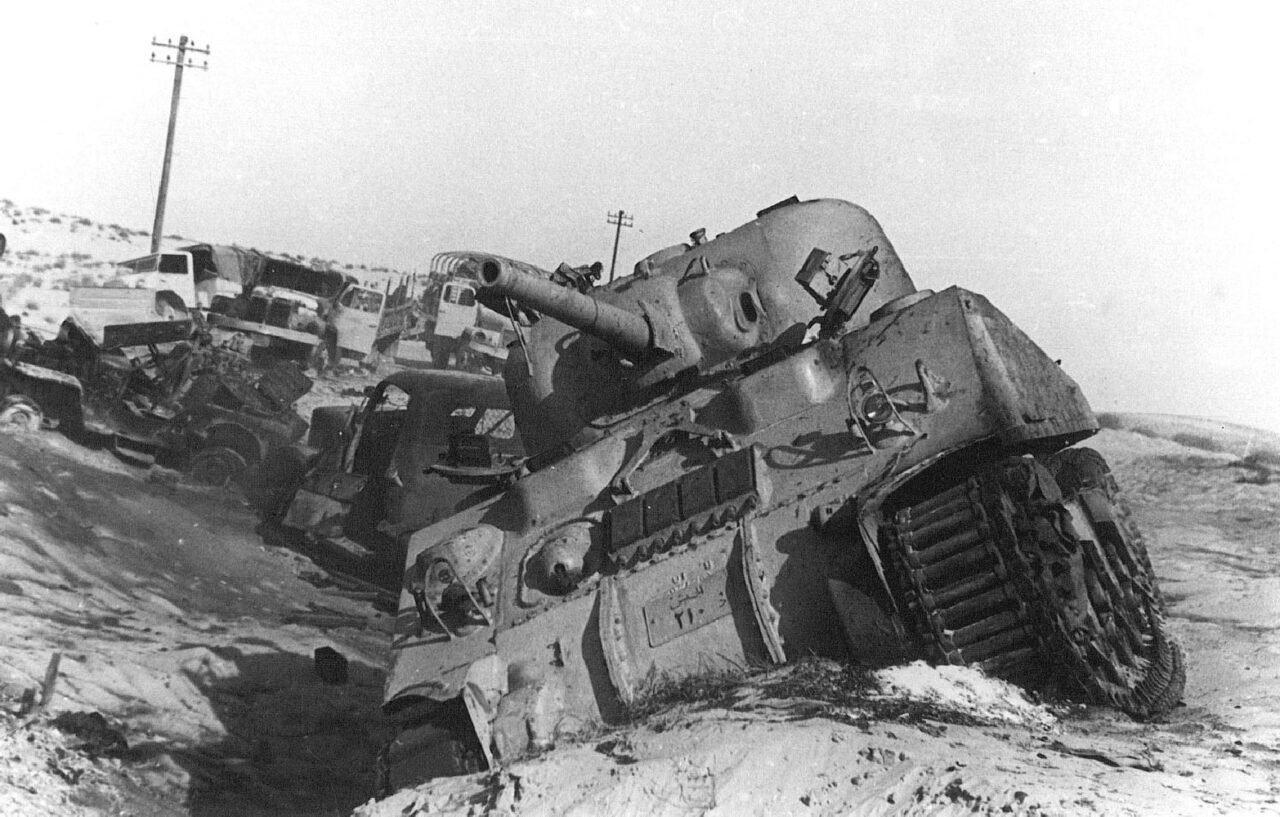
In October 1956, Israel launched a lightning assault across the Sinai Peninsula, driving toward the Suez Canal. The operation was, to put it plainly, a coordinated piece of theater. It was scripted in secret meetings at Sèvres with the United Kingdom and France, two imperial powers determined to reverse Egyptian President Gamal Abdel Nasser’s nationalization of the canal and topple a leader they regarded as a Soviet-friendly destabilizer of their fraying Middle Eastern order. Israel provided the pretext. The UK and France provided the air cover and the amphibious landings. Everyone understood the arrangement, even as they publicly denied it.
The coalition collapsed almost immediately—not from Arab military resistance, but from American pressure. President Dwight Eisenhower, furious at being kept in the dark and alarmed by Soviet threats, forced a humiliating withdrawal. The United Kingdom and France retreated from their imperial ambitions for the last time. Israel withdrew from the Sinai, receiving in exchange only vague security guarantees and eventually a UN buffer force that evaporated the moment Nasser demanded it leave in 1967.
The lesson Israel drew from 1956 was, at best, ambiguous. On one reading: external patrons are unreliable, and Israel must cultivate its own deterrence and strategic depth. On another reading—the one that has, I would argue, increasingly dominated Israeli strategic culture—the solution is not to reduce dependency on great powers but to choose the right great power and bind itself to it as tightly as possible.
The parallels with the present situation in the Middle East are striking enough to be uncomfortable. Once again, Israel finds itself as the kinetic arm of a broader coalition project, this time centered on rolling back Iranian power—its nuclear program, its regional proxy network, the entire architecture of what Washington strategists call the “Axis of Resistance.” Once again, the driving force behind the campaign is not solely Israeli security anxiety, though that anxiety is genuine enough. It is the confluence of Israeli strategic interest with American regional objectives, amplified by a Washington foreign policy establishment that has, for two decades, treated Iran as the primary threat to the Middle Eastern order it wishes to preserve.
The operational details differ, of course. In 1956, Israel struck first, and the great powers followed. Today, the sequencing is more complex—a cascade of Israeli strikes on Iranian nuclear infrastructure, Iranian missile and drone responses, American naval and air assets engaged in active defense and, increasingly, offensive operations. The collusion, if one wants to use that word, is far less secret than Sèvres. It is conducted through joint operational planning, shared intelligence, forward-deployed American carrier groups, and public statements of “ironclad” commitment from Washington.
But the structural logic is the same: Israel as the forward element of a great-power strategy it did not entirely author, operating with the assumption that American support is both unlimited and indefinite. Here is where the historical analyst must resist the temptation of false symmetry and acknowledge what is genuinely different—and, from Israel’s perspective, more favorable—this time around.
In 1956, the superpower that pulled the plug was the United States. Today, American commitment to the anti-Iran campaign is, for the moment, robust. The current administration came to office with a maximalist posture toward Tehran and has been willing to commit American assets in ways that Eisenhower never contemplated. This is not 1956, when Ike could simply threaten economic sanctions and watch the coalition dissolve.
Moreover, Iran is not Egypt. Nasser had Soviet backing but lacked nuclear weapons. Iran is months or years, depending on which intelligence assessment one trusts, from crossing the nuclear threshold that would change the entire calculus. There is, in other words, a genuine Israeli security interest at stake that was arguably less existential in Sinai.
And yet, the deeper structural problem that plagued Israel in 1956 persists, arguably in more acute form. The country has become so deeply enmeshed in American strategic calculations—dependent on American weapons, diplomatic cover at the UN Security Council, and deterrence of Iranian escalation—that it has traded strategic autonomy for strategic insurance. The policy has worked in the sense that Israel has survived and prevailed in numerous military confrontations. It has come at a cost that Israeli strategic culture rarely examines with full honesty.
That cost is this: when your security is substantially outsourced to a patron, your security is only as reliable as the patron’s attention span, domestic politics, and competing global commitments. The United States today is a country simultaneously managing China’s rise, a reconstituted Russian threat to European security, and the fiscal implications of a defense budget already strained. The “ironclad commitment” to Israel is ironclad until it isn’t—until a future administration, a future Congress, a future public exhausted by Middle Eastern entanglements decides that the price is too high.
Israel in 1956 learned this the hard way when its patron, France, collapsed as a great power and the United Kingdom retreated permanently east of Suez. What lesson has it drawn from that experience in its current embrace of American power? Largely, it seems, the wrong one.
There is another parallel worth drawing, one that cuts in a different direction and is less comfortable for the realist critique.
In 1956, the fundamental Israeli strategic objective—ensuring that hostile Arab states could not achieve military preponderance—was rational and achievable, even if the method was imprudent. The same can be said of the current campaign against Iranian nuclear capability. The objective of preventing a regional adversary with genocidal rhetoric and a demonstrated willingness to fund proxy violence from acquiring nuclear weapons is not a neoconservative fantasy. It is a rational security interest, and the fact that great-power support has enabled its pursuit does not automatically render it illegitimate.
The critique, then, is not that Israel is wrong to want Iran defanged. It is that the method—deep entanglement with American grand strategy, essentially functioning as a forward base and operational partner for US regional hegemony—creates dependencies and entanglements that will outlast the current moment and constrain Israeli freedom of action in ways that have not yet fully revealed themselves.
In 1956, Israeli Prime Minister David Ben-Gurion thought he had secured Israel’s strategic position through the Sinai campaign. Within 11 years, Israel was fighting for its existence again in the same desert. Military success, even dramatic military success, does not resolve the underlying political contradictions. It defers them, and sometimes intensifies them.
What, then, should we expect?
The current campaign against Iran will likely achieve significant tactical results—degraded nuclear infrastructure, weakened proxy networks, and a temporary reduction in Iranian regional capacity. These are not nothing. But Iran is not a state that can be destroyed by air power and naval pressure alone. It is a civilization-state with a long memory and a demonstrated ability to absorb punishment and reconstitute. The Islamic Republic has survived worse than what is currently being visited upon it.
What comes after is the question that the architects of the current campaign seem most reluctant to answer. In 1956, the “after” was a Nasser more popular than ever, a Soviet Union more deeply embedded in Arab politics, and a US-Israeli relationship that had been strained almost to the breaking point. The campaign that was supposed to solve the problem created new versions of the same problem.
History does not repeat. But it does, as Mark Twain allegedly observed, rhyme. And this particular rhyme is growing uncomfortably familiar to anyone who has been paying attention to the region for long enough.
About the Author: Leon Hadar
Dr. Leon Hadar, a contributing editor with The National Interest, is a former senior fellow at the Foreign Policy Research Institute (FPRI) and a former research fellow in foreign policy studies at the Cato Institute. He has taught international relations, Middle East politics, and communication at American University in Washington, DC, and the University of Maryland, College Park. A columnist and blogger with Haaretz (Israel) and Washington correspondent for The Business Times of Singapore, he is a former United Nations bureau chief for The Jerusalem Post.